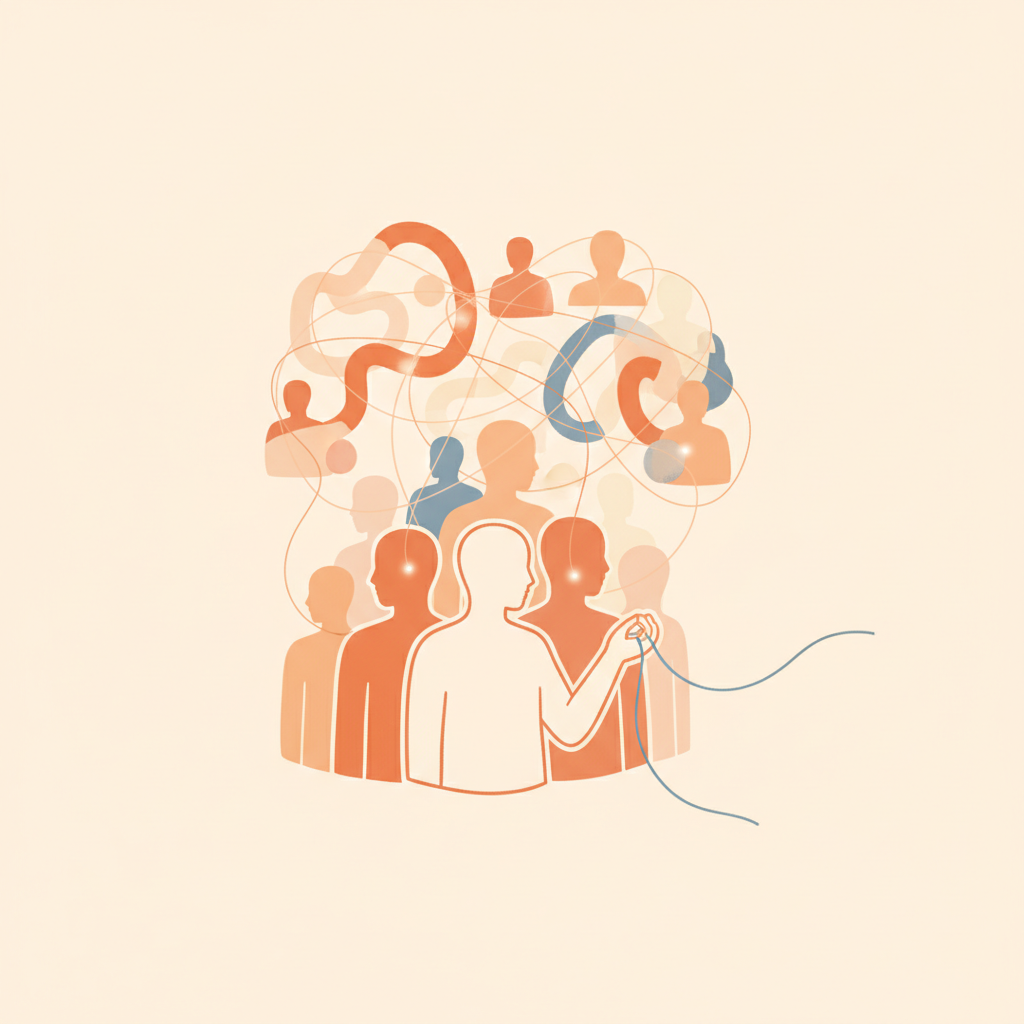
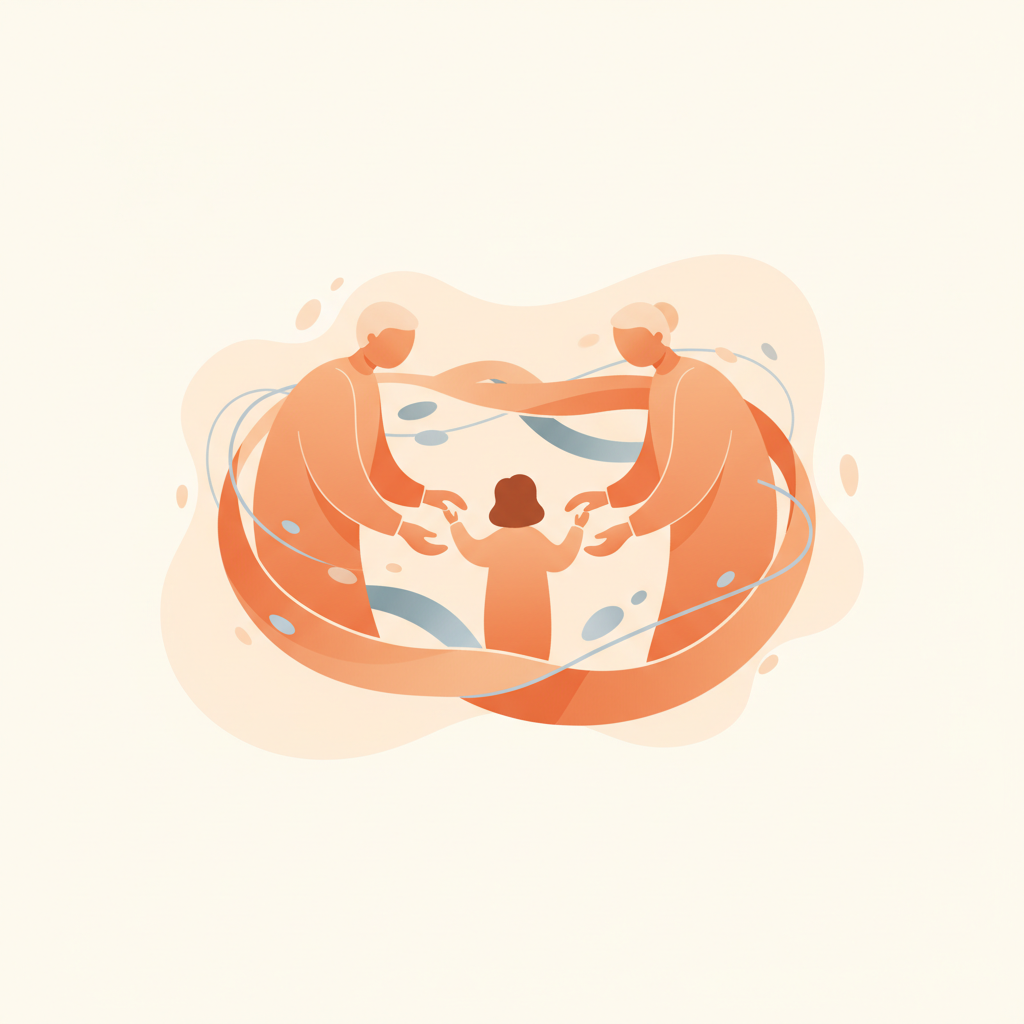
An intergenerational pattern is a sequence of behaviours, beliefs or emotional dynamics that repeats across several generations within the same family, usually without its members being aware of the repetition. Murray Bowen, psychiatrist and founder of family systems theory, coined the concept of the "multigenerational transmission process" to explain how levels of emotional differentiation — the ability to separate thought and emotion — are inherited from parents to children, not through genes but through everyday interactions. Virginia Satir reinforced this idea by observing that families transmit not only explicit values but also invisible rules about which emotions are permitted, who may talk about what, and how conflict is handled.
| Intergenerational pattern |
Example of transmission |
Sign that you are repeating it |
| Conflict avoidance |
Grandparents who never argued → parents who stay silent → you who swallow everything |
You feel "better not to say anything" before any disagreement |
| Alcoholism / addictions |
Three generations with a problematic relationship with alcohol |
You use substances to manage emotions without questioning it |
| Parentification |
Grandmother cared for her mother → your mother raised you as an adult |
You feel excessive responsibility for your parents' wellbeing |
| Emotional abandonment |
Great-grandfather absent → grandfather distant → father who does not express affection |
You struggle to express or receive affection without discomfort |
| Emotional fusion |
Families where "everything is shared" and there is no individual privacy |
You cannot make decisions without consulting your family |
| Normalised violence |
"I was hit and I turned out fine" repeated across generations |
You consider a certain level of aggression normal in relationships |
How Are Patterns Transmitted From One Generation to the Next?
Transmission occurs through three simultaneous pathways. The first is modelling: children observe and internalise how parents manage emotions, conflicts and relationships. A child who watches their mother swallow her anger for years learns that anger is not to be expressed, even though nobody says it in words. The second pathway is family projection. Bowen described how parents project their unresolved anxiety onto one child — usually the most sensitive or the emotionally closest — and that child absorbs the emotional burden as if it were their own. The third pathway is emotional cut-off: when a member breaks with the family without processing the conflict, they do not eliminate the pattern but carry it with them and reproduce it in new relationships.
Salvador Minuchin, from structural therapy, added that the family's very structure — who holds power, who is excluded, what alliances exist — replicates generation after generation because children build their own families using the only model they know.
Why Is It So Hard to See Your Own Patterns?
Because what is repeated becomes normalised. If in your family money was never discussed, you do not perceive that avoidance as a pattern: you perceive it as normal. "That's just how we are in my family." That sentence is the clearest signal that an intergenerational pattern is at work. Virginia Satir explained that families create invisible rules that are obeyed without question, because questioning them feels like betraying the group.
Furthermore, the human brain seeks familiarity, not wellbeing. We choose partners, friendships and work environments that replicate known dynamics, even when they are painful. A child of an emotionally absent father may feel attracted to distant partners, not out of masochism but because emotional distance feels familiar and therefore safe.
How Can You Identify Your Intergenerational Patterns?
The emotional genogram is the most effective tool. It is a family tree that includes not only names and dates but also emotions, conflicts, cut-offs, alliances and secrets. When you draw three generations back, the repetitions usually become obvious: divorces at the same age, recurring psychosomatic illnesses, roles inherited like surnames.
Another useful technique is the family interview. Ask aunts, uncles, grandparents or cousins about family history with specific questions: "How were conflicts resolved when you were young?", "Who really ran the household?", "What was never talked about?" The answers often reveal patterns the parents never mentioned.
Can Intergenerational Patterns Be Broken?
Yes, and Bowen considered this the central goal of family therapy. The key is to increase differentiation of self: the ability to remain in emotional contact with the family without losing your own identity. A differentiated person can visit their parents, hear their opinions, feel the system's pressure and still make their own decisions without guilt or reactive rebellion.
The process has several concrete steps. First, make the pattern conscious: name what is repeating and since when. Second, understand the function it served at the time: conflict avoidance may have protected your grandparents in a post-war context where arguing was dangerous. Third, consciously decide what you want to keep and what you want to change. It is not about rejecting the entire family legacy but about choosing with clarity.
LetsShine.app can accompany this process of emotional archaeology, helping you explore inherited dynamics and distinguish between what is yours and what you absorbed from the system.
What Happens When You Try to Break a Pattern and the Family Reacts?
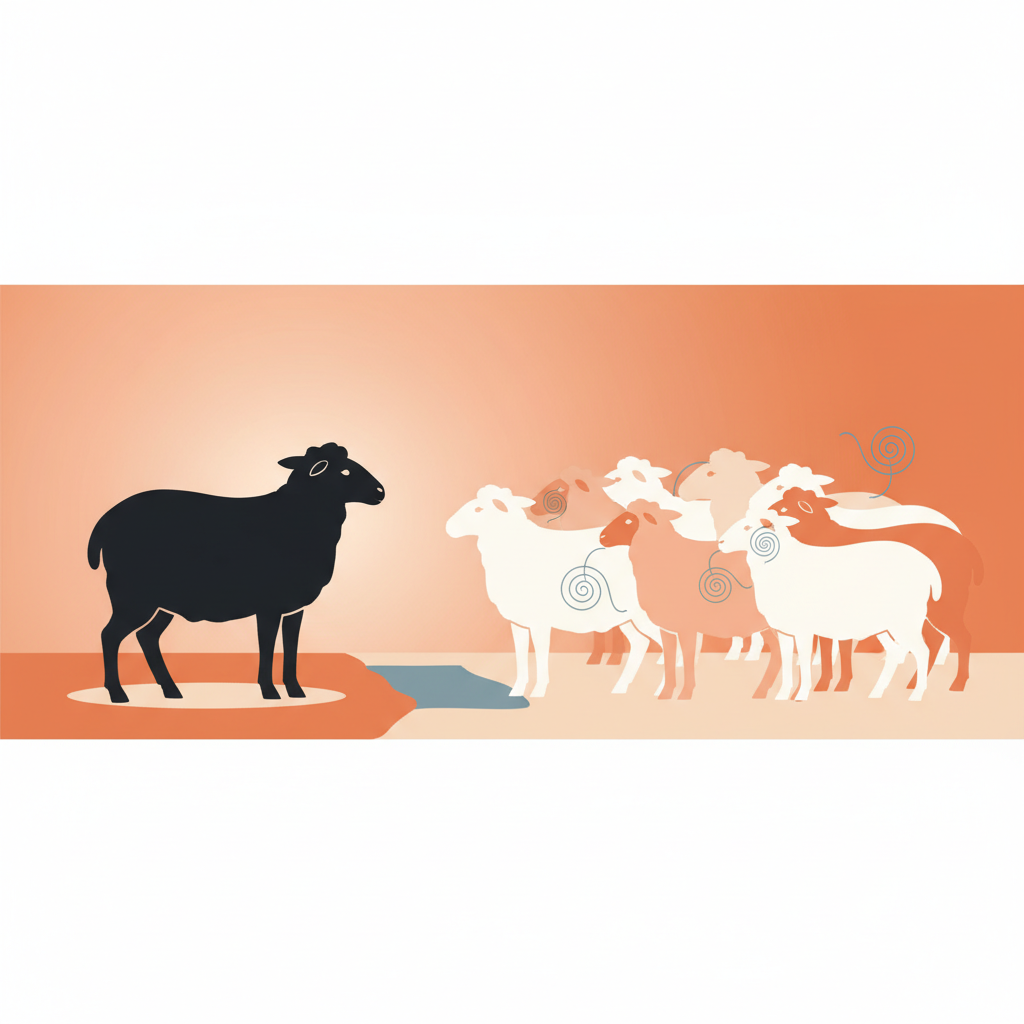
The reaction is inevitable and predictable. Bowen called it the "homeostatic response": the family system presses for everything to return to its place. If you were always the one who yielded and you suddenly set a boundary, the family will not applaud. There will be phrases like "you've changed a lot," "they're brainwashing you," "you're not the same person any more." Those phrases do not mean you are doing something wrong: they mean the system is readjusting.
The key is to maintain the change without cutting contact. Bowen insisted that real differentiation is achieved within the relationship, not outside it. Fleeing from the family is another form of fusion: you are so emotionally bound that you need physical distance to function. The goal is to be able to be close without losing yourself.
Are Positive Patterns Also Transmitted?
Of course. Generosity, the ability to listen, resilience in adversity, healthy humour and committed loyalty are also intergenerational patterns. Virginia Satir emphasised the importance of identifying and reinforcing these positive transmissions, rather than focusing exclusively on what is broken. Recognising what your family gave you that was valuable is not denying the pain: it is completing the picture.
Minuchin observed that the most resilient families were those that combined clear structure with emotional flexibility: they knew who was in charge but allowed roles to shift according to circumstances. That flexibility is also inherited when it is consciously modelled.
Frequently Asked Questions
How many generations define an intergenerational pattern?
Technically, two generations already constitute repetition. However, Bowen recommended studying at least three generations to confirm that the sequence is not coincidence but an active transmission process.
Can I break a pattern without therapy?
It is possible but harder. The main difficulty is that patterns operate outside awareness. A professional or a tool like LetsShine.app can help verbalise what you carry inside without words.
Do intergenerational patterns have a genetic basis?
Epigenetics suggests that extreme stress can modify gene expression and be transmitted biologically. However, most family patterns are transmitted through the relational pathway, not the genetic one. They are learned, not inherited.
Is it necessary to talk to the family of origin to break a pattern?
Not always, but it is often useful. Even a brief conversation with an older relative can illuminate dynamics you did not know about. If contact is not possible or safe, the work can be done internally, through guided reflection and writing.