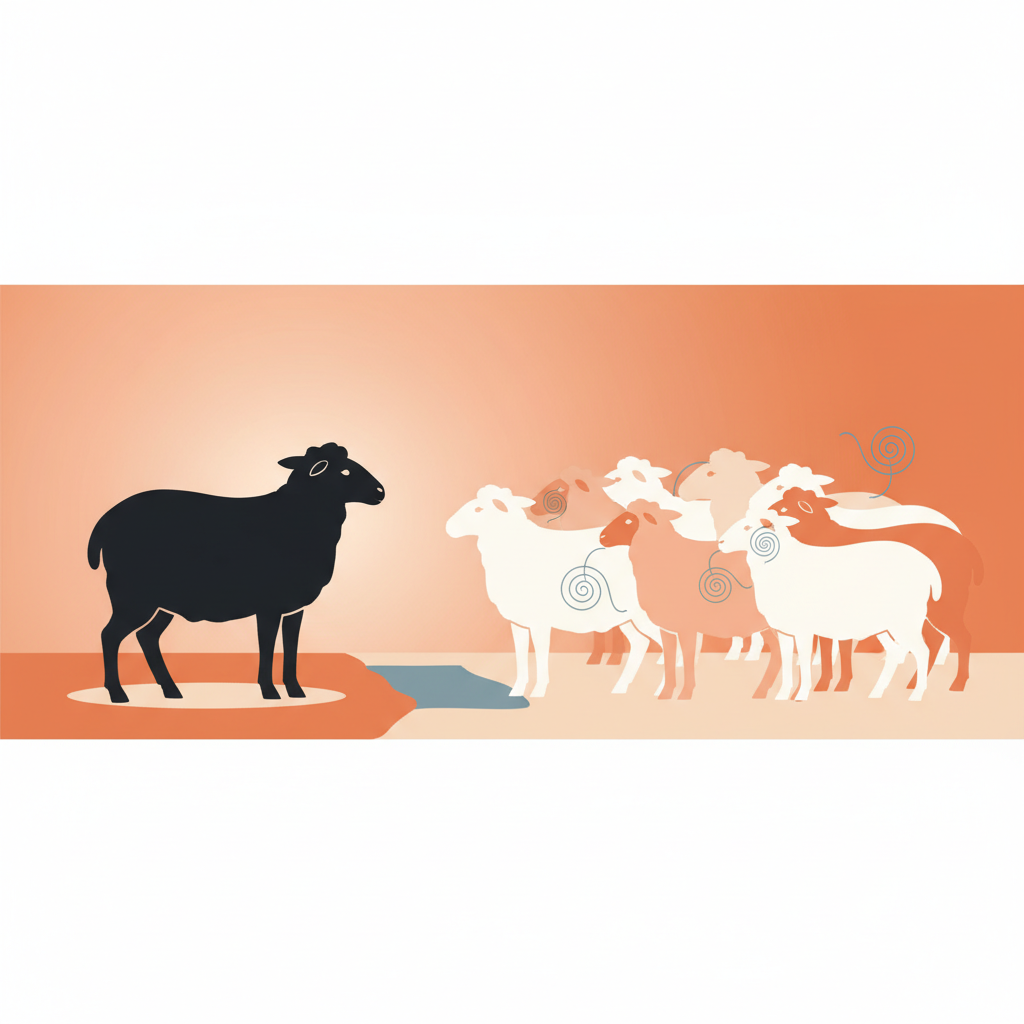
The black sheep is the family member who, through their behaviour, values, orientation, lifestyle or simply their temperament, deviates from the implicit norms of the family system and is singled out — explicitly or subtly — as the "different one," the "problematic one" or the "one who causes us grief." In Murray Bowen's family systems theory, the black sheep fulfils a precise systemic function: they absorb and channel the group's anxiety, allowing the other members to perceive themselves as normal, healthy or correct by contrast. Salvador Minuchin, from structural therapy, described this mechanism as the designation of the "identified patient": the family arrives at the consultation pointing to one member as the problem, but analysis of the family structure reveals that the real problem is in the system, not in the individual. Virginia Satir summarised it with a phrase that has become emblematic: "The identified patient is the spokesperson for the family's pain."
| What the family says |
What the system needs |
What the black sheep feels |
| "You've always been the difficult one" |
Someone to justify the existing tension |
Misunderstanding, loneliness, anger |
| "You're not like us" |
A contrast to reinforce the group's identity |
Exclusion, need for belonging |
| "You embarrass us" |
A repository for collective shame |
Guilt, low self-esteem |
| "If you changed, everything would be fine" |
To keep the focus away from the real problems |
Constant pressure to conform |
| "You are the cause of all the problems" |
A scapegoat for family anxiety |
Injustice, helplessness |
Why Do Families Need a Black Sheep?
Because group cohesion is strengthened when there exists an "other" against which to define itself. This dynamic, which social psychology has extensively documented in groups of all kinds, is especially intense in families because the emotions are deeper and the bonds more primitive. Bowen explained that when the family system's anxiety increases — due to a couple conflict, an economic crisis, an illness, a life change — the system seeks a vertex on which to discharge that anxiety. The most vulnerable, most different or most sensitive member becomes the repository.
Minuchin demonstrated experimentally that in families with an "identified patient," when the system was restructured — strengthening the parental alliance, clarifying boundaries, redistributing power — the symptoms of the designated member improved or disappeared, confirming that the problem was not in them but in the structure. It is a powerful finding: the black sheep is not sick. The family is disorganised.
What Profile Does the Typical Black Sheep Have?
There is no single profile, but there are recurring traits. The black sheep tends to be the most perceptive member of the family: the one who notices the tension that the others deny, who asks what nobody wants to hear, who reacts emotionally to dynamics the others have learned to ignore. Paradoxically, their "problem" is usually their lucidity. The teenager who rebels may be reacting to a dysfunctional marriage that nobody else wants to see. The daughter who "always complicates things" may be the only one who dares to question the system's unjust rules.
Virginia Satir observed that the black sheep tends to be the member with the lowest differentiation of self, which makes them more reactive to the system's anxiety, but they can also be the one with the greatest growth potential, precisely because their discomfort with the system pushes them to seek answers outside the family.
What Are the Effects of Being the Black Sheep for Years?
The effects are profound and lasting. At the identity level, the person internalises the label: they perceive themselves as defective, inadequate or inherently problematic. At the relational level, they oscillate between two extremes: seeking acceptance at any price — adapting, people-pleasing, self-erasing — or rejecting any group belonging out of fear of being excluded again. At the emotional level, the black sheep carries a mixture of anger, sadness, guilt and loneliness that can manifest as depression, anxiety, addictions or self-destructive behaviours.
Bowen pointed out that the black sheep who cuts off from the family without processing the dynamic tends to repeat the pattern in other contexts: they become the "different one" in their friend group, their company, their community. The role follows them because it is part of their relational identity, not their personal identity. Distinguishing between the two is the first step towards liberation.
How to Reclaim Your Difference Without Renouncing the Family?
Reclamation is not an act of rebellion or revenge: it is an act of truth. It consists of separating who you are from what the family needed you to be. That separation requires internal work of emotional archaeology that can be done in therapy, through reflective writing, or with tools like LetsShine.app that facilitate guided exploration of these dynamics.
The process has several stages. First: recognise the systemic function you fulfilled. You were not the problem; you were the thermometer of the problem. Second: stop trying to prove that you are not what they say. That struggle perpetuates the dysfunctional bond: as long as you keep trying to demonstrate your worth to the family, you remain trapped in the system. Third: build an identity outside the role. Who are you when nobody calls you the black sheep? What interests you, what do you value, what do you desire? Fourth: decide what kind of relationship you want with your family from the new position, if you want one at all.
What Happens in the Family When the Black Sheep Leaves?
Minuchin predicted that when the identified patient leaves the system, another member takes on the role. The anxiety that the black sheep channelled continues to exist, and the system needs a new repository. It is common for the "perfect" sibling to begin showing symptoms — anxiety, relationship problems, addictions — shortly after the black sheep distances themselves. This phenomenon confirms once more that the problem was never in the person but in the structure.
Some families, faced with the absence of their scapegoat, are forced to confront the real conflicts they were avoiding. In those cases, the black sheep's departure can be the catalyst for positive systemic change. But that only happens if the family has the capacity and willingness to look inward.
Is It Possible to Stop Being the Black Sheep Without Stopping Being Yourself?
Yes. The key is Bowen's differentiation: the ability to remain emotionally connected to the family without automatically reacting to their labels. When you can hear "you've always been the odd one" without it activating your need to defend, attack or flee, you have stopped being the black sheep without stopping being who you are. You do not change: your reaction to the system changes. And when your reaction changes, the system must reorganise.
Virginia Satir proposed a therapeutic exercise in which the designated person took the floor and said: "I am different. And my difference is not a defect. It is a perspective that this family needs to hear, even if it finds it uncomfortable." The act of naming difference as a value — rather than accepting it as a defect — transforms the person's position within the system.
Frequently Asked Questions
Is the black sheep always aware of their role?
Not always. Many people grow up assuming they genuinely are the problem. Awareness usually arrives in adulthood, often through therapy, reading or comparison with other families that function differently.
Can I be the black sheep and the favourite child at the same time?
It is uncommon but possible, especially in families where the parents hold opposing views: one may single out the child as problematic while the other protects them. That dual position is particularly confusing for the child.
If my family considers me the black sheep, does that mean my family is toxic?
Not necessarily. All families assign roles to a greater or lesser extent. Toxicity appears when the role is rigid, when there is no space to question it and when anyone who tries to break free is punished.
Does the black sheep exist in small families with only children?
Yes. In only-child families, the child can simultaneously be the hero and the black sheep: everything good and everything bad is concentrated in one person. The pressure is enormous.
How can I support someone who is the black sheep of their family?
Listen without judging, validate their experience and avoid the phrase "but they're your family." That phrase, however well-intentioned, reinforces guilt and minimises suffering. The most useful thing you can do is treat them as what they are: a person, not a role.