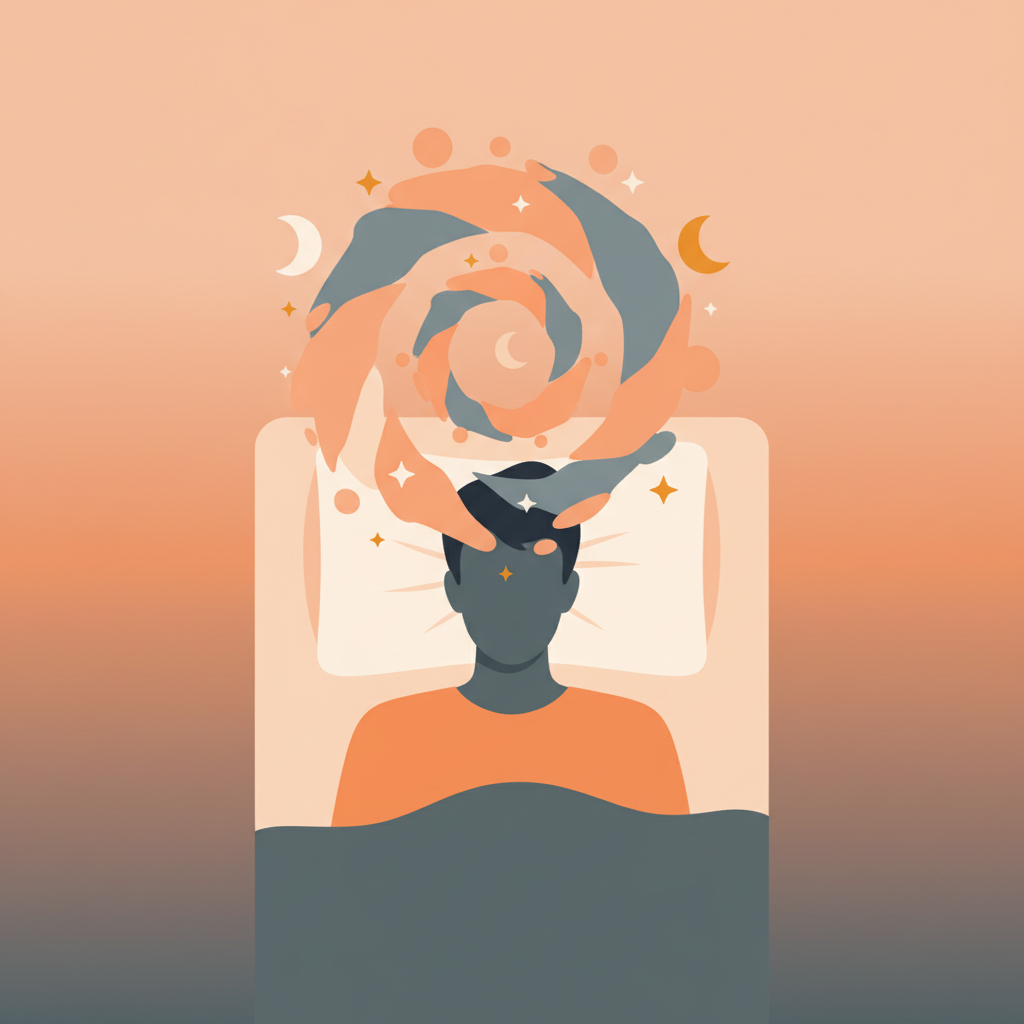
Guided meditation for sleep is a practice in which a voice — human or AI-generated — leads you through a sequence of relaxation techniques designed to quiet the mind, release physical tension and transition the nervous system from sympathetic (fight-or-flight) to parasympathetic (rest-and-digest) activation. In a world where the CDC reports that one in three adults does not get enough sleep, and the global insomnia market is projected to reach $7.8 billion by 2027, the demand for non-pharmaceutical sleep solutions has never been higher. The good news: meditation works. The better news: you do not need years of practice to benefit.
The Science of Meditation and Sleep
| Study |
Key finding |
| Black et al., 2015 (JAMA Internal Medicine) |
Mindfulness meditation improved sleep quality more than sleep hygiene education in older adults |
| Ong et al., 2014 (Annals of the New York Academy of Sciences) |
MBTI (Mindfulness-Based Therapy for Insomnia) reduced insomnia severity by 50% |
| Rusch et al., 2019 (meta-analysis) |
Meditation interventions produced moderate improvements in sleep quality across 18 trials |
| Huberman Lab podcast, 2023 |
NSDR (Non-Sleep Deep Rest) protocols can accelerate sleep onset and improve sleep architecture |
5 Guided Meditation Techniques for Better Sleep
1. Body Scan Meditation (20-30 minutes)
The body scan is the most researched sleep meditation technique. You systematically direct attention to each part of your body, from toes to crown, noticing sensations without trying to change them.
How to practise: Lie on your back. Close your eyes. Starting with your toes, bring your attention to each body part and hold it there for 3-5 breaths. Notice tension, warmth, tingling or numbness — whatever is there. Do not try to relax. The paradox is that the effort to relax creates tension. Simply observe.
Why it works: the body scan shifts attention from ruminative thought loops to physical sensation, interrupting the cognitive hyperarousal that prevents sleep.
2. 4-7-8 Breathing (5-10 minutes)
Developed by Dr Andrew Weil, this technique uses controlled breathing to activate the parasympathetic nervous system.
How to practise: Inhale through your nose for 4 counts. Hold for 7 counts. Exhale slowly through your mouth for 8 counts. Repeat 4-8 cycles.
Why it works: the extended exhale stimulates the vagus nerve, slowing heart rate and reducing cortisol levels. Most people report drowsiness within the first four cycles.
3. Yoga Nidra / Non-Sleep Deep Rest (20-45 minutes)
Yoga Nidra, recently rebranded by neuroscientist Andrew Huberman as "Non-Sleep Deep Rest" (NSDR), is a guided practice that takes you to the threshold between waking and sleeping — the hypnagogic state.
How to practise: follow a guided recording (there are excellent free options on YouTube and apps). The guide will lead you through a body rotation, breath awareness, visualisation and intention setting while you remain completely still.
Why it works: Yoga Nidra induces delta and theta brainwave patterns similar to deep sleep, even if you remain conscious. Regular practice retrains your nervous system to transition more easily into sleep.
4. Gratitude Meditation (10-15 minutes)
A simple but powerful technique: before sleep, mentally review three specific things from your day that you are grateful for, dwelling on each with full sensory detail.
How to practise: close your eyes and bring to mind one positive moment from the day. Recall it in detail: what you saw, heard, felt. Let the feeling of gratitude expand in your chest. Repeat with two more moments.
Why it works: gratitude meditation shifts the brain from threat-scanning mode (which keeps you awake) to appreciation mode. Emmons and McCullough (2003) found that gratitude journaling before bed improved both sleep latency and sleep duration.
5. AI-Guided Personalised Meditation
This is the newest frontier. AI-guided meditation adapts in real time to your responses, emotional state and personal patterns. Instead of a one-size-fits-all recording, the AI selects techniques, pacing and themes based on what you need tonight.
How to practise: platforms like LetsShine.app offer voice-guided relaxation sessions that adapt based on your reported emotional state and the patterns the AI has observed over time. If you tend to ruminate about relationship conflicts at night, the AI might guide you through a specific reflection exercise before the sleep meditation.
Why it works: personalisation increases engagement and addresses the root cause of your sleeplessness, not just the symptoms.
Creating a Sleep Meditation Routine
The most effective approach is consistency, not perfection:
- Same time each night: signal to your brain that it is time to wind down.
- Same space: your bed, with lights off and phone on Do Not Disturb.
- Start small: five minutes is better than zero minutes. Build to 20.
- Do not measure success by falling asleep: the goal of meditation is awareness, not unconsciousness. If you fall asleep, wonderful. If you do not, you still benefited from the relaxation.
Frequently Asked Questions
How long does it take for meditation to improve sleep?
Most people notice a difference within one to two weeks of daily practice. However, some studies show benefits from the very first session, particularly with body scan and 4-7-8 breathing.
Can I use meditation instead of sleeping pills?
For mild to moderate insomnia, research supports meditation as a viable non-pharmaceutical alternative. For severe or chronic insomnia, consult a sleep specialist. Meditation can complement medical treatment but should not replace it without professional guidance.
What if my mind keeps wandering during meditation?
That is meditation. Noticing that your mind has wandered and gently returning to the practice is the core skill. You are not failing; you are training your attention. Each return is a repetition, like a bicep curl for your brain.
Is AI-guided meditation as effective as human-guided?
Early research is promising. The advantage of AI is personalisation and availability — it adapts to you and is available every night. The advantage of a human guide is warmth and presence. LetsShine.app combines AI personalisation with natural-sounding voice to bridge this gap.
Can meditation help with sleep problems caused by relationship stress?
Yes. Relationship stress is one of the most common causes of insomnia. Meditation helps by reducing physiological arousal, but addressing the underlying relationship dynamics — through tools like LetsShine.app or couples therapy — is equally important for long-term sleep improvement.
Your relationships can improve. Today.
Start free in 2 minutes. No credit card, no commitment. Just you, the people you care about, and an AI that helps you understand each other.
Start free now