Attachment theory, formulated by psychiatrist and psychoanalyst John Bowlby in the 1950s and developed experimentally by developmental psychologist Mary Ainsworth through her famous "Strange Situation" paradigm, identifies four main attachment styles: secure, anxious (also called preoccupied), avoidant (also called dismissive), and disorganised. Of these four, disorganised attachment is the least understood, the least discussed, and — paradoxically — the one that generates the most suffering in adult relationships. It was identified by Mary Main and Judith Solomon in 1986 when they observed that some children did not fit into Ainsworth's original three categories: their responses to separation and reunion with the attachment figure were contradictory, chaotic, and apparently without strategy. Recent research, including a 2022 meta-analysis in Attachment & Human Development, confirms the strong link between disorganised attachment in childhood and relational difficulties in adulthood.
What Are the Four Attachment Styles?
| Style |
Model of self |
Model of others |
Behaviour in relationships |
| Secure |
"I am worthy of love" |
"Others are reliable" |
Comfortable with intimacy, open communication |
| Anxious |
"I am not enough" |
"Others might abandon me" |
Need for reassurance, fear of abandonment |
| Avoidant |
"I can handle it alone" |
"Others are intrusive or disappointing" |
Excessive independence, difficulty with intimacy |
| Disorganised |
"I don't know if I'm worthy" |
"Others are needed but dangerous" |
Approach followed by flight, relational confusion |
Important clinical note: attachment style is not a diagnosis. It is a relational pattern. If you recognise disorganised attachment characteristics in yourself and experience significant suffering, consult a therapist specialising in attachment or trauma. This article does not replace a professional assessment.
What Is the Origin of Disorganised Attachment?
Disorganised attachment arises when the attachment figure — the person who should be a source of safety — is, at the same time, a source of fear. This occurs in contexts of:
- Physical or emotional abuse by the primary caregiver.
- Severe neglect: failing to meet the child's basic needs consistently.
- Unresolved trauma in the caregiver: parents who, without being abusers, are emotionally absent due to their own trauma (unprocessed grief, severe depression, addictions).
- Frightening behaviour: uncontrolled shouting, threatening facial expressions, caregiver dissociation.
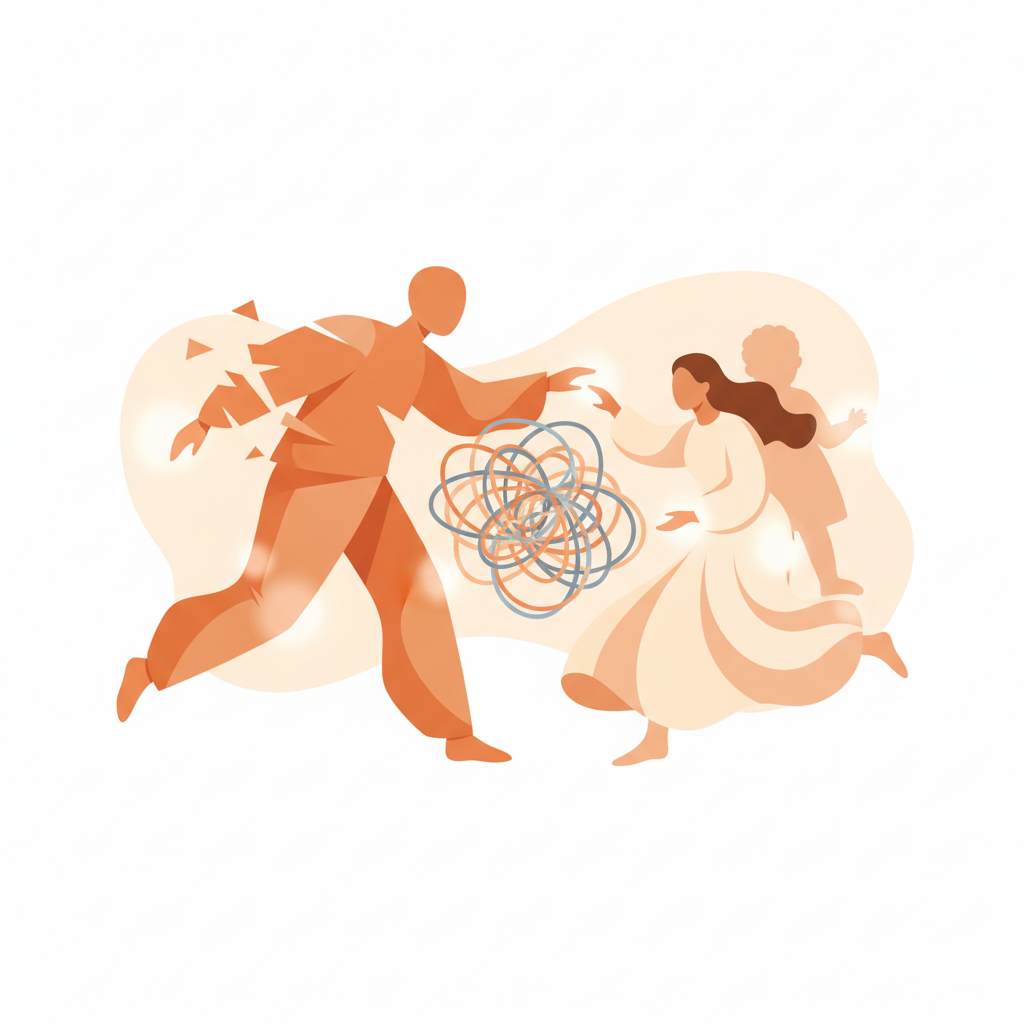
The child faces an irresolvable dilemma: they need to approach the attachment figure to feel safe, but that very figure generates fear. The result is an "approach-flight" pattern that, without intervention, perpetuates itself in adult relationships.
How Does Disorganised Attachment Manifest in Adult Relationships?
The signs can be bewildering for both the person and their partner:
- Intense desire for intimacy followed by abrupt withdrawal: "I need you, but when you come close I feel suffocated."
- Idealisation and devaluation: the partner shifts from being "the perfect person" to "someone I cannot trust" within hours.
- Simultaneous fear of abandonment and intimacy: a constant internal conflict between wanting to stay and wanting to flee.
- Difficulty regulating emotions: disproportionate emotional responses to relational triggers.
- Dissociation during conflict: emotionally disconnecting when the relationship becomes intense.
- Chaotic relationship patterns: frequent breakups and reconciliations.
It is important to note that disorganised attachment shares characteristics with borderline personality disorder (BPD) as described in the DSM-5, but they are not the same. A qualified professional can make the distinction.
Can Attachment Style Be Changed?
The answer, supported by research, is yes. It is called "earned secure attachment" and refers to people who, despite having had insecure attachment in childhood, develop a secure style in adulthood. Mary Main's research with the Adult Attachment Interview (AAI) demonstrated that what matters is not what happened to you, but how you have integrated and made sense of what happened to you. A 2023 longitudinal study in Development and Psychopathology confirmed that approximately 40% of individuals with childhood insecure attachment can achieve earned security through therapeutic intervention.
Paths Toward Earned Secure Attachment
- Specialised attachment and trauma therapy: approaches such as EMDR (Eye Movement Desensitisation and Reprocessing), Pat Ogden's sensorimotor psychotherapy, or attachment-focused psychotherapy.
- Reparative relationships: a secure partner, a trusted friend, or a reliable therapist can become a "secure base" that facilitates attachment repair.
- Deep self-knowledge: understanding your own attachment history without judging it. A coherent narrative about your own childhood is the best predictor of earned secure attachment.
- Emotional regulation: learning techniques to manage intense emotional activation without resorting to avoidance or explosion.
How Can a Partner Navigate Disorganised Attachment?
If your partner has a disorganised attachment style:
- Do not take their withdrawal personally: when they pull away, it is not because they do not love you; it is because intimacy activates their threat system.
- Be predictable and consistent: regularity and reliability are the antidotes to the unpredictability of their childhood.
- Do not force intimacy: respect their pace. Forcing closeness confirms their fear of being invaded.
- Seek professional help together: couples therapy with an attachment focus (such as Sue Johnson's Emotionally Focused Therapy) can be transformative.
At LetsShine.app, we believe that understanding each person's attachment is a fundamental step toward improving the relationship. Our guided reflective space can help you identify patterns, but the deep work with disorganised attachment requires professional therapeutic support.
Frequently Asked Questions
What percentage of the population has disorganised attachment?
It is estimated that between 15 and 20% of the general population has a disorganised attachment style. In populations with a history of trauma or abuse, the percentage is significantly higher.
Is disorganised attachment passed from parents to children?
There is evidence of intergenerational transmission. Studies show concordance of up to 75% between the caregiver's attachment style and the child's. However, this is not destiny: the parent's therapeutic work can break the cycle.
Can I have secure attachment in some relationships and disorganised in others?
Yes. Attachment is not a fixed, global trait; it can vary by relationship and context. It is possible to have relatively secure attachment with friends but disorganised attachment with romantic partners, because the latter activate the attachment system more intensely.
Is disorganised attachment the same as being "toxic" in relationships?
No. Labelling people as "toxic" is reductive and harmful. Disorganised attachment is a pattern learned in childhood as an adaptive response to a frightening environment. It can be healed.
How long does it take to change attachment style?
There is no fixed timeline. It depends on the severity of the original trauma, the quality of the therapeutic relationship, and current relationships. It is a gradual process that may take months or years, but every step counts.
Your relationships can improve. Today.
Start free in 2 minutes. No credit card, no commitment. Just you, the people you care about, and an AI that helps you understand each other.
Start free now