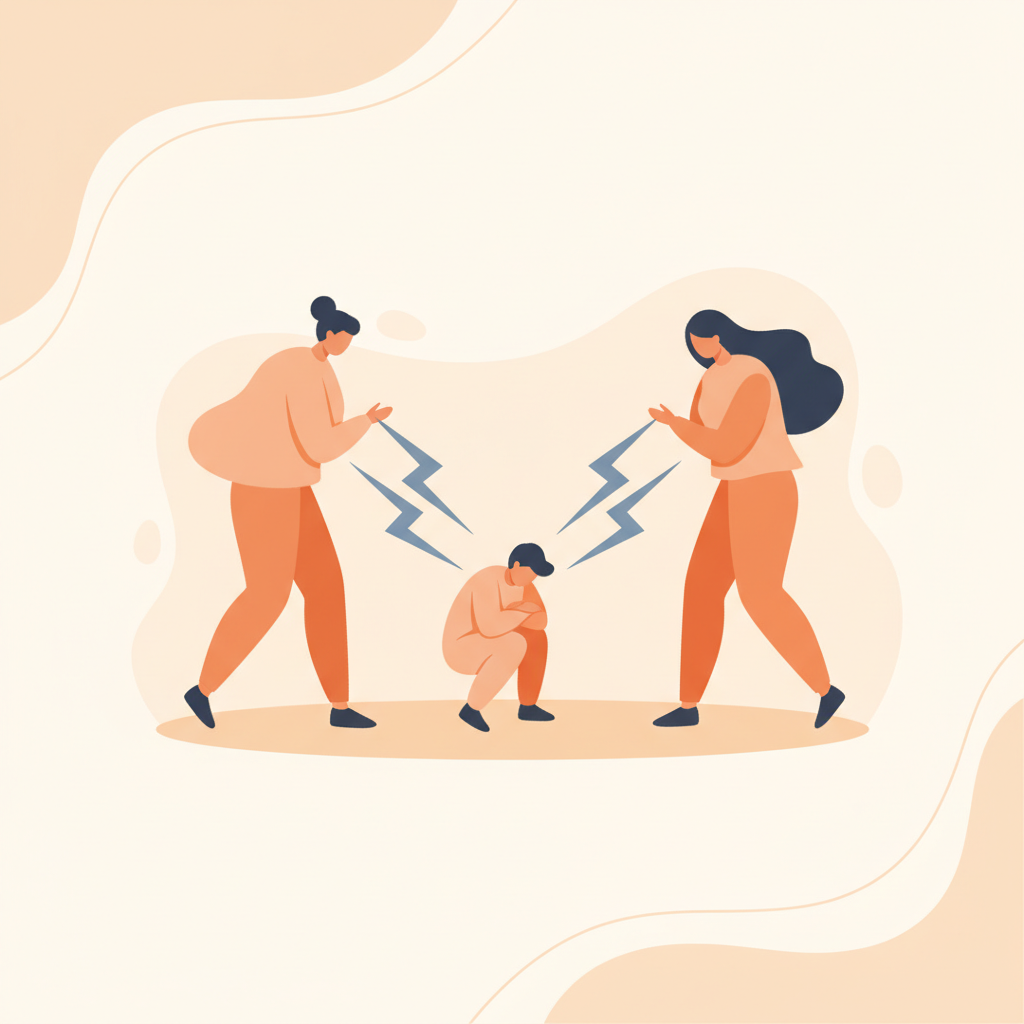
Triangulation is a relational process in which two people experiencing tension between them incorporate a third person to stabilise their relationship, diverting the conflict instead of resolving it. Murray Bowen identified the triangle as the basic unit of every emotional system: when anxiety between two people exceeds their capacity to manage it, they automatically seek a third party to absorb part of that tension. In the family, this translates into everyday yet deeply damaging situations: a mother complaining about the father to her daughter, a sibling acting as messenger between two siblings who are not speaking, a child forced to choose sides after a divorce. Virginia Satir noted that triangulation is one of the most insidious forms of communicative dysfunction because it appears harmless — "I'm just venting" — but erodes bonds from within.
| Type of triangulation |
Typical example |
Who suffers most |
| Father-mother-child |
"Tell your father dinner is ready" (they are not speaking) |
The child, turned into a messenger |
| Post-divorce |
"Your mother is the one who broke this family" |
The child, forced to choose a side |
| In-laws vs. couple |
The mother-in-law complains to her son about his spouse |
The spouse, who feels excluded |
| Siblings-parent |
One sibling uses the parent to pressure the other |
The parent, trapped between their children |
| Grandmother-mother-grandchild |
The grandmother overrides the mother in front of the grandchild |
The mother, whose authority is eroded |
| Work-family |
External allies are brought into the family conflict |
Everyone, as the conflict expands |
Why Do We Triangulate Instead of Resolving the Conflict Directly?
Because direct conflict generates anxiety, and anxiety seeks immediate relief. Bowen explained that people with lower differentiation of self — less capacity to separate thought from emotion — are more likely to triangulate. It is not a conscious decision: it is an automatic mechanism of emotional regulation. Talking about the problem with a third person temporarily eases the pain, but resolves nothing between the two original people. It is like taking a painkiller for a broken bone: the pain decreases, but the fracture remains.
Salvador Minuchin observed that triangulation is especially frequent in enmeshed families, where boundaries between members are diffuse and everyone feels entitled to weigh in on — and intervene in — everyone else's conflicts. In these families, speaking directly to the person you have the problem with is perceived as aggression, while speaking to a third party is perceived as normal and even necessary.
How Does Triangulation Manifest in Divorce?
Divorce is the most fertile ground for triangulation. When parents cannot manage their pain, anger or disappointment between themselves, children become the apex of the triangle. The most common forms include: using the child as a messenger ("tell your father to send the maintenance payment"), as a spy ("does your mother have a boyfriend?"), as an ally ("you know I'm right"), as a weapon ("if you misbehave, you're going to live with your father"), or as a therapist ("your father destroyed my life").
Bowen warned that children triangulated in their parents' divorce develop lower levels of differentiation, which means they will carry that tendency to triangulate into their own adult relationships. The pattern transmits from generation to generation until someone identifies it and stops it.
How Do You Know If You Are Being Triangulated?
There are clear signals. You feel you are carrying a conflict that is not yours. You receive contradictory versions from two people who are not speaking to each other. You feel pressure to choose a side. You become the messenger, the translator or the mediator without anyone having explicitly asked you. After speaking with one party, you feel guilt, exhaustion or the sensation that nothing you do is enough. Another indicator is that, if you try to withdraw from the middle, both parties blame you.
Virginia Satir added that the people most prone to being triangulated are those with a high sense of responsibility and a low tolerance for others' discomfort: they cannot bear seeing others suffer and offer themselves as buffers, without realising they are absorbing damage that does not belong to them.
How to Detriangulate Without Breaking Relationships?
The detriangulation process Bowen proposed has several principles. First, do not transmit messages: if someone tells you "tell your brother that...," the answer is "tell him yourself, directly." Second, do not take sides: you can listen to both parties without validating either position. "I understand you're having a hard time, but this is an issue between the two of you." Third, return the responsibility: "I think it's best if you talk to each other. I cannot resolve this."
It is essential to stay calm during the process. The family system will press for you to return to the triangle because your presence relieved the tension. There will be reproaches: "You don't care about us any more," "you're very cold," "you're abandoning us." Tolerating those reactions without yielding or getting angry is the hardest and most transformative part. Every time you resist the pressure to triangulate, you increase your differentiation and, paradoxically, help the two people in conflict more than when you were mediating between them.
Is Triangulation Always Negative?
Bowen distinguished between functional and dysfunctional triangles. A triangle becomes dysfunctional when the third person absorbs the anxiety chronically and the original two systematically avoid facing the conflict. However, seeking a professional mediator — a therapist, a family mediator, or even the AI on LetsShine.app as a neutral space — is not pathological triangulation: it is asking for help. The difference lies in the intention: are you looking for an ally against the other, or a facilitator for the encounter?
Minuchin insisted that therapeutic intervention consists precisely of entering the family triangle as a third party who does not allow themselves to be absorbed: they maintain a neutral position, point out the dynamics they observe and return responsibility to the parties involved. This model is replicable in everyday life if trained.
How to Protect Children from Triangulation in a Divorce?
There are clear rules that family mediation professionals recommend. Never speak badly of the other parent in front of the child. Never use the child as a messenger. Never interrogate the child about the other parent's life. Never ask the child who they want to live with as a way to win a battle. Never emotionally unload on the child about relationship issues.
Children need explicit permission to love both parents without guilt. That is the most effective vaccine against childhood triangulation.
Frequently Asked Questions
Is it triangulation if I talk about my family problems with a friend?
It depends. If you talk to let off steam and then return to address the conflict directly with the person involved, it is not triangulation: it is seeking support. If you talk to avoid the direct conversation and to recruit allies, it is.
Should I detriangulate all at once or gradually?
Bowen recommended gradual, sustained change. Abrupt changes generate intense reactions from the system. The ideal is to start with low-intensity situations and increase progressively.
What do I do if my parents triangulate me and get angry when I don't participate?
Maintain your position with firmness and warmth. You can say: "I love you both and that is exactly why I cannot be in the middle. This is something between the two of you." The first time will be uncomfortable; over time, the system adapts.
Can triangulation occur in couples without children?
Yes. The third element can be a friend, a relative, a colleague or even an activity (work, alcohol, social media). Any element that interposes itself between two people to avoid direct conflict functions as the apex of the triangle.
Is there positive triangulation?
Virginia Satir used the concept of the "constructive third party": a person who enters the dynamic not to relieve tension but to facilitate direct dialogue between the two parties. A good therapist or mediator fulfils that function. The difference is that the constructive third party works to make themselves dispensable.
Your relationships can improve. Today.
Start free in 2 minutes. No credit card, no commitment. Just you, the people you care about, and an AI that helps you understand each other.
Start free now