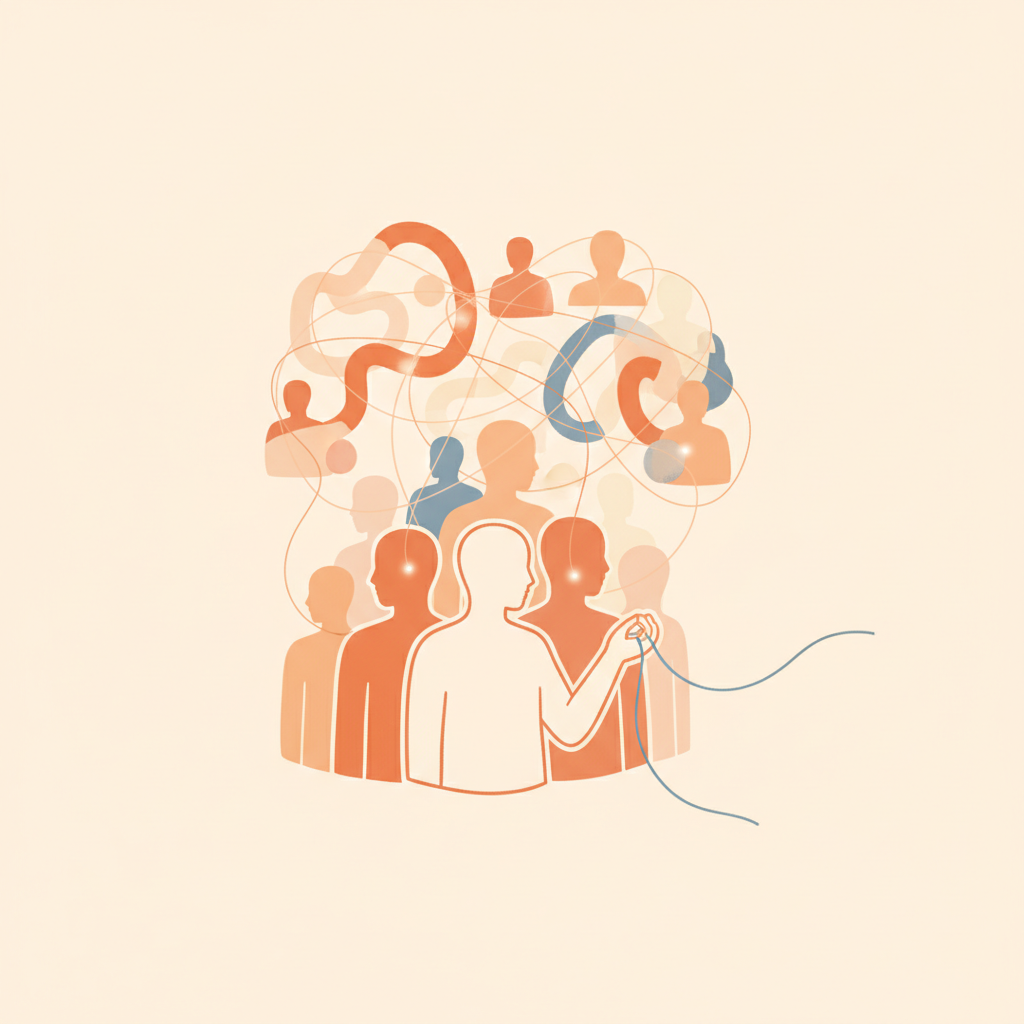
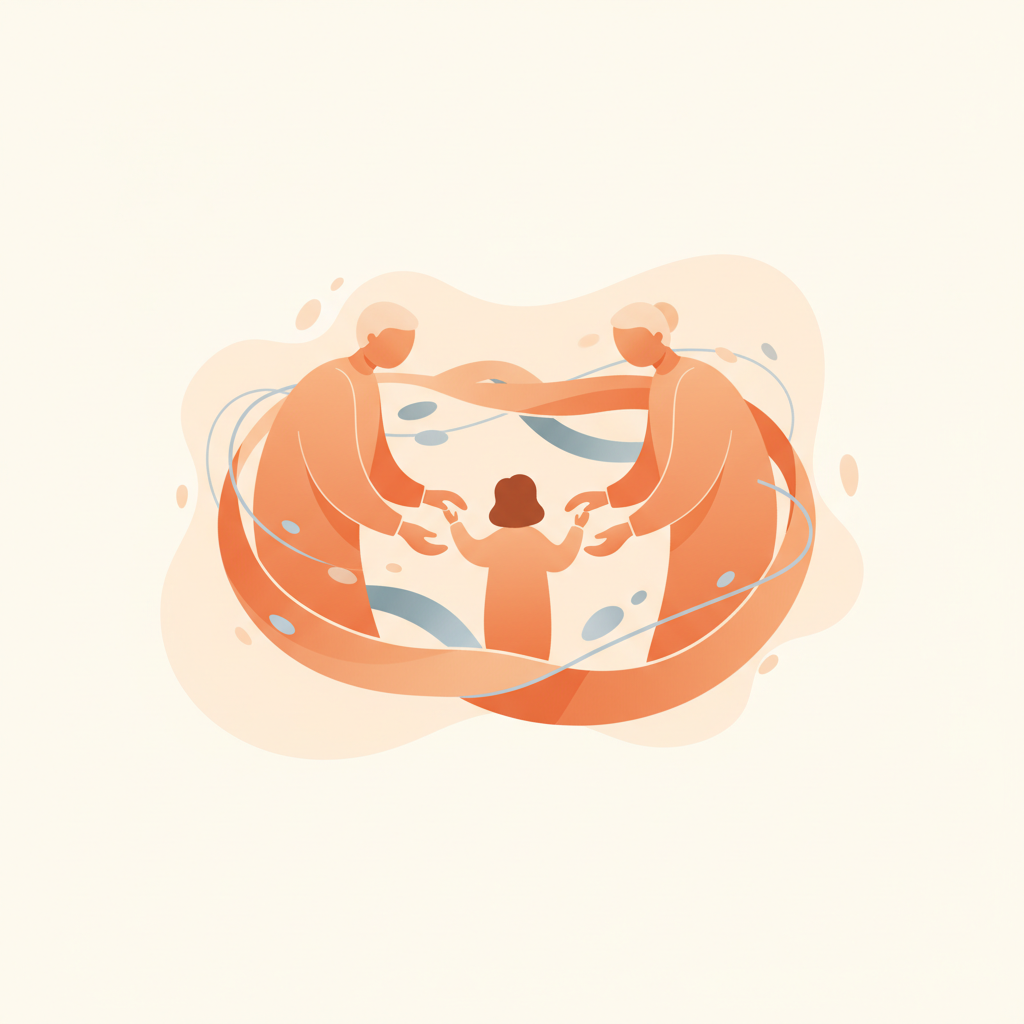
An enmeshed family — or enmeshed system, in Salvador Minuchin's terminology — is one in which the boundaries between its members are so diffuse that each person's individuality is absorbed by the system. Minuchin, creator of structural family therapy, placed enmeshment at one end of a continuum: at the other end is the disengaged family, where members are so independent that there is barely any emotional connection. The healthy family sits in the centre, with clear but permeable boundaries. Virginia Satir described the enmeshed family as a system where "everyone feels what one person feels": if the mother is sad, the whole family becomes sad; if the son fails, the shame is collective. Individual emotion does not exist, and what appears to be unconditional love is in reality a form of emotional control.
| Characteristic |
Enmeshed family |
Family with healthy closeness |
| Boundaries |
Diffuse or non-existent |
Clear and flexible |
| Emotions |
Contagious and obligatorily shared |
Owned by each member |
| Decisions |
Made as a group even when individual |
Consulted but respected |
| Secrets |
Do not exist: "there are no secrets here" |
Each member has their own privacy |
| Conflict |
Existential threat to the system |
Natural part of coexistence |
| Autonomy |
Perceived as betrayal or abandonment |
Celebrated as growth |
| Guilt |
Constant when setting any boundary |
Occasional and manageable |
How Does an Enmeshed Family Form?
Minuchin identified several pathways. The most frequent is unresolved parental anxiety. When parents feel that the outside world is dangerous, they create a closed system where children are permanently protected and monitored. Extreme closeness is not born from love: it is born from fear. Another pathway is loss: families that have suffered a death, abandonment or traumatic migration tend to fuse as a survival mechanism. "If we stick together, nothing will happen to us." A third pathway is cultural: in Mediterranean and Latin American societies, the value of family can slide towards an obligation of fusion, where individuating is interpreted as ingratitude.
Murray Bowen observed that enmeshed families typically show low differentiation of self in all their members. The parents did not differentiate from their own families of origin, and they replicate the same fusion with their children. The pattern transmits intergenerationally until someone questions it.
What Are the Signs That You Live in an Enmeshed Family?
The signs are subtle because they disguise themselves as virtues. "We are a very close family" is the banner phrase, but underneath there are concrete indicators. You cannot make an important decision — career, partner, relocation — without consulting the family and without feeling guilty if your decision differs from their opinion. Your parents know intimate details of your romantic relationship because "in this family we share everything." If you set a boundary — such as not attending a family dinner — the reaction is disproportionate: tears, reproaches, threats to withdraw affection. You have no personal spaces that the family respects: your room, your time, your friendships, your money, your body.
Virginia Satir added that in enmeshed families, loyalty is demonstrated through renunciation: "If you love us, you won't leave." Love is conditional on remaining within the system, and any movement outward is interpreted as abandonment.
What Are the Consequences of Growing Up in an Enmeshed Family?
The consequences manifest in adult life in various ways. Difficulty forming romantic relationships: either you choose a partner with whom to replicate the family fusion, or you flee from any intimacy because all closeness feels like suffocation. Chronic anxiety when making individual decisions, because the family system installed the belief that deciding alone is dangerous or selfish. A diffuse identity: the person does not know what they want, feel or think outside the family context, because they never had space to find out.
Minuchin also documented psychosomatic consequences. Enmeshed families with a sick child — asthma, diabetes, anorexia — showed a recurring pattern: the child's illness served as a regulator of family tension, and when the family was therapeutically restructured, the symptoms improved. The body expresses what the system does not allow to be verbalised.
How to Set Boundaries in an Enmeshed Family?
The first step is internal: dismantle the equation boundaries = not loving. Setting a boundary is not ceasing to love: it is defining where you end and the other begins. That distinction, which is obvious for people from families with clear boundaries, is revolutionary and terrifying for someone who grew up in an enmeshed family.
The second step is to start small. There is no need to deliver a speech about enmeshment or confront the entire family at once. It can be something as simple as not returning a call immediately, or saying "I'd rather not talk about that" in response to an invasive question. Each small boundary is an act of differentiation.
The third step is to tolerate the reaction. The enmeshed family will react badly to any boundary because it perceives the boundary as a loss. There will be guilt-tripping, victimhood, anger or withdrawal of affection. Bowen insisted that this reaction is temporary if the position is held calmly. The system will recalibrate, not immediately, but progressively. If you yield to the pressure, the message is that fusion works, and the pressure will increase next time.
Is It Possible to Stay Close to the Family Without Fusing?
Yes, and that is precisely the goal. Minuchin did not propose turning enmeshed families into disengaged ones: he proposed establishing clear boundaries that allow closeness without absorption. A healthy family can dine together, share worries, support each other in crises and celebrate together, but it can also respect that each member has different opinions, independent relationships and their own emotional space. On LetsShine.app, exploring these dynamics with the AI mediator allows you to identify where the boundaries are diffuse and to rehearse ways of strengthening them without destroying the bond.
Virginia Satir used an eloquent metaphor: "Healthy families are like the fingers of a hand: they are joined at the palm, but each one can move independently. Enmeshed families are like a fist: together, but without mobility."
What Is the Difference Between Enmeshment and Secure Attachment?
Secure attachment allows connection and autonomy. The child with secure attachment knows they can explore the world and return to base when they need to. In the enmeshed family, exploration is forbidden or penalised: the secure base becomes a cage. The difference is not in the intensity of love but in the freedom it allows. If loving your family prevents you from living your own life, it is not attachment: it is fusion.
Bowen added that people with secure attachment show high differentiation: they can be emotionally connected without losing their identity. People from enmeshed families typically show anxious attachment: they need constant confirmation of the bond because separation, however minimal, triggers an alarm of abandonment.
Frequently Asked Questions
Is enmeshment more frequent in some cultures?
Yes. Collectivist cultures — Mediterranean, Asian, Latin American — place greater value on family cohesion, which can facilitate enmeshed dynamics. However, enmeshment is not a cultural value: it is a dysfunction disguised as a cultural value. Healthy closeness is compatible with any culture.
Can I have an enmeshed family and not realise it?
That is the most common scenario. Because enmeshment presents itself as love, cohesion and unity, it is rarely questioned from within. The signs usually appear when the person tries to form their own couple and discovers that their family cannot tolerate the new alliance.
What do I do if my partner comes from an enmeshed family?
Patience and firmness. Do not ask them to choose between you and their family: that replicates enmeshed logic. Help them see that it is possible to love both. Establish joint boundaries as a couple and uphold them, even if the family reacts. If the situation is unsustainable, professional mediation can be very helpful.
Do children of enmeshed families always repeat the pattern?
Not always, but the risk is high. Some children repeat the fusion; others go to the opposite extreme and create emotionally disconnected families. Balance is achieved through conscious work: therapy, reflection and tools like LetsShine.app that facilitate understanding of these patterns.
Is it possible that only one family member is enmeshed and the rest are not?
Not in the strict sense. Enmeshment is a property of the system, not of the individual. However, there can be degrees: one child may be more fused than another, especially if they were the repository of parental anxiety according to Bowen's concept of family projection.