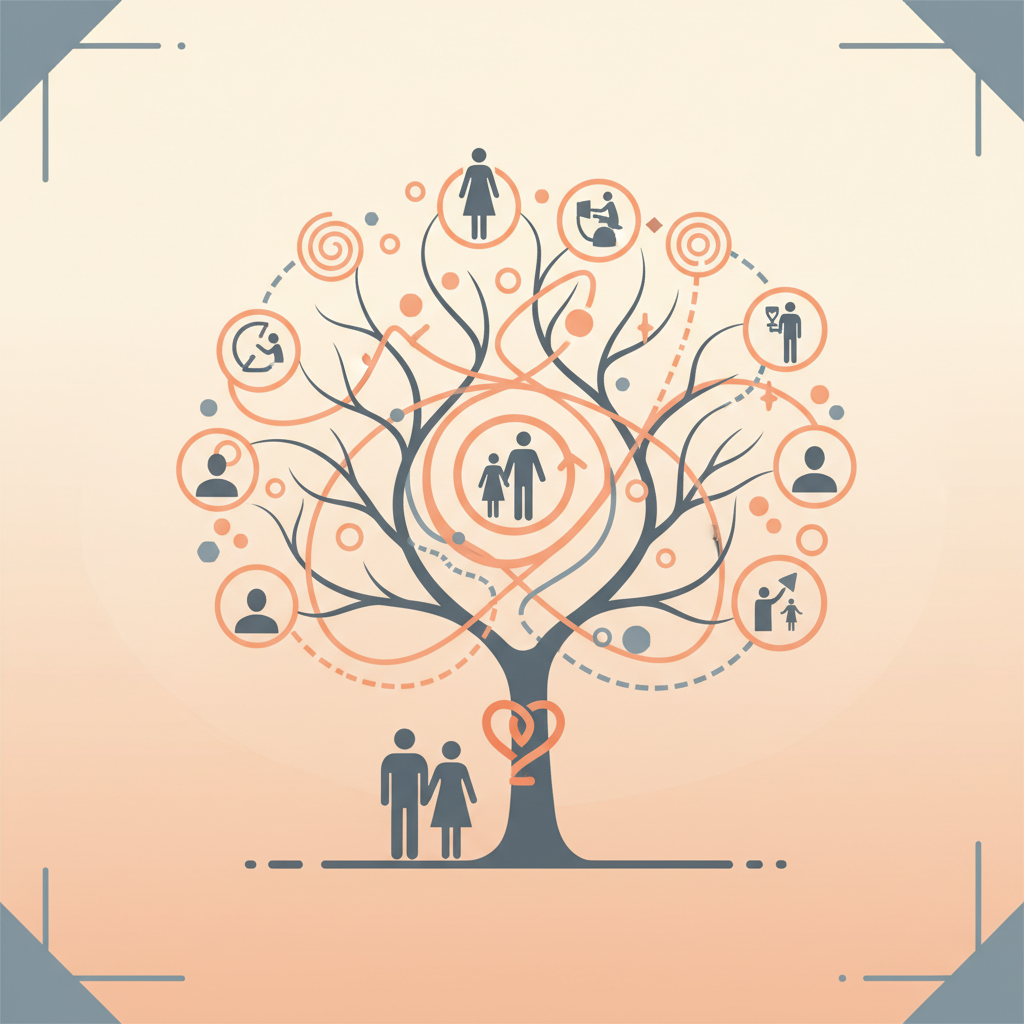
An emotional genogram is a graphic representation of the family structure that, unlike the conventional family tree, includes not only biographical data — names, dates of birth, marriages, deaths — but also the relational and emotional information that defines how the system truly functions: alliances, conflicts, emotional cut-offs, triangulations, fusions, secrets, illnesses, addictions, repeated patterns and the quality of the bonds between each member. It was Murray Bowen who incorporated the genogram as a central tool of his therapeutic model, having established that emotional patterns are transmitted from generation to generation and that making them visible on paper is the first step towards being able to modify them. Monica McGoldrick and Randy Gerson systematised its clinical use in the 1980s, turning it into one of the most widely used tools in family therapy, social work and mediation. Virginia Satir, though she did not use the formal genogram, employed similar techniques — such as family reconstruction — to help people visualise their history and free themselves from their patterns.
| Genogram symbol |
Meaning |
What it reveals |
| Thick continuous line |
Fused / enmeshed relationship |
Too much closeness, diffuse boundaries |
| Double continuous line |
Very close and healthy relationship |
Strong bond with autonomy |
| Dashed line |
Distant relationship |
Little emotional contact |
| Zigzag line |
Conflictive relationship |
Chronic tension, arguments |
| Line broken with two bars |
Emotional cut-off / rupture |
Not speaking, total estrangement |
| Line with triangle |
Triangulation |
A third party involved in the conflict of two |
| Square |
Male |
— |
| Circle |
Female |
— |
| X over the symbol |
Deceased |
Date and cause if relevant |
What Is the Purpose of an Emotional Genogram?
The emotional genogram serves to make the invisible visible. While the family history lives only in memory — fragmented, idealised, denied or distorted — patterns remain hidden. Once placed on paper, the repetitions leap out. It is common for a person drawing their genogram to discover for the first time that the divorces in their family always happen around the age of forty, that depression affects all the women on the maternal line, that the male children always distance themselves from the family in adolescence, or that there is a secret — an unacknowledged child, a mental illness, a suicide — that explains dynamics that had seemed inexplicable.
Bowen used the genogram to demonstrate to his patients that their current problems were not personal failures but chapters of a multigenerational story. That perspective reduces guilt and opens space for change: if the pattern comes from far back, the person is not the cause, but they can be the one who transforms it.
Salvador Minuchin, though focused on the structure of the present rather than on history, valued the genogram as a tool for identifying transgenerational alliances — for example, a grandchild allied with their grandmother against their own mother — that affect the current family structure.
How to Draw Your Emotional Genogram Step by Step
Step 1: Gather the information. You will need data from at least three generations: your grandparents, your parents and your generation. If you can include great-grandparents, even better. The basic data are: names, dates of birth and death, marriages, divorces, children, professions and place of residence. The emotional data are: quality of relationships, known conflicts, physical and mental illnesses, addictions, significant deaths, migrations, secrets and traumatic events.
Step 2: Draw the structure. Use squares for men and circles for women. Place each generation on a horizontal line, with the oldest generation at the top. Join couples with horizontal lines. Place children underneath, from oldest to youngest, left to right. Mark the deceased with an X. Indicate divorces with two diagonal bars over the joining line.
Step 3: Add the emotional relationships. This is the most revealing step. Use the symbols from the table above to represent the quality of the bond between each pair of people. Do not limit yourself to the obvious bonds: include the relationships between in-laws and their children's partners, between siblings-in-law, between grandparents and grandchildren. The most powerful dynamics often lie in the least visible relationships.
Step 4: Identify the patterns. Look for repetitions: are there recurring divorces? Addictions across several generations? Young deaths? Professions that repeat? Roles that are inherited? Emotional cut-offs that replicate? Mark the patterns you identify with colours or symbols.
Step 5: Reflect. Sit in front of your genogram and ask yourself: what patterns am I repeating? What invisible loyalties are operating in my life? What role do I occupy in this system? What emotional inheritance do I want to keep and what do I want to transform?
What Questions Should You Ask to Complete the Emotional Genogram?
The best questions go beyond data and touch emotions. Some useful questions to ask relatives or to answer yourself include: What was the relationship between your grandparents like? Who really ran the household? What was never talked about? Who was the favourite and who was invisible? Was there an event that changed the family forever? How was affection expressed? How was anger expressed? Who looked after whom? Were there secrets that were discovered late?
Bowen recommended that the therapist or the person undertake "trips home": visits to the family of origin with prepared questions and an attitude of curiosity, not confrontation. These visits do not seek to change the family but to gather information that allows the system to be understood.
Can You Create a Genogram Without the Family's Cooperation?
Yes. Although information from relatives enormously enriches the genogram, it is possible to create a valuable one with what you yourself remember and know. Gaps in information are, in themselves, revealing: why do you know nothing about your grandfather's brother? Why does nobody talk about your father's first wife? Gaps in the genogram tend to coincide with the system's secrets.
On LetsShine.app, the AI can guide you through structured questions to build your emotional genogram even if you do not have access to your family. The reflective process that the genogram provokes is therapeutic in itself, regardless of whether the result is a complete map or a sketch with gaps.
What Are the Most Common Patterns in Genograms?
Clinical experience with genograms has identified recurring patterns. The most common is the repetition of family structure: children of divorced parents who divorce, children of alcoholics who develop addictions, children of emotionally distant parents who are emotionally distant. Another frequent pattern is compensation: children who do exactly the opposite of their parents — overprotect because they were neglected, are permissive because they were raised rigidly — but without finding balance.
Bowen also identified the "anniversary" pattern: events that repeat at the same ages or dates across generations. A divorce at 38, like the father's. A first child at 22, like the grandmother's. A career crisis at 45, like the grandfather's. These coincidences, which appear to be chance, reveal the force of unconscious mandates.
Minuchin noted structural patterns: families that reproduce the same hierarchy generation after generation — a dominant mother and a peripheral father, for example — as if it were the only possible way to organise a family.
Does the Emotional Genogram Replace Therapy?
No. The genogram is a tool, not a treatment. Creating one can be revealing, but revelation without support can also be overwhelming. If drawing your genogram uncovers painful patterns, disturbing secrets or intense emotions, it is advisable to process those findings with a professional.
That said, the simple act of organising family information on paper has a clarifying effect that many people describe as liberating. "Now I understand why I do what I do" is one of the most frequent phrases after completing a genogram. That understanding does not solve the problem, but it changes the relationship with the problem: it shifts from being a personal defect to being an inherited pattern that can be modified.
Frequently Asked Questions
Do I need drawing skills to make a genogram?
No. The genogram uses simple symbols — squares, circles, lines — that anyone can draw. It is not an artistic exercise but an emotional one. You can do it on paper, on a whiteboard or with digital tools.
How many generations should I include?
Bowen recommended at least three: grandparents, parents and your generation. If you have information about great-grandparents, include it. The more generations, the more visible the patterns. But even a two-generation genogram can be revealing.
Should I include people I have no relationship with?
Yes, especially those people. The "erased" family members — the uncle nobody talks about, the sister who left — tend to be key pieces of the system. Their absence in the family narrative says as much as their presence would.
Can the genogram serve as a couples' tool?
Absolutely. Drawing the genograms of both members of the couple and comparing them is one of the most powerful exercises in couples therapy. It allows each person to understand why the other reacts the way they do and what family inheritances are clashing in the relationship.
How often should I update my genogram?
There is no set frequency. It is worth revisiting when significant family events occur — births, deaths, divorces, reconciliations — or when you feel an old pattern activating in your life. The genogram is not a static document: it grows and changes with you.