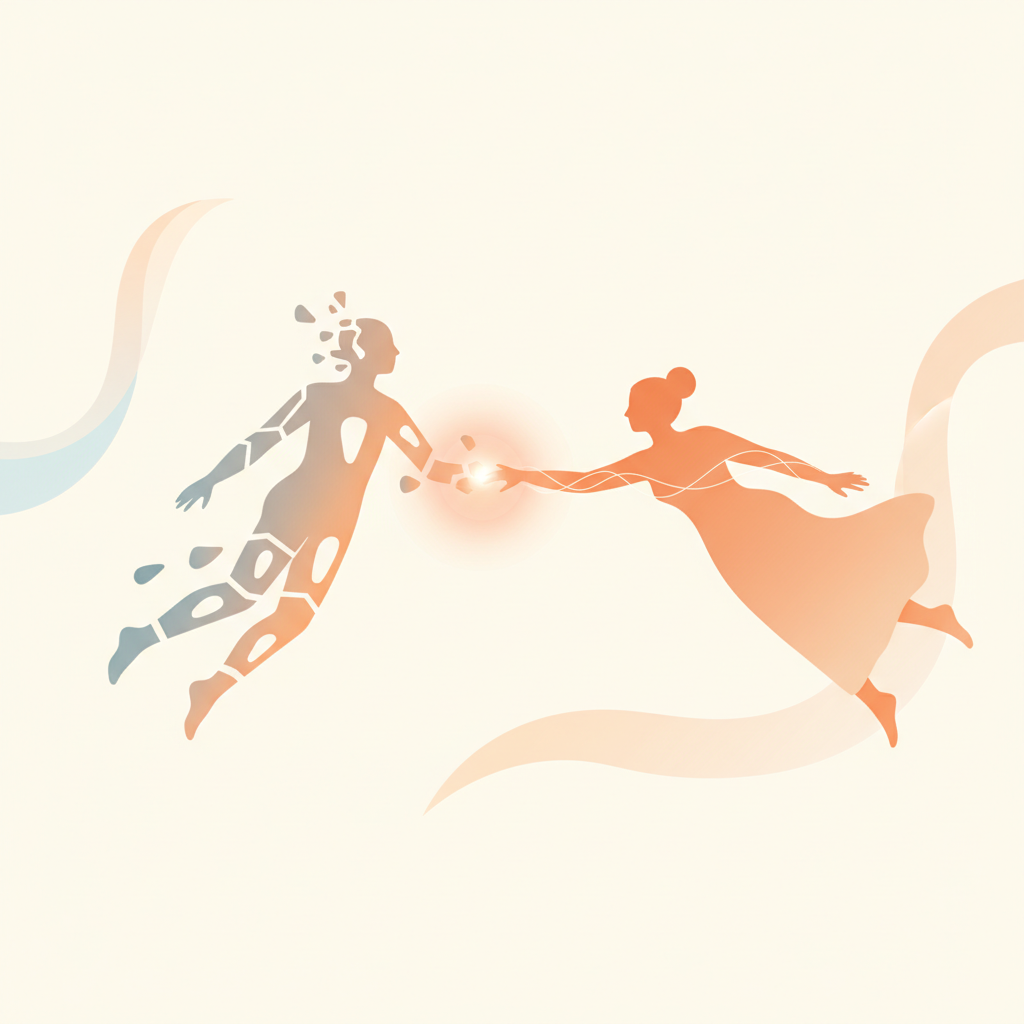
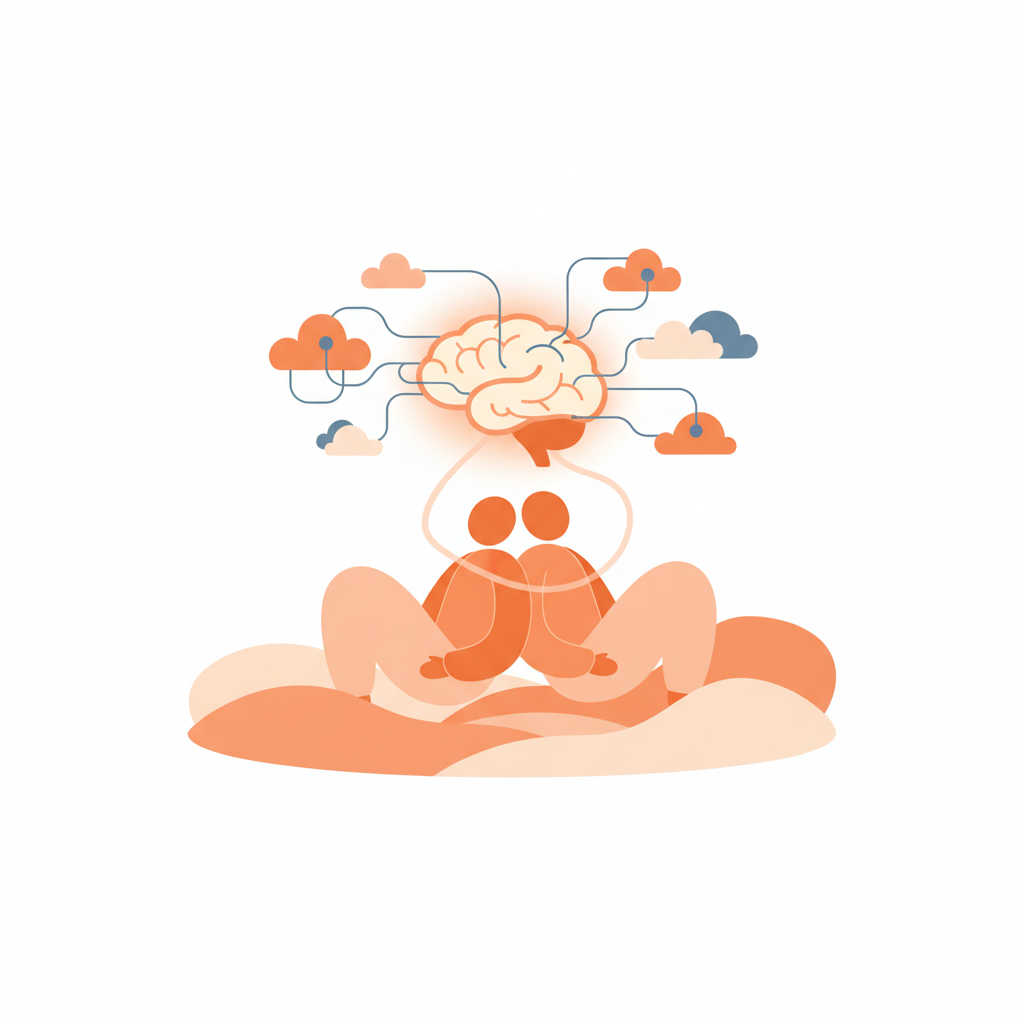
Emotional dissociation is a psychological mechanism through which a person partially or totally disconnects from their own emotions, bodily sensations, or even their sense of identity, in response to an experience that overwhelms their processing capacity. In clinical terms, dissociation exists on a spectrum ranging from mild emotional disconnection — "feeling like things aren't real," "being on autopilot" — to severe dissociative disorders. Bessel van der Kolk, in The Body Keeps the Score, explains that dissociation is not a primary pathology but a survival mechanism: when pain — physical or emotional — is too intense for the nervous system to process, the brain "disconnects" the emotional experience to protect the organism. Peter Levine, from Somatic Experiencing, describes this phenomenon as "freeze": the human equivalent of the immobilisation response animals activate when they can neither fight nor flee. John Bowlby documented dissociation in children separated from their mothers: after the protest phase and the despair phase came "detachment" — an apparent calm that was not peace but surrender, the disconnection from pain upon realising that nobody would come to relieve that suffering.
Overview: the spectrum of emotional dissociation
| Level |
Description |
Everyday example |
When to seek help |
| Mild |
Momentary disconnection |
"I was reading and didn't take in a thing" |
Normal, no intervention needed |
| Moderate |
Recurrent emotional numbness |
"My partner is crying and I feel nothing" |
When it affects relationships |
| Intense |
Depersonalisation |
"I look in the mirror and don't recognise myself" |
Consult a professional |
| Severe |
Identity fragmentation |
Time loss, "gaps" |
Urgent specialised therapy |
Why do some people "feel nothing"?
Van der Kolk explains that chronic emotional dissociation usually originates in childhoods where feeling was dangerous. The most common scenarios:
- Families where emotions were forbidden: "Don't cry," "Don't get angry," "Men aren't afraid." The child learns that expressing emotions brings punishment or rejection and gradually disconnects the ability to feel them.
- Sustained traumatic environments: when abuse or neglect is continuous, the brain activates dissociation as a permanent mechanism. It is not a choice — it is the nervous system's automatic response to unceasing pain.
- Early relational trauma: Bowlby documented that children with avoidant attachment learn to suppress distress signals because expressing them brings not comfort but distance from the caregiver. Externally they appear "calm"; internally, their cortisol is as elevated as in children who cry.
Gabor Mate synthesises: "Dissociation is not the absence of emotions. It is the presence of a wall between you and your emotions. The emotions are still there — they live in your body, in your tension, in your chronic pain — but your awareness has lost access to them."
How does emotional dissociation manifest in relationships?
Emotional dissociation is devastating for relationships because it attacks exactly what relationships need: emotional presence.
- "I don't know what I feel": the partner asks "What's wrong?" and the sincere answer is "I don't know." It is not evasion; it is genuine inability to access the emotion.
- Apparent coldness: the dissociated person may seem indifferent to emotionally significant events — the death of a family member, the birth of a child, a declaration of love. It is not that it does not matter to them; the emotion is blocked.
- Disconnection during conflict: Hendrix describes the phenomenon of stonewalling: the person emotionally "shuts down" when the conversation escalates. Van der Kolk explains that it is not a manipulative strategy — it is the dorsal vagal nervous system activating the immobilisation response.
- Difficulty with sexual intimacy: the body "leaves" during intimacy. The person is physically present but emotionally absent.
- Sudden emotional explosions: paradoxically, the person who "feels nothing" can have bursts of anger or crying seemingly without cause. What happens is that accumulated emotion temporarily breaks through the dissociation dam.
What happens in the brain when we dissociate?
Van der Kolk identified through neuroimaging that during dissociation:
- The insula — the brain region that processes bodily sensations and self-awareness — reduces its activity. The person literally stops feeling their own body.
- The medial prefrontal cortex — which generates the sense of "I" — partially deactivates. The person feels they are watching their life from the outside, as if it were happening to someone else.
- The amygdala may be hyperactive (generating the internal alarm that triggers dissociation) or hypoactive (when dissociation is already established and the person has "disconnected" the alarm entirely).
Peter Levine adds that chronic dissociation alters vagal tone: the vagus nerve, responsible for autonomic nervous system regulation, becomes trapped in dorsal mode — the most primitive — which produces freeze, numbness, and disconnection.
How to reconnect with your emotions
1. Reconnect with the body first
Van der Kolk insists that you cannot feel emotions if you cannot feel your body. The first step is not "talking about what you feel" but recovering bodily sensation:
- Conscious bath or shower: pay attention to the water's temperature on each part of your body.
- Self-massage: rub your hands, press your feet into the floor, stroke your arms. You are sending the brain the signal: "You have a body. You are here."
- Body-aware exercise: yoga, tai chi, dance. Not as performance but as presence.
2. Name sensations before emotions
Levine suggests starting with the most basic: not "What do you feel?" (too abstract for the dissociated person) but "What do you notice in your body?" Chest tightness. Warmth in the hands. A lump in the throat. From there, gradually, you can connect sensation to emotion.
3. Pace the reconnection
Bourbeau warns that reconnecting with emotions all at once can be overwhelming. Dissociation installed itself for a reason: to protect you. Dismantling it abruptly can leave the nervous system without protection against pain it does not yet know how to manage. Reconnection should be gradual, ideally with professional support.
4. Create safety before opening the door
Van der Kolk insists that dissociation is dismantled from safety, not from exposure. Before attempting to feel, you need a space — a relationship, a therapist, an environment — where feeling is safe. Without that foundation, forcing reconnection can retraumatise.
When is dissociation a problem and when is it normal?
We all dissociate occasionally: daydreaming, driving on autopilot, getting lost in a book. This is normal and functional. Dissociation becomes a problem when:
- It is your habitual response to stress, conflict, or intimacy.
- It interferes with your relationships: your partner feels you are "not there."
- You cannot access your emotions when you need to.
- You frequently experience depersonalisation (feeling outside your body) or derealisation (feeling the world is not real).
At LetsShine.app, we understand dissociation as a form of self-protection that made sense at the time but now prevents you from connecting with the people you love. Our approach is always compassionate: it is not about forcing you to feel, but about creating the conditions for feeling to become safe again.
Frequently Asked Questions
Is emotional dissociation the same as alexithymia?
They are related but different concepts. Alexithymia is difficulty identifying and describing one's own emotions. Emotional dissociation is a broader mechanism that includes disconnection not only from emotions but also from bodily sensations and, in severe cases, from identity. A person can be alexithymic without dissociating, and dissociate without being alexithymic.
Is emotional dissociation inherited?
Not directly, but the attachment patterns that generate it are transmitted intergenerationally. Bowlby and Van der Kolk documented that parents with avoidant attachment — who are often emotionally dissociated — tend to generate the same attachment style in their children.
Do men dissociate more than women?
There is no evidence that dissociation is more common in one gender, but men are more socialised to suppress emotions, which can contribute to chronic emotional dissociation normalised as "masculinity."
Is it possible to feel too much after years of dissociation?
Yes. When dissociation begins to dismantle — through therapy, a secure relationship, or a life crisis — the person may feel an emotional avalanche that seems unbearable. It is important that this process be accompanied by a professional.
Can LetsShine.app help me if I struggle to feel emotions?
LetsShine.app can help you become aware of the moments when you disconnect, identify which situations trigger your dissociation, and practise gradual forms of emotional reconnection. If dissociation is intense, we recommend complementing with specialised therapy.
Your relationships can improve. Today.
Start free in 2 minutes. No credit card, no commitment. Just you, the people you care about, and an AI that helps you understand each other.
Start free now