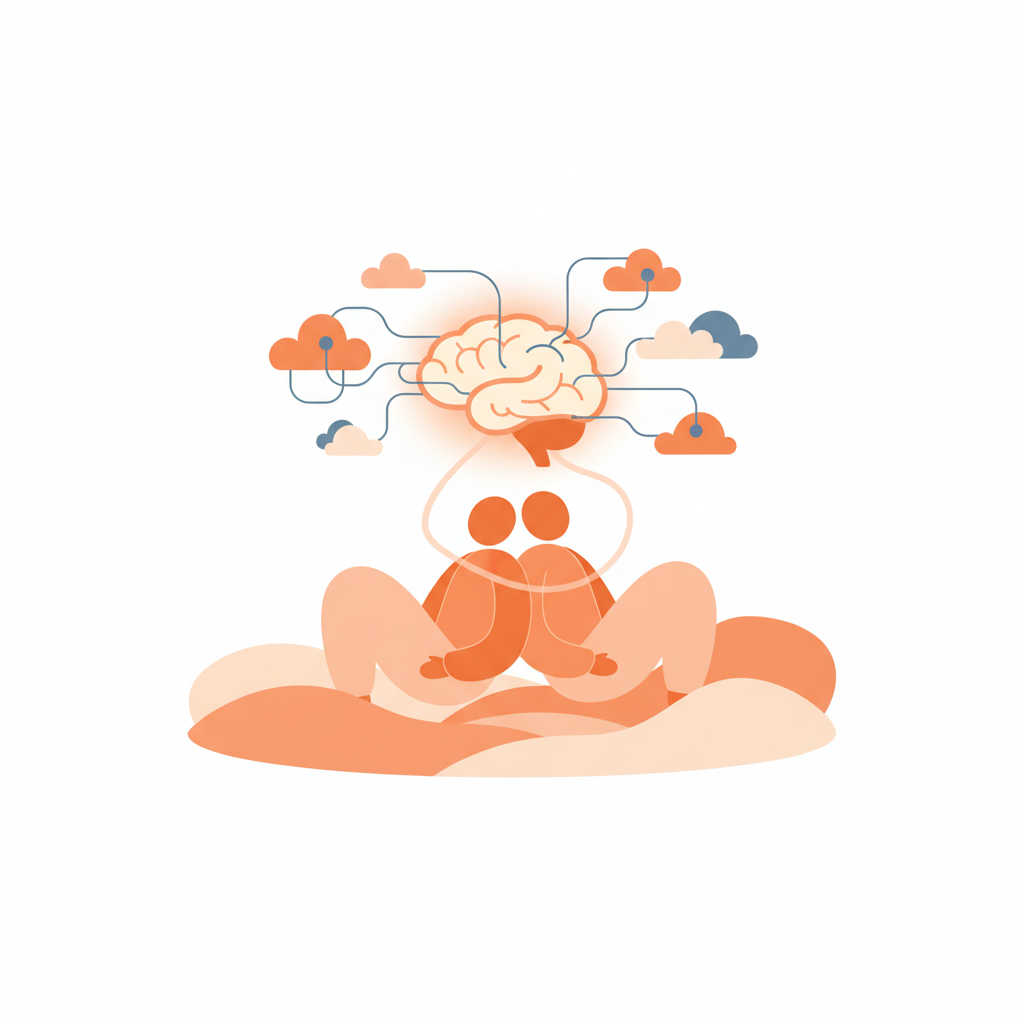
Boredom — that uncomfortable, restless state we spend enormous energy avoiding — turns out to be one of the most neurologically productive states the brain can enter. Manoush Zomorodi, author of Bored and Brilliant: How Spacing Out Can Unlock Your Most Productive and Creative Self (2017), argues that "boredom is the gateway to mind-wandering, mind-wandering is the gateway to creativity, and creativity is the gateway to self-understanding." When the brain has nothing external to process, it activates the default mode network (DMN) — a constellation of brain regions associated with self-reflection, future planning, empathy, moral reasoning, and creative problem-solving.
| Brain State |
Network Active |
Activities |
Relational Value |
| Focused attention |
Task-Positive Network (TPN) |
Work, screens, problem-solving |
Direct but limited |
| Mind-wandering / Boredom |
Default Mode Network (DMN) |
Daydreaming, spacing out, idle moments |
Self-reflection, empathy, creativity |
| Constant stimulation |
Neither fully active |
Social media scrolling, multitasking |
Fragmentary, shallow |
What Happens in the Brain When You Are Bored?
Marcus Raichle, the Washington University neuroscientist who discovered the default mode network in 2001, found that the DMN consumes 20% of the brain's energy — more than any focused cognitive task. This is not wasted energy. The DMN is doing essential maintenance work:
- Autobiographical memory consolidation: making sense of your life narrative.
- Future simulation: imagining possible scenarios and planning.
- Theory of mind: understanding other people's perspectives and emotions.
- Moral reasoning: processing ethical dilemmas and values.
- Creative incubation: making novel connections between seemingly unrelated ideas.
Andrew Huberman explains that the DMN and the Task-Positive Network (TPN) operate like a seesaw: when one is active, the other is suppressed. Constant external stimulation (screens, podcasts, notifications) keeps the TPN engaged and the DMN suppressed. The result is a mind that can process information but cannot reflect on itself — a mind that can react but cannot understand why it reacts the way it does.
Why Boredom Has Become Extinct
Johann Hari, in Stolen Focus, documents how the modern attention economy has systematically eliminated boredom from daily life. Every idle moment — queuing, waiting for a bus, sitting on the toilet — is now filled with a screen. Gloria Mark's research confirms that the average person checks their phone 96 times per day, with the gap between checks shrinking year on year.
Zomorodi conducted an experiment with 20,000 participants: she asked them to progressively reduce phone use over one week. The most common response on the first day of reduced stimulation was anxiety. By day three, participants reported surprising bursts of creativity. By the end of the week, many described a qualitative shift in self-awareness: "I suddenly had thoughts I had not had in years."
Cal Newport frames this through the lens of digital minimalism: "We have replaced the discomfort of boredom with the comfort of distraction, not realising that the discomfort was doing something essential."
Boredom and Emotional Intelligence
The connection between boredom and relational quality is mediated by the DMN's role in theory of mind — the ability to understand another person's internal states. When the DMN is chronically suppressed by constant stimulation, our capacity for empathy and perspective-taking degrades. This manifests in relationships as:
- Difficulty understanding your partner's emotional experience.
- Reduced patience for conversations that do not have an immediate "point."
- A tendency to reach for the phone during any conversational pause.
- Feeling restless when simply being with someone without an activity.
Huberman explains this neurochemically: constant dopamine stimulation from screens raises the baseline threshold for engagement. The subtle dopamine rewards of quiet presence, eye contact, and unhurried conversation fall below the threshold, making them feel "boring" — even though they are the foundation of deep connection.
How to Reclaim Boredom
Strategy 1: Create Stimulus-Free Zones
James Clear's environment design principle applies: make distraction difficult and boredom easy. Designate specific times or places as phone-free:
- The first 30 minutes after waking.
- The commute (if not driving, resist the podcast).
- Queues and waiting rooms.
- The last 30 minutes before bed.
Strategy 2: The Boredom Walk
Zomorodi recommends a daily "boredom walk" — 15–20 minutes of walking without a phone, podcast, or music. No destination required. The goal is not exercise but mind-wandering. Florence Williams notes that combining nature and boredom is particularly powerful: the natural environment provides enough soft stimulation to prevent anxiety while leaving the DMN free to operate.
Strategy 3: Single-Tasking
Cal Newport's deep work philosophy extends to daily life: do one thing at a time. Eat without a screen. Wait without scrolling. Cook without a podcast. Each of these micro-moments of undistracted experience gives the DMN brief opportunities to activate.
Strategy 4: The Tiny Habit of Pausing
BJ Fogg suggests: "After I park the car, I will sit for 30 seconds before getting out." Thirty seconds of nothing. No phone, no music, no planning. Just existing. This tiny practice builds tolerance for the discomfort of understimulation and gradually retrains the brain to accept — even enjoy — stillness.
Boredom and Creativity in Relationships
Some of the most meaningful moments in a relationship happen when nothing is planned. The spontaneous conversation that arises during a lazy Sunday afternoon. The unexpected idea that surfaces while cooking together in silence. The sudden emotional insight that appears during a long car ride with no entertainment.
Johann Hari argues that "the most dangerous thing you can do to a relationship is to fill every moment with content." When every car ride has a podcast and every evening has a series, there is no space for the unstructured interaction where real intimacy emerges.
At LetsShine.app, we believe that some of the most important relational work happens not during guided exercises but in the quiet moments between them — when the mind is free to wander and wonder.
Frequently Asked Questions
Is boredom the same as mindfulness meditation?
Not exactly. Mindfulness meditation directs attention to a specific anchor (breath, body sensations). Boredom — or what researchers call "unstructured wakeful rest" — allows the mind to wander freely. Both are valuable, but they activate different neural processes. Huberman recommends both: structured mindfulness for focus training, and unstructured boredom for DMN activation.
How much "doing nothing" time do I need daily?
Manoush Zomorodi suggests a minimum of 15–20 minutes daily of time without external stimulation. Huberman adds that even brief moments count: every queue where you do not reach for your phone is a micro-training session for the DMN.
Does boredom work the same for children?
Yes, and it is especially important. Children who never experience boredom do not develop the capacity for autonomous imagination or frustration tolerance. When a child says "I'm bored," the best response is: "Good. Let's see what you come up with."
Is doing nothing the same as procrastinating?
No. Procrastinating is avoiding a specific task by substituting another activity (usually digital). Doing nothing is an active choice to consume no stimulation. Johann Hari distinguishes them: "Procrastinating is escaping from work; proactive boredom is escaping from distraction."
How do I tolerate the restlessness of doing nothing?
BJ Fogg suggests starting with homeopathic doses: 30 seconds of silence after parking, one minute without your phone in a queue. Tolerance for emptiness is trained like a muscle. James Clear adds: "The discomfort of boredom is temporary; the benefits are cumulative and permanent."
Your relationships can improve. Today.
Start free in 2 minutes. No credit card, no commitment. Just you, the people you care about, and an AI that helps you understand each other.
Start free now