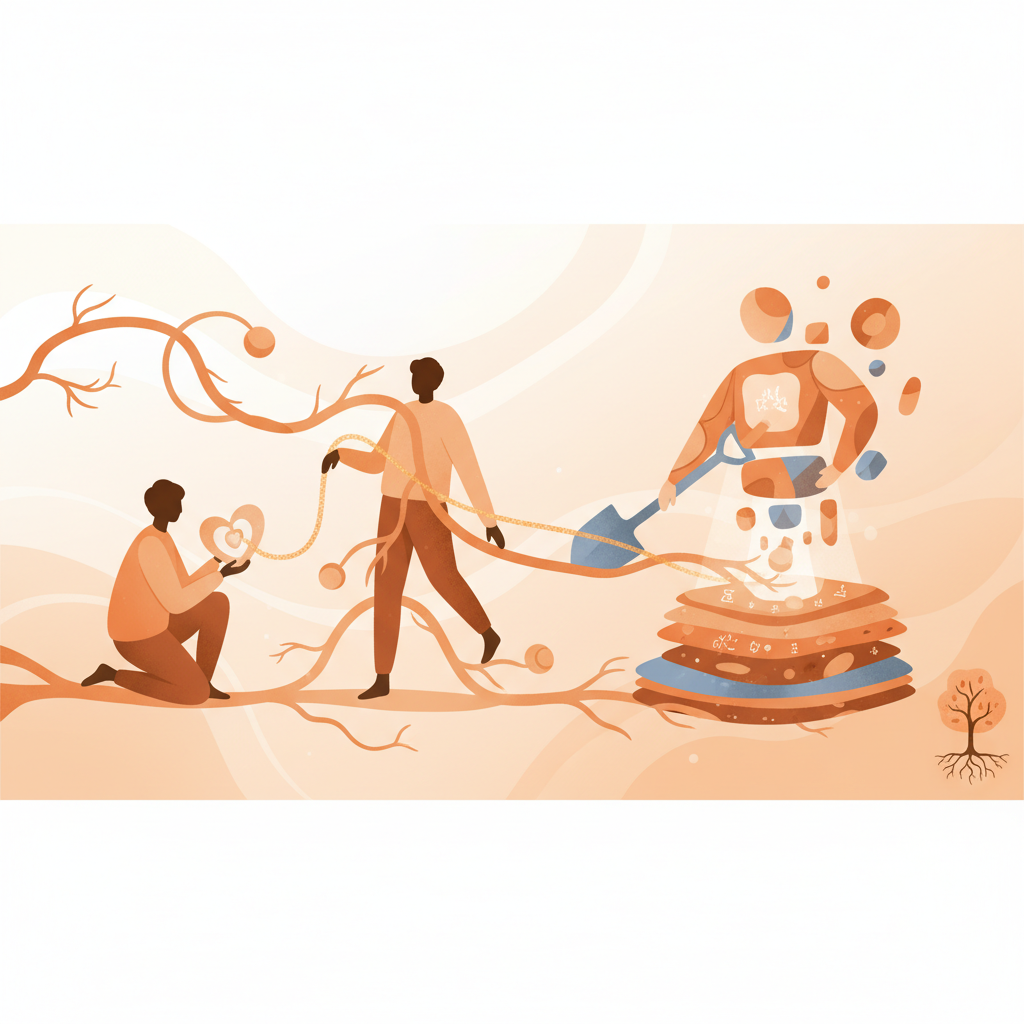
Emotional archaeology is a self-knowledge approach that involves exploring the deep layers of our personal history — childhood, early bonds, formative experiences — to understand why we feel what we feel and why we react the way we react in the present. Just as an archaeologist digs carefully to unearth artefacts that explain a civilisation, emotional archaeology invites us to excavate our emotional biography with curiosity and compassion — not to blame anyone or to get trapped in the past, but to understand the roots of our current patterns and, from that understanding, choose freer responses. This concept, which forms the philosophical backbone of LetsShine.app, draws on attachment theory (Bowlby), depth psychology (Jung), schema therapy (Young), and contemporary affective neuroscience.
| Concept |
What it means in emotional archaeology |
| Surface layer |
Current reaction: "I get angry when my partner is late" |
| Intermediate layer |
Repeated pattern: "I always get angry when I feel I'm not a priority" |
| Deep layer |
Foundational wound: "As a child, I learned that if I wasn't visible, I didn't matter" |
| Emotional schema |
Core belief: "I'm not important enough for anyone to prioritise me" |
| Conscious response |
"I can ask for what I need without assuming I'll be abandoned" |
Why Do I React Disproportionately to Certain Situations?
We all have emotional "buttons": apparently small situations that trigger enormous reactions. Your partner forgets to buy something you asked for and a wave of rage sweeps over you that does not match the situation. Your boss corrects a report and you feel like a fraud. A friend cancels dinner and you feel profoundly rejected.
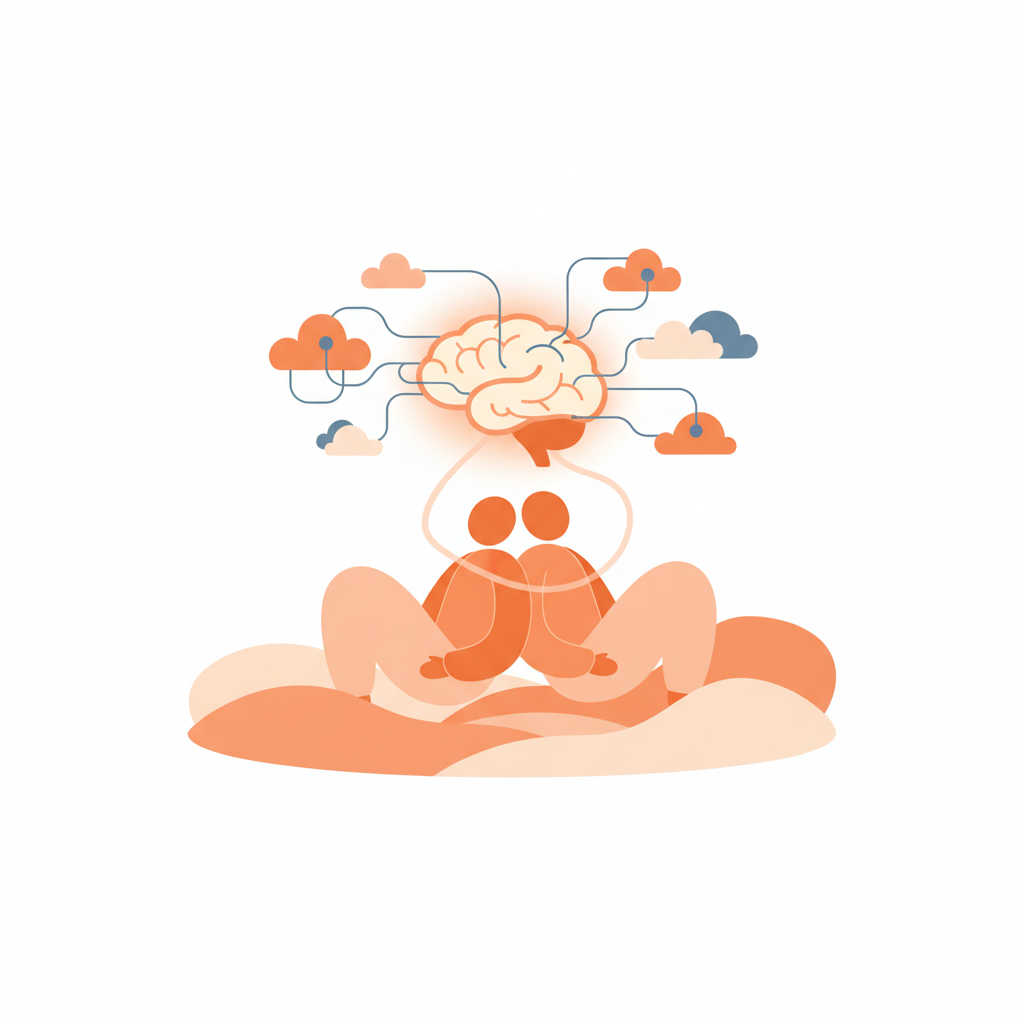
These disproportionate reactions are not irrational. They are perfectly logical when viewed through the lens of emotional archaeology. What happens is that the present situation activates an "emotional charge" from the past. Your brain does not clearly distinguish between today's rejection and the rejection you experienced at age five. The amygdala — the brain structure responsible for threat detection — responds to the emotional pattern, not to the objective fact.
Neuroscientist Joseph LeDoux demonstrated that emotional memories are stored in the amygdala differently from declarative memories (the ones you can put into words). That is why you can "know" rationally that your partner forgetting an errand is not abandonment and, at the same time, "feel" exactly that.
How Does Emotional Archaeology Work in Practice?
The process follows an exploratory path from surface to depth:
Level 1: Identify the Reaction
The first step is noticing when you are having an emotional reaction that seems bigger than the situation warrants. It is not about judging it as "exaggerated" (that would be invalidating), but about observing it with curiosity: "What I'm feeling is very intense. What lies beneath?"
Level 2: Find the Pattern
Ask yourself: has this happened before? In what other situations have I felt something similar? Is there a common denominator? You will usually find a recurring theme: abandonment, rejection, control, invisibility, injustice, helplessness.
Level 3: Trace the Origin
This is where the archaeology gets interesting — and uncomfortable. When was the first time you felt something like this? What was happening at home when you were a child? How did your parents handle conflict? What did you learn about asking for help, about showing weakness, about expressing anger?
This is not about blaming your parents. Most parents did what they could with the tools they had. But understanding what you experienced allows you to understand why you developed certain emotional-survival strategies.
Level 4: Connect With the Wound
The most common emotional wounds that emotional archaeology unearths are:
- Wound of abandonment: "The people I love will eventually leave."
- Wound of rejection: "There is something fundamentally wrong with me."
- Wound of humiliation: "If I show who I really am, people will laugh at me."
- Wound of betrayal: "I cannot trust anyone."
- Wound of injustice: "The world is a place where effort goes unrecognised."
Lise Bourbeau popularised this classification, although the concept of emotional wounds has roots in Carl Jung's depth psychology and John Bradshaw's inner-child work.
Level 5: Integrate and Choose
Understanding the wound does not eliminate it, but it strips it of its automatic power. When you know that your disproportionate anger comes from your abandonment wound — and not from the fact that your partner was twenty minutes late — you gain a space to choose. You can say: "I know this touches a sensitive spot for me. I need a moment before I respond."
That moment between stimulus and response is the space Viktor Frankl called freedom. And emotional archaeology is the tool that expands it.
What Does Emotional Archaeology Have to Do With Attachment Theory?
A great deal. John Bowlby, the father of attachment theory, showed that early bonds with our primary caregivers configure an "internal working model" that functions as a relational map for the rest of our lives.
- Secure attachment: "I can trust others and myself. The world is a reasonably safe place." Developed when caregivers were consistently available and responsive.
- Anxious attachment: "I need a lot of closeness and I'm terrified of abandonment." Developed when caregivers were inconsistent — sometimes present, sometimes absent.
- Avoidant attachment: "I don't need anyone. Better not to depend." Developed when caregivers did not respond to emotional needs or rewarded self-sufficiency.
- Disorganised attachment: "I want to get close but I'm afraid." Developed in contexts of trauma or severe neglect.
Emotional archaeology helps us identify our predominant attachment style and understand how it manifests in our adult relationships. Not to label ourselves, but to understand ourselves.
Can I Practise Emotional Archaeology on My Own or Do I Need Help?
You can start on your own. In fact, self-observation and reflective writing are very powerful tools. Some practices you can incorporate:
- Emotional journal: each evening, note down the most intense emotion of the day, what triggered it, and whether it reminded you of something from the past.
- The "and beneath that?" question: when you feel something intense, ask yourself: "What lies beneath this emotion? And beneath that?" Keep asking until you reach something that surprises or moves you.
- Letters you never send: write a letter to your child self, to a parent, or to a past version of you. Not to send it, but to process.
However, the deeper layers usually require accompaniment. A specialised therapist provides the safety and expertise needed to excavate without collapsing. And for everyday reflective work, the AI on LetsShine.app is specifically designed to accompany you in this process: it asks questions that help you go deeper, reflects patterns back to you that you might not see, and offers a safe space available around the clock.
Does Emotional Archaeology Really Work?
Emotional archaeology as a concept integrates principles from therapeutic approaches with extensive evidence:
- Schema therapy by Jeffrey Young, which works with early maladaptive schemas (deep beliefs formed in childhood), has demonstrated effectiveness for personality disorders and chronic relational problems.
- EMDR therapy by Francine Shapiro, which processes stored traumatic memories, has been validated by the WHO as the treatment of choice for post-traumatic stress.
- Emotionally Focused Therapy (EFT) by Sue Johnson, which works with attachment patterns in couples, has one of the highest effectiveness rates in couples therapy (70–75 %).
What emotional archaeology offers is not a new therapeutic technique, but an integrative framework and an accessible metaphor that allows you to understand and embark on your own journey of self-discovery.
Frequently Asked Questions
Is emotional archaeology the same as therapy?
No. Emotional archaeology is a self-knowledge approach that can be practised independently or as a complement to therapy. It does not replace a mental-health professional, especially when there are serious traumas, diagnosed disorders, or symptoms affecting daily functioning. On LetsShine.app we use it as a guided-reflection tool, always recommending professional help when the situation requires it.
Do I need to remember my childhood in detail for it to work?
You do not need to remember "everything." In fact, many emotional memories are not available as narrative recollections: they manifest as bodily sensations, automatic reactions, or behavioural patterns. Emotional archaeology works with both explicit memories and the implicit traces left by early experiences.
Can I do emotional archaeology if my childhood was "normal"?
Yes. You do not need to have experienced an obvious trauma. Emotional wounds also form through omission: through what was missing (validation, presence, permission to feel) and not only through what was done wrong. Many people with apparently normal childhoods discover surprising patterns when they begin to excavate honestly.
Isn't it dangerous to stir up the past?
It can be uncomfortable, but it is not dangerous if done with the right tools. The risk is not in looking at the past but in getting trapped in it. Emotional archaeology does not seek to re-victimise you or blame anyone: it seeks understanding and freedom. If at any point in the process you feel overwhelmed, that is the moment to seek professional support.
How does LetsShine.app help with emotional archaeology?
The AI on LetsShine.app functions as a reflective mirror: it asks questions that help you go deeper into your reactions, identifies recurring patterns in what you share, and offers perspectives you may not have considered. It does not diagnose, prescribe, or replace a therapist, but it provides an accessible space to practise emotional self-exploration on a regular basis.