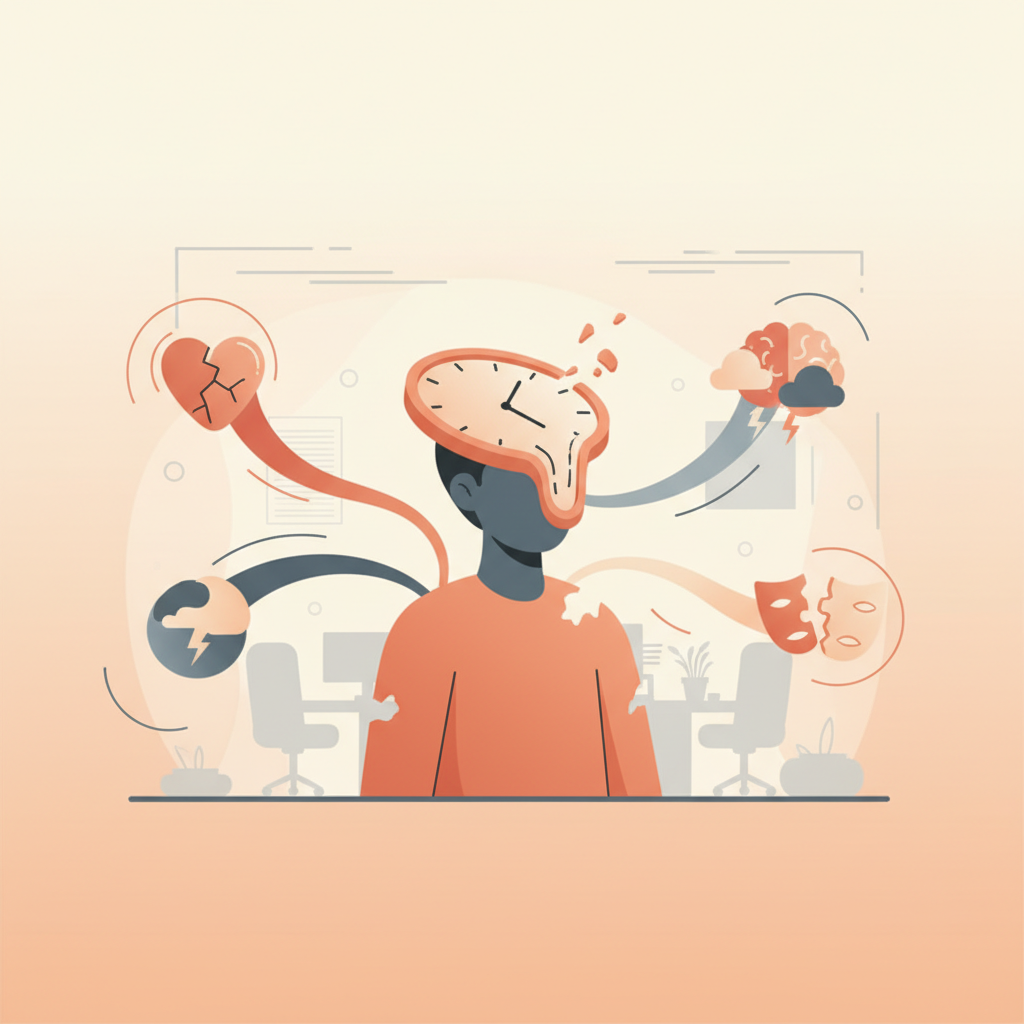
Burnout — or occupational exhaustion syndrome — is a state of physical, emotional, and mental depletion caused by prolonged exposure to chronic workplace stress. The World Health Organisation (WHO) included it in the International Classification of Diseases (ICD-11) in 2019, defining it as "a syndrome resulting from chronic workplace stress that has not been successfully managed." It is not a clinical diagnosis of mental illness, but an occupational phenomenon that, without intervention, can lead to depression, anxiety disorders, and cardiovascular disease. Psychologists Christina Maslach and Susan Jackson at the University of California developed the Maslach Burnout Inventory (MBI) in 1981, the most widely used instrument globally to measure this syndrome, establishing that burnout manifests in three interdependent dimensions.
Quick Overview: The Three Dimensions of Burnout (Maslach)
| Dimension |
Definition |
How It Feels |
| Emotional exhaustion |
Depletion of one's own emotional resources |
"I can't take any more, I feel empty" |
| Depersonalisation (cynicism) |
Distant, cold, or cynical attitude toward work and people |
"I don't care about anything, let them sort it out" |
| Reduced personal accomplishment |
Feeling of incompetence and lack of achievement |
"Nothing I do matters at all" |
When Does Tiredness Stop and Burnout Begin?
Everyone gets tired. Normal tiredness resolves with rest: a weekend, a holiday, a good night's sleep. Burnout does not. Burnout is exhaustion that persists even after resting, because it does not stem from the quantity of work, but from a dysfunctional relationship with work. It is the difference between "I am tired" and "I have lost myself in this job."
Christina Maslach explains it this way: burnout emerges when there is a chronic mismatch between the person and their work in at least one of six areas: workload, control, reward, community, fairness, and values. The more areas that are misaligned, the greater the risk.
What Are the Symptoms of Burnout?
Dimension 1: Emotional Exhaustion
- Chronic fatigue that does not improve with rest.
- Difficulty getting out of bed each morning.
- Feeling of having nothing left to give.
- Easy crying or emotional numbness.
- Physical symptoms: headaches, digestive problems, muscle tension.
Dimension 2: Depersonalisation (Cynicism)
- Treating clients, patients, or colleagues as objects rather than people.
- Constant sarcasm and irritability.
- Emotional disconnection from work.
- Feeling that "nothing matters."
Dimension 3: Reduced Personal Accomplishment
- Doubting your own professional competence.
- Feeling that your work has no impact.
- Comparing yourself unfavourably with colleagues.
- Loss of creativity and initiative.
What Causes Burnout? The Six Areas of Mismatch
Maslach and Leiter identified six organisational areas whose chronic imbalance predicts burnout:
- Workload: too much to do, too little time, insufficient resources. The most obvious trigger, but rarely the only one.
- Control: feeling you have no say over how you do your job, your schedule, or your priorities.
- Reward: not just salary — also recognition, appreciation, and a sense of progress.
- Community: isolation, toxic colleagues, lack of trust in the team.
- Fairness: perception of favouritism, unequal treatment, opaque decisions.
- Values: doing work that conflicts with your personal ethics or that you find meaningless.
When three or more areas are chronically misaligned, burnout becomes almost inevitable regardless of individual resilience.
How to Recover From Burnout
1. Acknowledge the Problem
Burnout thrives in denial. "I just need to push through," "everyone is stressed," "I'll rest when this project finishes." If you recognise the three Maslach dimensions in yourself, you are not merely stressed — you need to act.
2. Identify Which Areas Are Misaligned
Use the six-area framework above as a diagnostic tool. Which mismatches are driving your burnout? Workload alone? Or also lack of control, unfairness, or values conflict?
3. Negotiate Changes
Once you have identified the root causes, negotiate with your manager or organisation. "I need to adjust my workload this quarter" is more actionable than "I'm burnt out." If the organisation is unwilling to make structural changes, that is critical information for your next decision.
4. Protect Recovery Rituals
Sleep, exercise, nutrition, and social connection are not luxuries — they are the foundation of recovery. Treat them as non-negotiable appointments.
5. Professional Help
If symptoms are severe — persistent insomnia, inability to concentrate, emotional numbness, thoughts of self-harm — seek professional support immediately. Burnout left untreated can evolve into clinical depression.
6. Consider Whether the Job Is the Right Fit
Sometimes burnout is the body's way of telling you that this job, this company, or this career path is fundamentally misaligned with who you are. That is not failure — it is information.
At LetsShine.app, our AI tools can help you track your emotional patterns over time, identify early burnout signals, and articulate your needs before a difficult conversation with your manager. However, they are not a substitute for professional mental health support when burnout becomes severe.
Frequently Asked Questions
Is burnout the same as depression?
No. Burnout is an occupational phenomenon specifically linked to work. Depression is a clinical disorder that affects all areas of life. However, untreated burnout can evolve into depression. If your symptoms extend beyond work (loss of interest in everything, persistent sadness, hopelessness), consult a mental health professional.
Can you get burnout from a job you love?
Absolutely. Passion can mask the warning signs. People in caring professions (healthcare, teaching, social work) and creative fields are especially vulnerable because emotional investment is high and boundaries are blurred.
Is burnout just a modern buzzword?
No. The research dates back to the 1970s (Herbert Freudenberger) and 1980s (Maslach and Jackson). The WHO's inclusion in ICD-11 in 2019 confirms it as a recognised occupational phenomenon with measurable health consequences.
What is the difference between stress and burnout?
Stress is characterised by over-engagement — too much pressure, but you still feel things could improve. Burnout is characterised by disengagement — emptiness, hopelessness, feeling that nothing will change. Stress feels like drowning; burnout feels like you have already dried up.
How long does it take to recover from burnout?
It depends on severity and the changes you make. Mild burnout may improve in weeks with rest and boundary-setting. Severe burnout can take months to years, especially if you remain in the same environment without structural changes.
Your relationships can improve. Today.
Start free in 2 minutes. No credit card, no commitment. Just you, the people you care about, and an AI that helps you understand each other.
Start free now