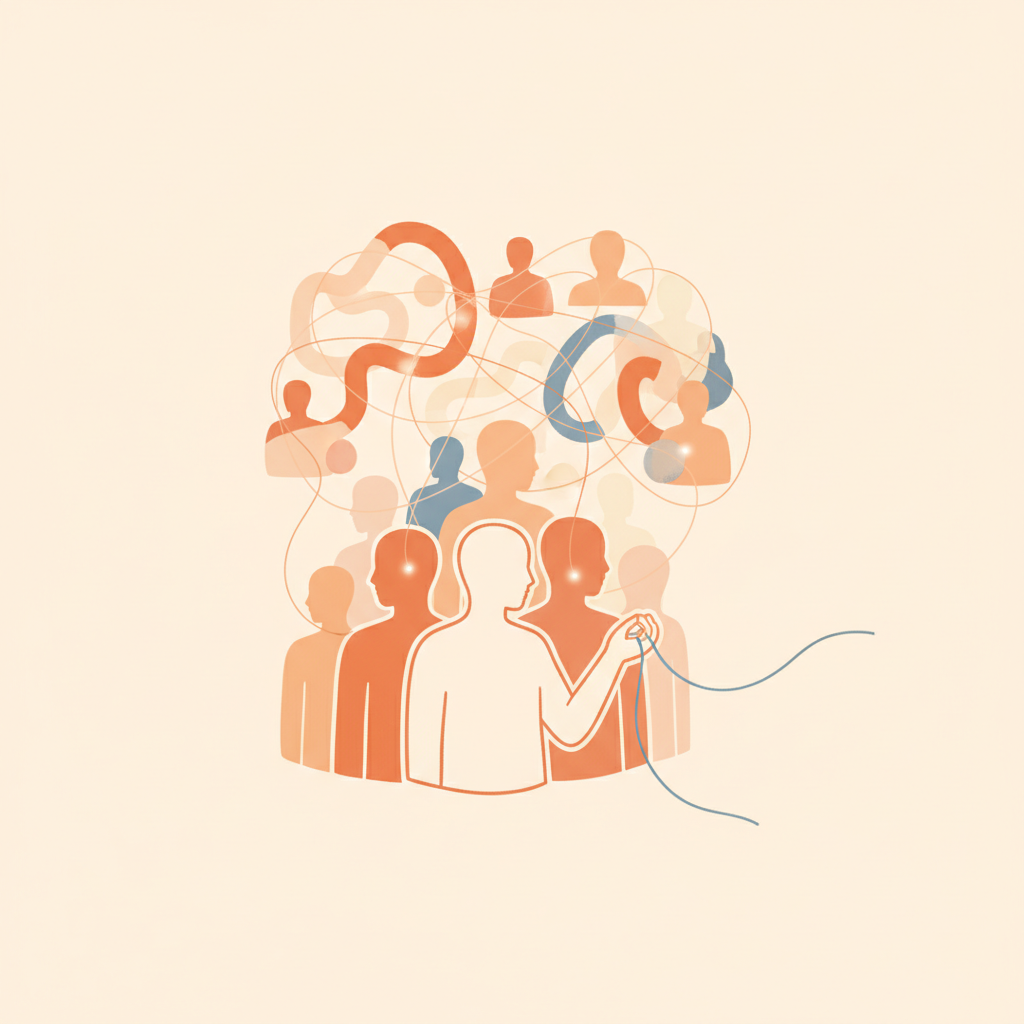
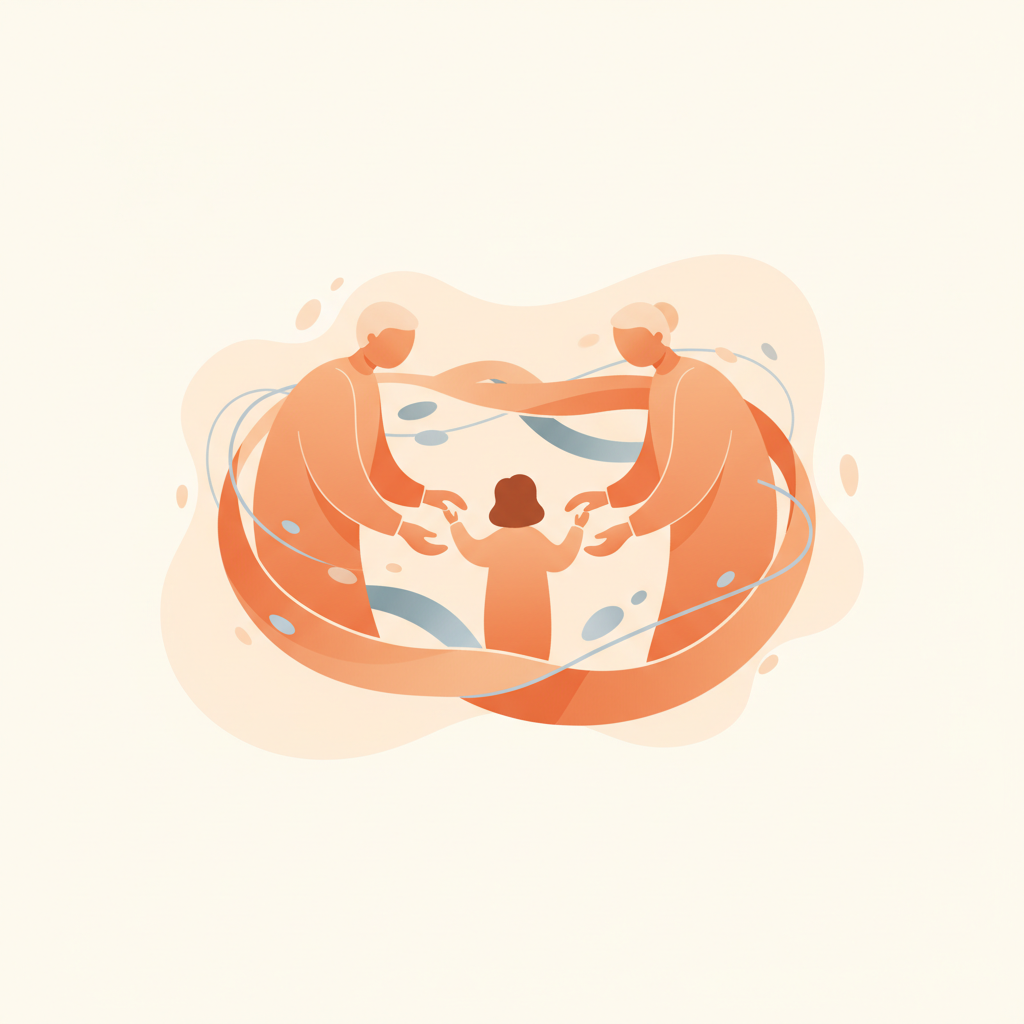
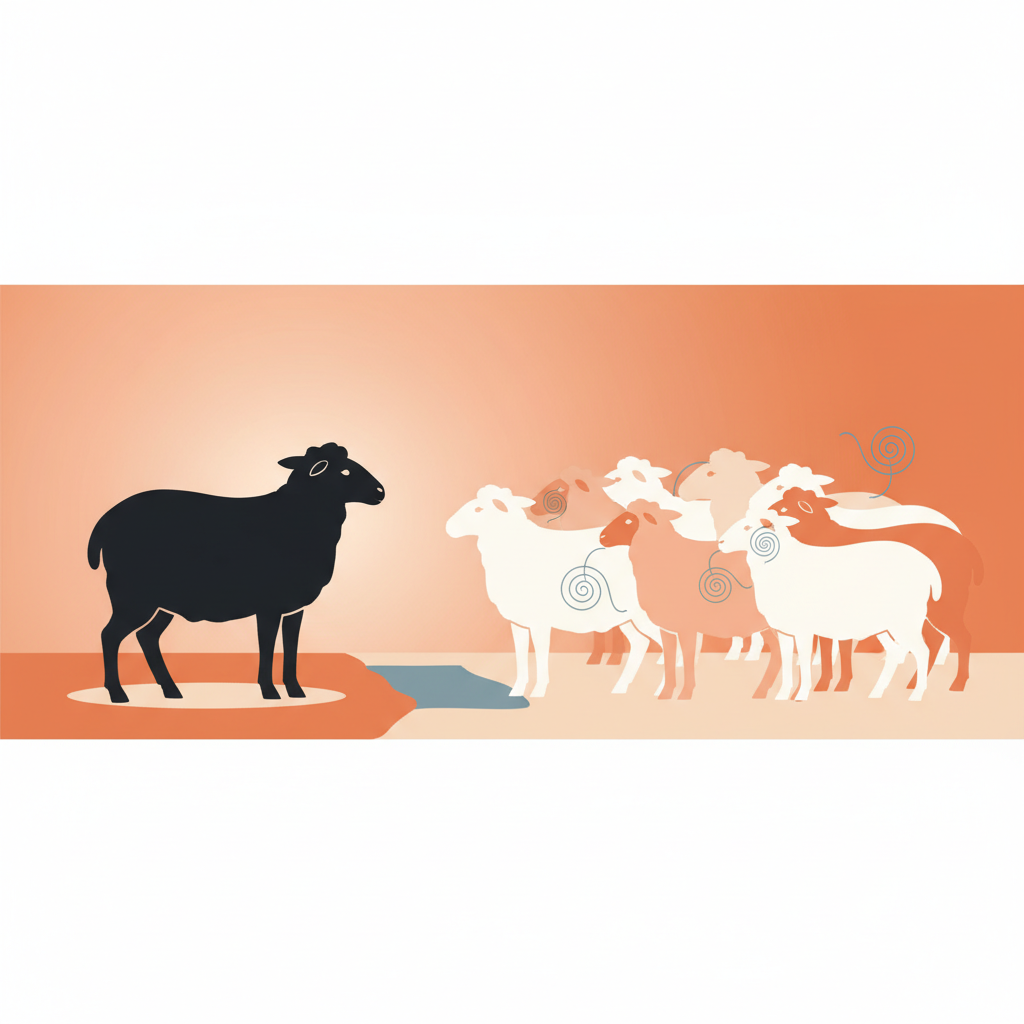
A family role is a stable emotional function that a family member performs implicitly to maintain the system's equilibrium. Murray Bowen's family systems theory demonstrated that every family operates like an organism: when one part becomes unbalanced, the others reorganize to compensate. These adjustments crystallize into roles — the responsible one, the funny one, the mediator, the invisible one, the rebel — that are rarely chosen consciously but determine each member's identity for decades. Virginia Satir, a pioneer of family therapy, identified that these roles do not reflect who each person truly is, but what the family needs them to be in order to survive emotionally.
| Family role |
Hidden function in the system |
Emotional cost to the person filling it |
| The responsible one / hero |
Project an image of normality to the outside world |
Anxiety, perfectionism, burnout |
| The funny one / mascot |
Relieve tension through humour |
Difficulty expressing real emotions |
| The invisible one / lost child |
Avoid generating more conflict |
Chronic loneliness, low self-esteem |
| The rebel / black sheep |
Divert attention from the real problem |
Labelled as "problematic," exclusion |
| The mediator / peacekeeper |
Prevent the family from exploding |
Suppression of personal needs |
| The caretaker |
Emotionally sustain the parents |
Parentification, loss of childhood |
How Are Roles Assigned in a Family?
Roles are assigned through a combination of birth order, the child's temperament and the parents' emotional needs. Murray Bowen observed that sibling position predisposes certain roles: the firstborn typically carries the weight of responsibility, while the youngest may be relegated to the part of "the baby" indefinitely. However, the decisive factor is what the parents unconsciously need resolved. If the mother carries untreated depression, one child is likely to assume the caretaker role long before they are old enough for it. If the father needs the family to appear perfect, a "hero" will emerge to manage the public image.
Salvador Minuchin, creator of structural family therapy, showed that roles harden when the boundaries between subsystems — parental, sibling, marital — become blurred. In families with diffuse boundaries, children end up performing functions that belong to adults, and adults behave as equals of their children. The result is a system in which nobody occupies their real place.
Why Do We Maintain These Roles in Adult Life?
Because the role becomes identity. If for twenty years you were "the responsible one," your self-esteem was built on the ability to solve other people's problems. Abandoning that part creates a terrifying void: if I am not the one who fixes everything, who am I? Bowen called this phenomenon "differentiation of self" and considered it the central axis of emotional maturity. A poorly differentiated person cannot separate their own emotions from those of the family system: they keep acting according to the learned script, even in completely different contexts such as romantic relationships or work.
The repetition is automatic. The responsible one chooses partners to look after. The funny one avoids emotional depth in all their relationships. The invisible one hides in every group they enter. It is not a lack of willpower: it is a neurological pattern carved by thousands of early family interactions.
Can You Change the Role You Were Assigned?
Yes, but the change provokes resistance. Virginia Satir described how, when a member tries to leave their role, the family reacts with pressure — direct or subtle — to push them back into place. "Since when do you say no?" or "You've become very selfish" are typical phrases directed at someone who begins to set boundaries. This resistance is not malice: it is the system protecting its equilibrium. Understanding this reduces guilt and allows the person to persist without breaking.
The process of change involves three phases. First, identify the role: what function do you serve in your family? Who would you be if you stopped serving it? Second, practise new behaviours: say no, ask for help, show vulnerability, stop mediating. Third, tolerate the system's discomfort as it readjusts. This process can take months. Tools like LetsShine.app facilitate this guided exploration, helping you see the patterns you cannot see alone.
What Happens When Two Roles Clash?
The most intense conflicts usually occur between the hero and the black sheep, because they represent opposite poles of the same system. The hero needs a "failure" to shine against; the black sheep needs a "perfect one" to rebel against. Minuchin showed that these roles are complementary: one cannot exist without the other. When the black sheep leaves home, another member often begins to cause problems, because the function they fulfilled is still necessary for the group's balance.
Another frequent conflict occurs between the mediator and the invisible one. The mediator wants everything to be discussed; the invisible one wants nothing to change. Both seek the same thing — to avoid pain — but their strategies are opposite, generating mutual frustration.
How Do Family Roles Affect Romantic Relationships?
Profoundly. Those who grew up as caretakers tend to choose dependent partners and to feel that love is synonymous with sacrifice. Those who were invisible may tolerate relationships where they are overlooked because that invisibility feels familiar. Those who were the funny one may use humour to dodge serious conversations, leaving their partner feeling that "we never really talk."
Bowen pointed out that the couple is the stage where family roles are performed most forcefully, because intimacy activates the same emotional circuits as the family of origin. The key is not to eliminate tendencies but to become aware of them. When you know you tend to over-caretake, you can ask yourself before acting: am I doing this out of love or out of habit?
What Part Does Therapy Play in Releasing Roles?
Minuchin's structural family therapy works directly with role reorganization within the session: the caretaker is asked to sit and observe, the invisible one is asked to speak, the mediator is asked to let the others resolve their conflict. Virginia Satir used the family sculpture technique: each member adopted a physical posture representing their role, and seeing it from the outside brought instant understanding.
Individual therapy also helps, but real change occurs when the entire family system participates, or at least when the person who is changing has a safe space to process the system's reaction. On LetsShine.app, the AI mediator can help identify which role you occupy and explore what happens when you begin to let go of it.
Frequently Asked Questions
Are all family roles negative?
No. Roles only become harmful when they are rigid and not freely chosen. Being responsible is fine if you can stop being responsible when you need to rest. The problem is the invisible obligation.
Can I hold more than one role in the family?
Yes, and in fact it is common. The caretaker and mediator often coincide in the same person. Roles can also shift over time: the rebellious teenager may become the responsible adult when the parents age.
Do parents also have assigned roles?
Absolutely. Parents carry the roles from their own family of origin. A father who was the invisible child may overcompensate by demanding constant attention from his children, or may repeat the pattern and be emotionally absent.
Is it possible for a family to function without fixed roles?
Virginia Satir defined the healthy family as one where roles are flexible: each member can be serious, funny, vulnerable and strong depending on the moment, without the system punishing them for departing from the script.
How do I know which role I was assigned if nobody said it explicitly?
Ask yourself: what do they expect of me when there is a crisis? What reaction do I provoke if I behave differently from usual? The answers reveal your function in the system.
Your relationships can improve. Today.
Start free in 2 minutes. No credit card, no commitment. Just you, the people you care about, and an AI that helps you understand each other.
Start free now