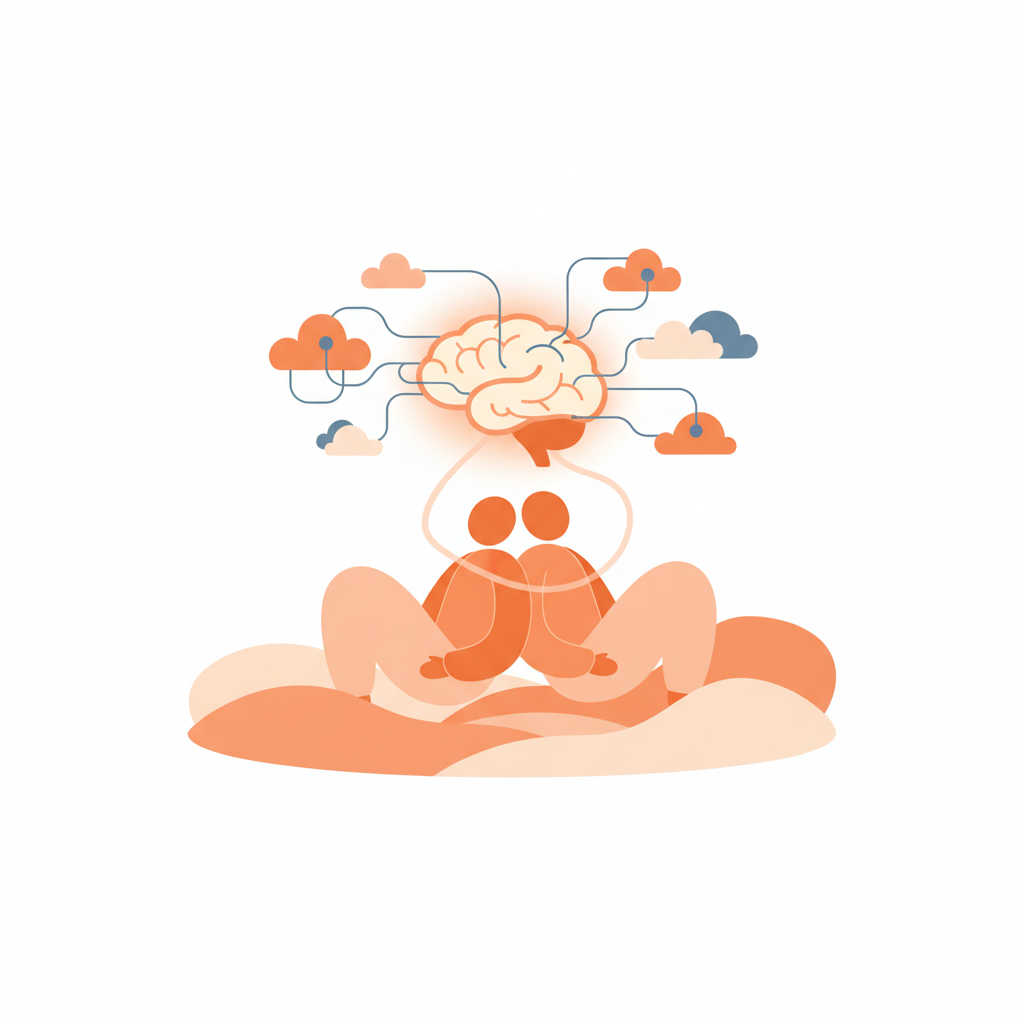
Understanding another person is the capacity to temporarily suspend your own frame of reference -- beliefs, needs, personal history -- to perceive the other's experience from their perspective, without needing to validate or share it. It is not agreeing. It is not yielding. It is not admitting they are right. It is something deeper and more difficult: it is releasing the need to be right in order to access something more valuable than dialectical victory. The contemplative tradition describes it as an act of inner emptying: to understand the other, you first need to empty your mind of the story you have already told yourself about them. Contemporary psychology confirms this from neuroscience: the brain areas associated with empathy (anterior insula, anterior cingulate cortex) activate when we suspend judgement, and deactivate when we enter defensive mode. Understanding and defence occupy the same neural territory: you cannot do both at the same time.
This idea -- that understanding gives more peace than being right -- is not a pretty slogan. It is an empirical observation that contemplative philosophy, relational psychology, and neuroscience converge in confirming. And yet it is one of the hardest truths to practise.
Summary: Being Right vs. Understanding
| Being Right |
Understanding the Other |
| Feeds the ego |
Feeds the relationship |
| Creates winner and loser |
Creates encounter |
| Closes the conversation |
Opens the conversation |
| Produces temporary victory |
Produces lasting peace |
| Based on your own logic |
Based on empathy |
| Requires the other to be wrong |
Does not require the other to change |
Why Do We Need So Desperately to Be Right?
The need to be right is not an intellectual whim: it is a survival strategy of the ego. The ego -- the image we hold of ourselves -- is built upon the certainty that our way of seeing the world is the correct one. When someone questions it, the ego perceives an existential threat. It is not that being contradicted "annoys" us: our very sense of identity trembles.
Evolutionary psychology offers a complementary explanation. In ancestral environments, being right about a threat ("Is that noise a predator?") meant survival. The human brain evolved to seek confirmation of its beliefs -- what psychologists call confirmation bias -- because doubting a potentially vital belief was more dangerous than clinging to it.
The problem is that this mechanism, useful for detecting predators, is devastating when applied to intimate relationships. In an argument about who said what or who is to blame, the brain activates the same responses it would before a lion: cortisol, adrenaline, elevated heart rate, muscle tension. The body does not distinguish between a physical threat and a threat to our beliefs. For the nervous system, "your partner tells you you're wrong" and "a predator stalks you" produce the same physiological cascade.
What Happens When You Choose Understanding Over Winning?
The contemplative tradition describes a process we might call "the sequence of peace": silence -> self-knowledge -> acceptance -> compassion -> understanding -> peace. Each step is a consequence of the previous one. Without inner silence, self-knowledge is impossible. Without self-knowledge, you cannot accept what you are. Without self-acceptance, you cannot have compassion for the other. Without compassion, you cannot understand. And without understanding, there is no peace -- only truce.
When you choose to understand instead of win, several phenomena occur simultaneously:
- The threat response deactivates: by ceasing to defend your position, your body exits the state of alert. Cortisol drops. Heart rate normalizes. You can think clearly.
- The other lowers their guard: the other person's defensiveness is, in large part, a response to your attack. When you stop attacking (even subtly, such as proving you are right), the other stops defending. And when they stop defending, they can show you what they truly feel -- which is almost never what it appears.
- You access new information: while defending your position, you can only see data that confirms it (confirmation bias). When you release it, you can perceive the other's perspective -- and often discover that their "error" has a logic you had not considered.
- You experience peace: not the peace of the winner who feels calm because they "were right," but the peace of the one who understands and discovers that being right was an obstacle to connection.
Is Understanding the Same as Agreeing?
No. This confusion is the primary barrier to understanding. Many people resist understanding the other because they believe it implies validating, accepting, or yielding. But understanding is a cognitive and empathic act, not an act of surrender.
You can understand why your partner acts the way they do without approving their conduct. You can understand the reasons for their anger without accepting how they express it. You can understand their perspective and still disagree. Understanding does not eliminate disagreement: it transforms it. You move from "you're wrong and I'm going to prove it" to "I see why you see things that way, I see them differently, and we can look for common ground."
Marshall Rosenberg put it precisely: "Empathy is a respectful understanding of what others are experiencing. Instead of offering empathy, we tend to give advice, to comfort, or to explain our own position."
What Does Emotional Archaeology Have to Do with Understanding?
Emotional archaeology -- a central concept at LetsShine.app -- consists of digging into the deep layers of our emotional reactions to discover what lies beneath. When your partner says something that infuriates you, the surface reaction is obvious: anger, defensiveness, counterattack. But beneath that reaction lie older layers: fear of abandonment, need for control, childhood wounds, patterns learned in the family of origin.
Understanding the other begins with understanding yourself. If you do not grasp why you react the way you react, you interpret your reactions as "the truth" and project them onto the other. Self-knowledge -- knowing that your anger is not solely about what your partner said, but about what their comment activated in you -- is the first step toward releasing the need to be right.
Those who know themselves deeply discover that many of their "reasons" are not logical arguments but emotional defences. And when you see that, the need to win the argument loses its force: why fight to defend a position born of fear?
How to Practise Understanding in a Real Argument
Step 1: Stop
Before responding, pause for three seconds. Not to think of your reply, but to register what is happening in your body. Is there tension in your chest? Is your pulse quickening? Those signals indicate you are in defence mode. Recognizing it is already an act of self-knowledge.
Step 2: Ask Instead of Assert
Replace "that's not true" with "can you help me understand what you mean?" Replace "you're overreacting" with "how does this make you feel?" Questions open; assertions close.
Step 3: Reflect What You Heard
Before giving your opinion, restate in your own words what you believe the other said: "If I understand correctly, what you're feeling is..." This step -- validation before response -- is, according to Gottman, the most powerful predictor of constructive conflict resolution.
Step 4: Release the Verdict
You do not need the conversation to end with a ruling on who was right. The conversation can end with "I understand better how you feel now" without anyone having won or lost. That is peace, not defeat.
What Does Neuroscience Say About Understanding and Peace?
Tania Singer at the Max Planck Institute has demonstrated that empathy and compassion activate distinct brain circuits. Empathy activates pain areas (anterior insula): when you understand the other's suffering, your brain partially experiences it. Compassion activates reward areas (orbitofrontal cortex, ventral striatum): when you act to alleviate that suffering, you experience well-being. Understanding is the bridge between both circuits: it allows you to move from shared pain to shared relief.
The practical implication for relationships is profound: when you choose to understand your partner instead of defeat them, you are not "being weak." You are activating the neural circuit of compassion, which produces authentic well-being -- not the fleeting satisfaction of winning an argument, but a deep and lasting sense of peace.
Frequently Asked Questions
Does understanding my partner mean I have to agree with everything they say?
Not at all. Understanding is a perceptual act, not an act of submission. You can fully understand why your partner feels the way they do, acknowledge their experience as valid, and still hold a different opinion. The key difference is that your disagreement comes from a place of connection rather than confrontation.
What if my partner takes advantage of my understanding and never tries to understand me?
Understanding is not a transactional exchange. However, healthy relationships require reciprocity. If you consistently feel unheard, that is important information. You can express your need for understanding clearly and compassionately: "I've been working on understanding your perspective, and I need you to try the same for me."
Is there a limit to understanding? What about abusive behaviour?
Yes. Understanding someone's motivations does not mean tolerating harmful behaviour. You can understand that a person acts out of their own pain while simultaneously establishing that their behaviour is unacceptable. Understanding is not permission. Boundaries and understanding coexist.
How do I practise understanding when I am very angry?
You do not practise it in the heat of the moment -- that is almost impossible. You practise it in advance, through regular mindfulness and self-reflection, so that when anger arises, you have built the neural pathways that allow you to pause before reacting. If you are too angry, say so honestly: "I need a few minutes before I can listen properly."
Can understanding really replace the need to be right?
Over time, yes. As you experience the peace that understanding brings -- repeatedly, consistently -- the reward value of "being right" diminishes. Your brain learns that connection feels better than victory. It is not instant, but it is reliable.