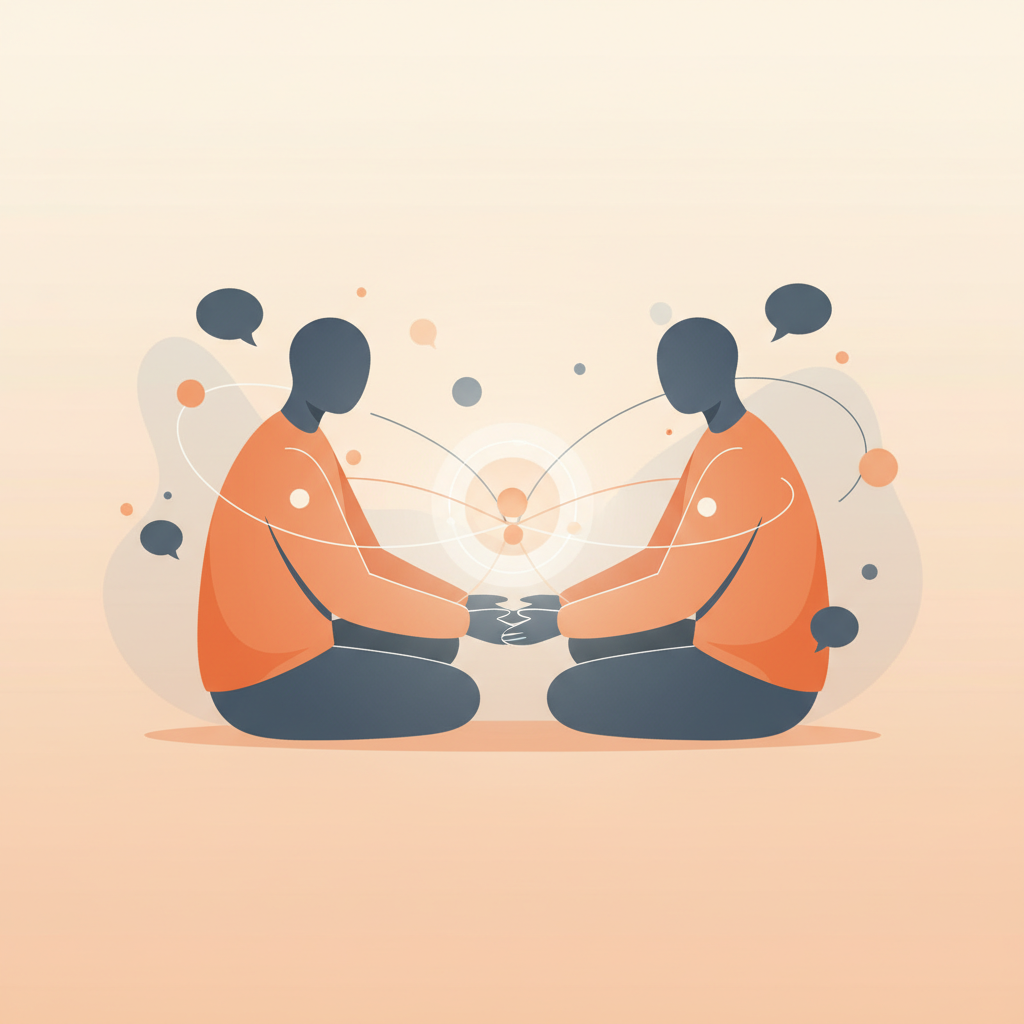
Relational consciousness is the lived awareness that you exist not as an isolated individual but as a node in a web of relationships that continuously shape who you are, how you feel, and what you are capable of. It is the recognition that "I" is always, already, "we" -- that your nervous system is designed for co-regulation, your brain for interpersonal resonance, and your deepest well-being for mutual care. This is not a philosophical abstraction. It is a biological fact that interpersonal neurobiology, attachment science, and contemplative traditions converge in affirming.
Dan Siegel, clinical professor at UCLA and the architect of interpersonal neurobiology, coined the term "MWe" -- a play on "me" and "we" -- to describe the integrated awareness that honours both individual identity and relational interdependence. Relational consciousness is MWe in practice: the ability to hold your own needs, feelings, and perspectives while simultaneously attuning to those of the people you are in relationship with.
Why Relational Consciousness Matters Now
We live in a cultural moment that simultaneously glorifies individualism and laments loneliness. Social media offers the illusion of connection while eroding its substance. Self-help culture encourages "self-sufficiency" and "not needing anyone," messages that, while intended to promote strength, often produce isolation and shame. The loneliness epidemic documented by researchers like Julianne Holt-Lunstad -- who found that social isolation is as lethal as smoking 15 cigarettes a day -- is not simply a lack of social contact. It is a deficit of relational consciousness: the widespread loss of the awareness that we need each other, not as a weakness, but as the most fundamental fact of our biology.
Relational consciousness is the antidote. It is not a return to enmeshment or codependence. It is the mature recognition that autonomy and connection are not opposites but partners -- that you can be fully yourself and deeply connected at the same time. In fact, the research consistently shows that the most autonomous individuals are also the most securely attached. Freedom and belonging grow together.
The Architecture of Relational Consciousness
Awareness of Self
You cannot be relationally conscious if you are unconscious of yourself. Self-awareness -- knowing your emotions, patterns, triggers, and needs in real time -- is the foundation. This is the inner work: meditation, journaling, therapy, emotional archaeology.
Awareness of Other
Beyond self-awareness lies the capacity to perceive the other's inner world without projecting your own. This is empathy in its deepest form: not "I imagine how I would feel in your situation" but "I sense how you feel in your situation." The distinction is crucial. The first keeps you at the centre; the second decentres you.
Awareness of the Space Between
This is the most subtle and most transformative dimension. Between any two people exists a relational field -- an atmosphere created by the quality of attention, care, and honesty that flows between them. You can feel this field: some relationships feel nourishing, others draining, others electric. Relational consciousness includes awareness of this field and the recognition that both people contribute to it constantly.
Awareness of Patterns
Every relationship has recurring patterns -- cycles of approach and withdrawal, criticism and defence, openness and closure. Relational consciousness includes the ability to observe these patterns as they happen, rather than only in hindsight. "We're doing the thing again" is a statement of relational consciousness that can short-circuit a destructive cycle.
What the Science Says
Interpersonal neurobiology has demonstrated that our nervous systems are not self-contained. They are open-loop systems that regulate each other through what researchers call interpersonal resonance or co-regulation. When you sit next to a calm person, your own nervous system tends to calm. When you argue with an agitated person, your agitation increases. This is not weakness; it is the design specification of the human brain.
Stephen Porges's Polyvagal Theory describes how the autonomic nervous system has three states: social engagement (ventral vagal), fight-or-flight (sympathetic), and shutdown (dorsal vagal). Relational consciousness includes the awareness of which state you and your partner are in at any given moment. A person in fight-or-flight cannot listen. A person in shutdown cannot connect. Knowing this -- and responding accordingly -- is a form of relational wisdom that prevents enormous amounts of unnecessary suffering.
Developing Relational Consciousness: Practical Steps
Practice System Awareness
Begin to think of your relationship not as "me + you" but as a system with its own dynamics, patterns, and emergent properties. When conflict arises, ask: "What is happening in our system right now?" rather than "What is wrong with you?"
Track Your Nervous System State
Several times a day, check in: "Am I in social engagement (calm, open, connected), fight-or-flight (tense, reactive, defensive), or shutdown (numb, withdrawn, collapsed)?" This self-monitoring is the first step toward co-regulation.
Create Relational Rituals
Rituals anchor relational consciousness in daily life. A morning greeting practice, an evening check-in, a weekly "state of the union" conversation -- these structures create containers for conscious connection that prevent the drift into autopilot.
Practise Repair Intentionally
Rupture is inevitable in relationships. Repair is optional. Relational consciousness prioritises repair: after a disconnect, taking the initiative to say "I think we lost each other back there. Can we try again?" This willingness to repair is, according to Ed Tronick's research on infant-caregiver relationships, the single most important relational capacity.
Relational Consciousness and Technology
At LetsShine.app, technology is employed in service of relational consciousness rather than as a substitute for it. The AI mediator does not tell you what to feel or what to say. It reflects your relational patterns, highlights moments of disconnection, and creates structured opportunities for the kind of conscious conversation that busy, stressed, modern couples rarely make time for.
The paradox of using technology to cultivate human connection is not lost on us. But the same could be said of a book, a therapy session, or a guided meditation recording. The tool is not the practice; the tool supports the practice. The practice is always, ultimately, between two people who have chosen to show up for each other with full presence.
Frequently Asked Questions
Is relational consciousness the same as being "in tune" with my partner?
It includes that, but goes further. Being in tune is an emotional attunement to one person. Relational consciousness is a broader awareness that encompasses your own inner state, the other's inner state, the relational field between you, and the patterns that shape your interactions. It is attunement plus awareness plus intentionality.
Can one person develop relational consciousness, or must both partners do it?
One person can develop it, and the relationship will benefit. However, the deepest transformation occurs when both partners share a commitment to relational consciousness. When both people are watching the pattern, the pattern changes.
How is relational consciousness different from codependence?
Codependence involves losing yourself in the other's experience. Relational consciousness involves holding yourself and the other simultaneously. In codependence, boundaries dissolve. In relational consciousness, boundaries are honoured as essential structures that protect both individuality and connection.
Does relational consciousness require meditation practice?
Meditation is the most efficient training ground for the awareness skills that relational consciousness requires. However, it is not the only path. Therapy, reflective journaling, honest conversation, and intentional relational practices can all develop these capacities.
Is relational consciousness relevant for non-romantic relationships?
Absolutely. Every significant relationship -- parent-child, friendship, professional collaboration -- benefits from greater awareness. The principles are universal; the application varies by context.