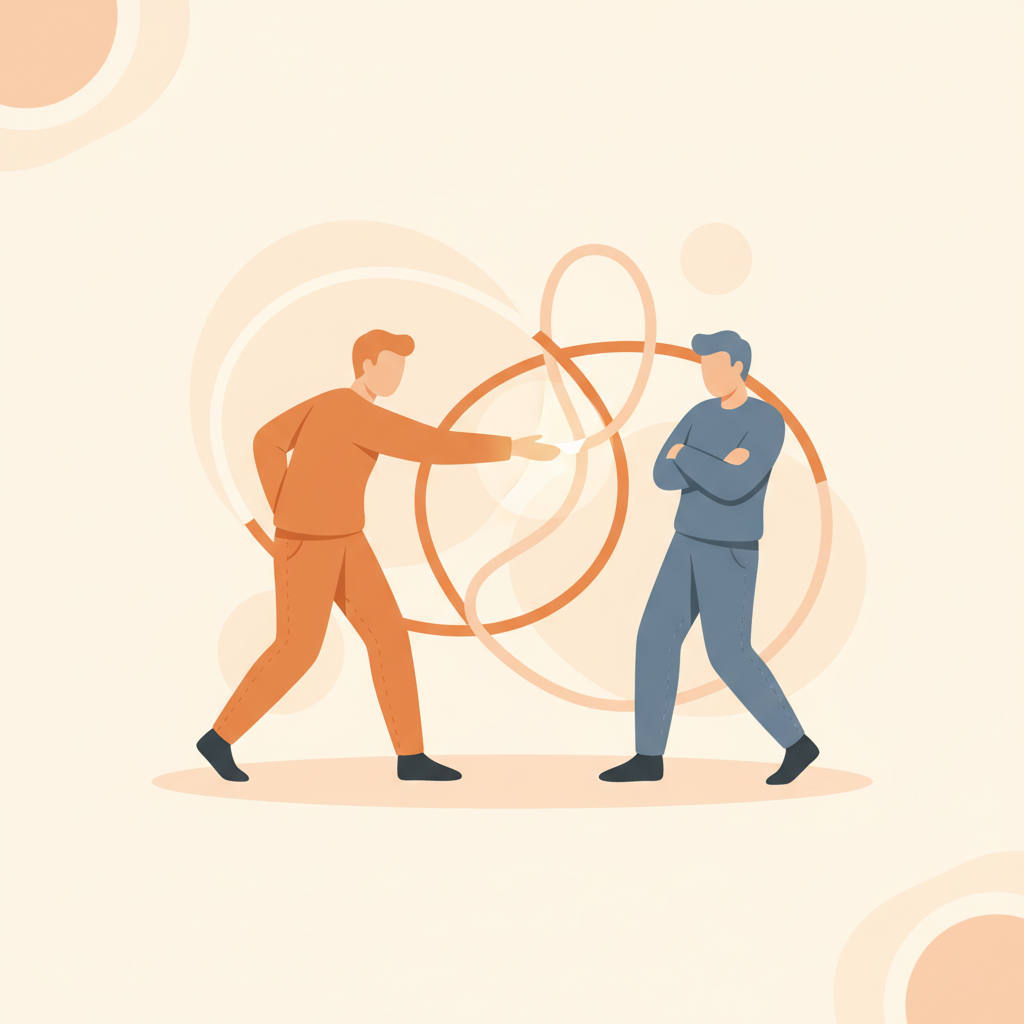
The pursuer-withdrawer cycle (pursue-withdraw pattern) is the most frequent negative interaction pattern in couples in conflict. Identified and studied in depth by Sue Johnson, creator of Emotionally Focused Therapy (EFT), this cycle describes a repetitive dynamic in which one partner — the pursuer — seeks connection, closeness, and emotional response through complaints, criticism, or insistence, while the other — the withdrawer — retreats, shuts down emotionally, or becomes coldly logical as a self-protection strategy. The more one pursues, the more the other withdraws. The more one withdraws, the more the other pursues. It is a self-reinforcing spiral that, without intervention, can drain a relationship into an emotional desert.
| Role |
Visible behaviour |
Hidden primary emotion |
Underlying attachment message |
| Pursuer |
Criticises, complains, demands, cries, interrogates |
Fear of abandonment, loneliness |
"Do I matter to you? Are you there for me?" |
| Withdrawer |
Shuts down, retreats, rationalises, minimises |
Fear of inadequacy, of not being enough |
"Am I valuable to you? Do you accept me?" |
Why Do We Enter the Pursuer-Withdrawer Cycle?
Sue Johnson explains it through John Bowlby's attachment theory: when we sense that our primary attachment figure (our partner) is not emotionally available, our alarm system activates. How we respond to that alarm depends on our attachment style.
People with anxious attachment tend to amplify their signals of need: they talk more, ask more, demand more, complain more. It is their way of saying "please don't leave, I need to know you are here." They become pursuers.
People with avoidant attachment tend to deactivate their emotions: they withdraw, become practical, minimise the importance of the conflict, and take refuge in work or their phone. It is their way of saying "if I show my emotions, I will get hurt; better to protect myself." They become withdrawers.
Gottman, from his observational framework, quantified this pattern: in 80 % of heterosexual couples in conflict, the woman initially adopts the pursuer role and the man the withdrawer role, though these roles can reverse and are not determined by gender.
How Does This Cycle Show Up in Everyday Life?
Typical scenario: Sarah comes home and asks Tom: "How was your day?" Tom replies: "Fine, nothing special." Sarah insists: "But tell me something — you never tell me anything." Tom feels pressured and answers: "I don't have anything special to say, I don't know what you want from me." Frustrated, Sarah raises her voice: "Talking to you is like talking to a wall." Tom gets up and goes to look at his phone in the other room. Sarah stays alone in the kitchen, confirming what she already felt: "He doesn't care about me."
Harville Hendrix, creator of Imago Therapy, adds a layer: "What Sarah experiences as Tom's indifference is actually an echo of an older wound." For Hendrix, we choose partners unconsciously to heal childhood wounds. Sarah may have grown up with an emotionally absent father; Tom may have grown up with an invasive mother. Both are repeating, without knowing it, the patterns of their family history.
Why Is It So Hard to Break Free?
Because both are right from their own perspective. The pursuer has a legitimate need for connection. The withdrawer has a legitimate need for space. The problem is not with the needs but with the strategies: pursuit generates withdrawal, and withdrawal generates more pursuit.
Esther Perel describes this paradox with precision: "The pursuer does not pursue because they are controlling; they pursue because they are hungry for connection. The withdrawer does not retreat because they do not care; they retreat because they feel overwhelmed. Both are suffering, but their suffering is invisible to the other."
Gary Chapman connects this to his Love Languages theory: often, the pursuer needs words of affirmation or quality time, while the withdrawer expresses love through acts of service or occasional physical touch. Each speaks a language the other does not understand.
How Do You Break the Pursuer-Withdrawer Cycle?
Step 1: Name the Dance
Sue Johnson insists that the first step is for both partners to recognise the cycle as a shared pattern, not individual blame. It is not "you are too demanding" or "you are too cold." It is: "We are stuck in a dance where the more I ask, the more you pull away, and the more you pull away, the more I ask."
Step 2: Access the Primary Emotions
Beneath the pursuit lies fear and loneliness. Beneath the withdrawal lies fear and shame. The pursuer needs to say: "When you pull away, I feel like I don't matter to you, and that terrifies me." The withdrawer needs to say: "When you demand, I feel like I am not enough for you, and that paralyses me."
Step 3: Create New Interactions
Gottman proposes that the withdrawer practise "turning toward" bids for connection, even small ones. And that the pursuer practise making requests without criticism, using the formula: "I feel ___ when ___. I need ___."
Step 4: The Change Event (EFT)
In Emotionally Focused Therapy, the transformative moment occurs when the withdrawer — for the first time — shares their vulnerability, and the pursuer — instead of responding with more demands — listens and holds space. Johnson calls it the "Hold Me Tight moment": the instant when both meet in shared vulnerability.
What Happens When Both Partners Are Withdrawers?
Sue Johnson identifies a second, less visible but equally destructive pattern: mutual withdrawal. Both partners distance themselves, avoid conflict, and the relationship becomes a polite but empty coexistence. Gottman notes that these couples may have an apparently acceptable positive-to-negative ratio but lack emotional depth. "They do not argue — but they do not connect either."
What About When Both Are Pursuers?
The attack-attack cycle is more explosive but less common. Both partners escalate simultaneously: shouting, reproaches, slammed doors. Perel notes that these couples have plenty of passion but lack emotional regulation. Gottman identifies them by the massive presence of the Four Horsemen.
Frequently Asked Questions
Does the pursuer-withdrawer cycle mean my relationship is doomed?
No. It is the most common conflict pattern treated in couples therapy. Sue Johnson reports 70-75 % recovery rates with EFT, even in couples who have been stuck in this cycle for decades.
Are the pursuer and withdrawer roles fixed?
Not necessarily. They can vary depending on the topic. A person might pursue on emotional matters and withdraw on sexual ones, for example. What matters is recognising the pattern, not labelling the person.
Can AI help identify this cycle?
Yes. On LetsShine.app, the AI analyses the couple's communication patterns and can identify pursuer-withdrawer dynamics, helping to name the cycle and suggesting ways to break it based on Johnson's and Gottman's principles.
What book do you recommend to understand this cycle?
Hold Me Tight by Sue Johnson is the most accessible reference. It explains the cycle with real cases and proposes seven conversations to transform the couple's dance.
Does meditation or mindfulness help with the pursuer-withdrawer cycle?
Yes, as a complementary tool. Meditation helps the pursuer tolerate uncertainty without reacting, and the withdrawer connect with the emotions they habitually avoid. It does not replace relational work, but it facilitates it.