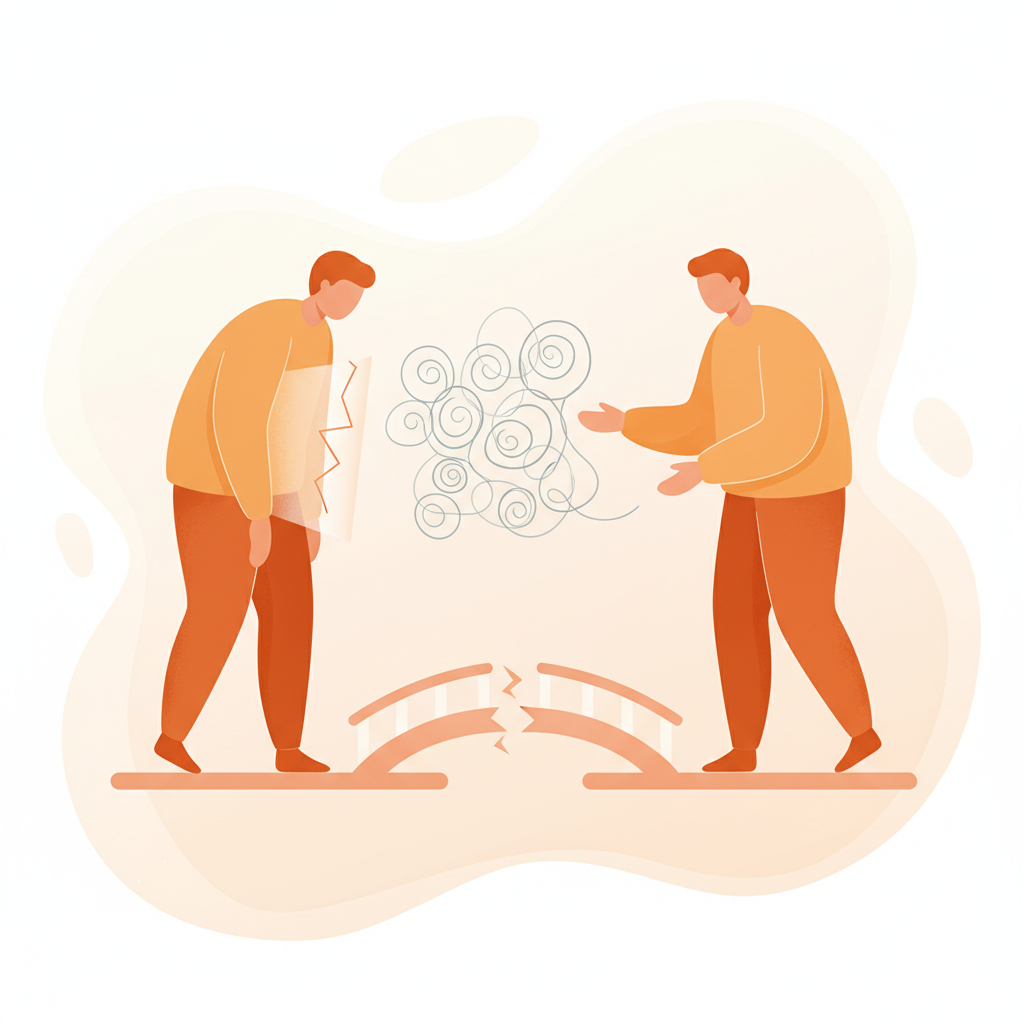
Passive-aggressive communication is a pattern of indirect hostility in which a person avoids open conflict but expresses their anger, resentment, or frustration through covert behaviours: sarcasm, the silent treatment, feigned compliance, deliberate procrastination, or subtle sabotage. The term was first used clinically by the US Army during World War II to describe soldiers who resisted orders indirectly. In relationships, passive aggression is especially damaging because it is difficult to confront — the sender can always deny their intention — and it corrodes trust like a slow acid that deteriorates the bond without leaving visible wounds.
Signs of Passive-Aggressive Communication in a Relationship
| Sign |
Example |
What It Hides |
| The silent treatment |
Not speaking to you for hours or days |
Unexpressed anger |
| Systematic sarcasm |
"Sure, because you're always right..." |
Accumulated resentment |
| Feigned compliance |
"Fine, I'll do it" (and doesn't, or does it poorly) |
Resistance to the request |
| Deliberate procrastination |
Indefinitely postponing something the other needs |
Passive control |
| Strategic victimhood |
"It's fine — I'm used to not mattering to you" |
Emotional manipulation |
| Poisoned compliments |
"How nice that you cooked, for once" |
Disguised reproach |
| Selective forgetfulness |
"I forgot" (only what you ask of them) |
Unconscious hostility |
Why Does a Person Communicate Passive-Aggressively?
Marshall Rosenberg would explain it like this: passive aggression appears when a person has a legitimate need (to be heard, respected, valued) but believes — consciously or unconsciously — that expressing it directly is dangerous. That perceived danger usually originates in childhood:
- Families where anger was forbidden: Virginia Satir documented that in families where "being angry" was punished or ignored, children learned to express their rage indirectly. Satir's placater is the precursor of the passive-aggressive adult.
- Passive-aggressive parental models: if one of your parents used silence as punishment or sarcasm as a weapon, you have likely inherited that pattern.
- Experiences of invalidation: when someone learns that expressing needs directly leads to rejection, humiliation, or conflict, they develop indirect ways to communicate what they feel.
Thomas Gordon pointed out that passive aggression is the predictable result of an environment where I-messages are not safe: if saying "I feel frustrated" leads to punishment, the person learns to express frustration in ways that cannot be confronted.
How to Respond Without Escalating
What Does NOT Work
- Returning the passive aggression: responding with sarcasm to sarcasm creates a spiral.
- Ignoring the pattern: acting as if nothing is happening reinforces the behaviour.
- Exploding: an emotional outburst confirms to the passive-aggressive person that expressing things directly is dangerous.
- Accusing: "You're being passive-aggressive" generates denial and counter-attack.
What DOES Work
1. Name what you observe, not what you interpret.
Instead of "you're being passive-aggressive" (interpretation), try: "I notice you haven't spoken to me for two hours since our conversation, and I'm concerned" (observation). Rosenberg would say: describe the behaviour, not the character.
2. Ask about the need.
"Is there something that bothered you that you haven't told me?" This question, asked in a genuine (not accusatory) tone, invites the other person to move from the indirect to the direct. Thich Nhat Hanh taught that deep listening creates the safe space a passive-aggressive person needs to open up.
3. Offer emotional safety.
"I'd rather you tell me you're angry than not speak to me. Your anger won't destroy me." This sentence disarms because it directly addresses the fear that sustains passive aggression: the fear that direct expression of conflict will destroy the relationship.
4. Set boundaries with empathy.
"I understand something is bothering you, and I want to hear it. What I can't do is guess what it is. Can we talk about it?" Gordon called this the constructive limit: you do not permit the harmful behaviour, but you offer an alternative.
What If I Am the Passive-Aggressive Person?
Recognising it is the hardest and most valuable step. Internal signs:
- You say "nothing's wrong" when something is.
- You feel resentment but do not express it.
- You do things "by accident" that you know annoy the other person.
- You use humour to say truths you dare not say seriously.
Rosenberg proposed an exercise: when you notice you are about to respond with sarcasm or silence, stop and ask yourself "what do I actually need?" Then try to express it using the NVC structure: observation, feeling, need, request. The first few times will be uncomfortable. With practice, it becomes liberation.
Can Passive Aggression Be Unlearned?
It is not a disease but a learned pattern. And like everything learned, it can be unlearned. The process requires:
- Awareness: identifying the pattern when it occurs.
- Safety: creating an environment where direct expression is safe.
- Practice: gradually replacing indirect responses with I-messages.
- Patience: change is not linear; there will be setbacks.
At LetsShine.app, the AI detects patterns of indirect communication and offers real-time reframings, helping the person express what they feel directly and helping the receiver respond with empathy instead of defence.
Frequently Asked Questions
What is passive-aggressive communication in a relationship?
It is a pattern of indirect expression of anger or resentment through sarcasm, the silent treatment, deliberate procrastination, feigned compliance, or selective forgetfulness. The person avoids open conflict but manifests hostility in ways that are hard to confront.
How do I tell the difference between passive aggression and a bad day?
A bad day is occasional; passive aggression is a repetitive pattern. If sarcasm, the silent treatment, or feigned compliance appear repeatedly in similar situations, it is probably a learned pattern rather than an isolated reaction.
Why does my partner deny being passive-aggressive when I point it out?
Because denial is part of the pattern. Virginia Satir explained that the passive-aggressive person may genuinely be unaware of their behaviour, since they learned it as a survival mechanism in childhood. That is why describing the specific behaviour works better than labelling the person.
Should I tolerate passive-aggressive communication?
No. Tolerating it is not the same as understanding it. You can understand the origin of the pattern and at the same time set a clear boundary: "I need you to tell me directly what bothers you. I'm ready to listen." Thomas Gordon taught that empathy and boundaries do not contradict each other — they complement each other.
Does couples therapy help with passive aggression?
Yes, especially if the passive-aggressive person has difficulty recognising the pattern. A therapist trained in systemic therapy or NVC can create the safe space the person needs to explore the fears that sustain indirect behaviour and practise more direct forms of expression.
Your relationships can improve. Today.
Start free in 2 minutes. No credit card, no commitment. Just you, the people you care about, and an AI that helps you understand each other.
Start free now