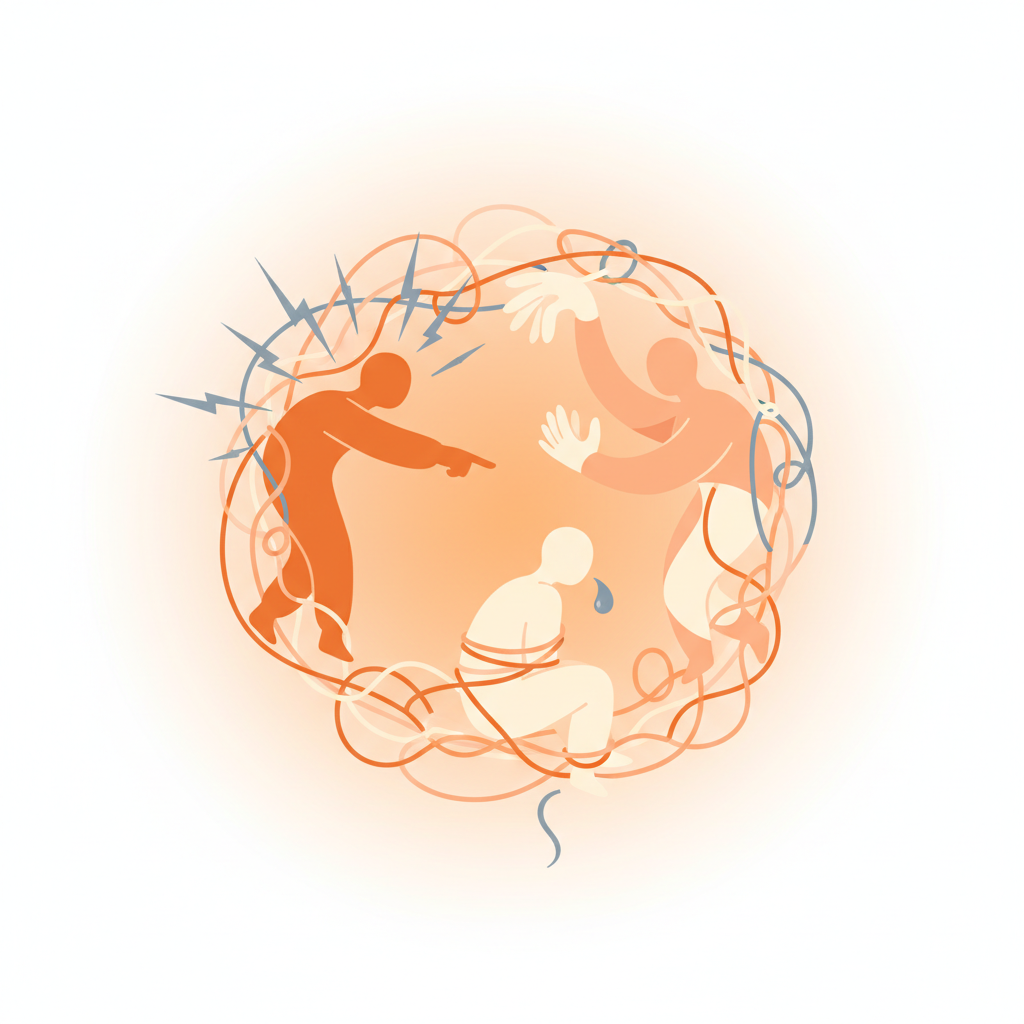
The drama triangle is a model of dysfunctional interaction formulated by psychiatrist Stephen Karpman in 1968, within the transactional analysis framework created by Eric Berne. The model describes three roles — victim, persecutor, and rescuer — that people adopt unconsciously during interpersonal conflict, especially in couples and families. The most disturbing feature of the triangle is not that it exists, but that the roles rotate: today's victim becomes tomorrow's persecutor, and today's rescuer ends up feeling like the victim. This rotation perpetuates the conflict and turns relationships into a cycle of drama that is hard to escape without awareness and proper tools.
Summary: The Three Roles of the Drama Triangle
| Role |
Typical phrase |
Hidden belief |
Life position (Berne) |
| Victim |
"Nobody helps me," "I just can't" |
"I am powerless, I need rescuing" |
I'm not OK, you're OK |
| Persecutor |
"It's your fault," "if it weren't for you..." |
"I have the right to control and punish" |
I'm OK, you're not OK |
| Rescuer |
"Let me handle it," "you couldn't manage without me" |
"I only matter if I rescue someone" |
I'm OK, you're not OK (but I need you) |
How Does the Triangle Work in Relationships?
A classic example: Anna comes home exhausted and complains about her boss (victim position). Carlos listens and tries to solve the problem by giving advice (rescuer position). Anna feels unheard and responds, "I don't want advice — I want you to understand me!" (she becomes the persecutor). Carlos, hurt, says, "I do my best and it's never enough" (he becomes the victim). And the cycle repeats.
Thomas Gordon observed that this dynamic is especially common in families where parents alternate between control (persecutor) and overprotection (rescuer), teaching children to occupy the victim role.
Marshall Rosenberg offered a complementary reading from NVC: each role in the triangle is a tragic attempt to satisfy a legitimate need. The victim needs support. The persecutor needs justice. The rescuer needs to feel valuable. The problem is not the need but the strategy.
How Do I Know If I Am Trapped in the Triangle?
Signs you occupy the victim role:
- You frequently feel powerless.
- You expect the other person to guess what you need.
- You use phrases like "I just can't," "there's no point with you."
Signs you occupy the persecutor role:
- You criticise more than you request.
- You use sarcasm, irony, or reproach as tools.
- You feel entitled to "teach the other a lesson."
Signs you occupy the rescuer role:
- You solve the other person's problems without being asked.
- You feel responsible for your partner's emotional well-being.
- When the other rejects your help, you get angry or feel hurt.
Virginia Satir identified that these three roles correspond to three of her dysfunctional communication stances: the placater (victim), the blamer (persecutor), and the super-reasoner (rescuer). Only the fifth stance — the leveller — operates outside the triangle.
Why Is It So Hard to Leave the Triangle?
Because the roles are addictive. Each one offers an unconscious psychological payoff:
- The victim avoids responsibility.
- The persecutor avoids vulnerability.
- The rescuer avoids facing their own needs.
Moreover, the roles reinforce each other: the rescuer needs a victim, the victim needs a rescuer, and the persecutor needs someone to blame. Breaking the triangle means someone must give up their payoff, and that requires courage.
How to Exit the Drama Triangle
1. Become Aware of Your Preferred Role
We all have a role we default to most often. Identify yours by reviewing your recurring arguments: do you tend to complain without acting (victim), attack (persecutor), or fix without being asked (rescuer)?
2. Take Responsibility for Your Own Needs
Rosenberg proposed replacing the complaint with a request: instead of "nobody helps me" (victim), say "I need help with this — can you do it?" (adult).
3. Stop Rescuing
Thich Nhat Hanh taught that "helping another person grow sometimes means allowing them to walk through their own suffering." The rescuer who fixes everything prevents the other from developing their own resources. Offer presence, not unsolicited solutions.
4. Replace Criticism with Requests
The persecutor can transform their energy: instead of "you always leave everything lying around" (attack), try "I'd like us to tidy up together after dinner" (request). Gordon called this moving from "the language of unacceptance" to "the language of influence."
5. Move to the Winner's Triangle
David Emerald proposed an alternative: the empowerment triangle, where the victim becomes a creator (takes responsibility), the persecutor becomes a challenger (points things out respectfully), and the rescuer becomes a coach (accompanies without fixing).
Can a Couple Leave the Triangle Without Therapy?
Yes, if both are aware of the pattern. At LetsShine.app, the AI identifies when a couple's communication dynamics fall into drama triangle roles and proposes real-time interventions: "It seems you're taking on the other's responsibility. What do you need in this situation?" This immediate awareness is the first step to breaking the cycle.
The way out of the triangle always passes through the same point: stop speaking from the role and start speaking from the need. As Rosenberg said, "Violence is the tragic expression of unmet needs." When you learn to express those needs directly, drama becomes unnecessary.
Frequently Asked Questions
What is Karpman's drama triangle?
It is a transactional analysis model describing three dysfunctional roles — victim, persecutor, and rescuer — that people adopt unconsciously during conflicts. Karpman formulated it in 1968 and it remains one of the most useful tools for understanding couple and family dynamics.
How do I know which role I play in the triangle?
Observe your pattern in arguments: if you complain about powerlessness, you lean towards victim; if you attack or blame, towards persecutor; if you solve others' problems unsolicited, towards rescuer. Virginia Satir noted that everyone has a preferred role, though we rotate through all three.
Does the drama triangle only occur in couples?
No. Karpman described it as a universal dynamic that appears in couples, families, friendships, and workplaces. It is especially visible in parent-teen relationships, where roles rotate rapidly.
What is the empowerment triangle?
It is the alternative proposed by David Emerald to Karpman's triangle. The victim transforms into a creator (takes responsibility), the persecutor into a challenger (confronts respectfully), and the rescuer into a coach (supports without fixing). It is the model of adult, constructive relating.
Can you leave the triangle if only one person is aware?
Yes. Rosenberg demonstrated that when one person stops feeding their role, the triangle's dynamic collapses. If you stop rescuing, the other is compelled to take responsibility. If you stop attacking, the other stops defending. One person's change alters the entire system.
Your relationships can improve. Today.
Start free in 2 minutes. No credit card, no commitment. Just you, the people you care about, and an AI that helps you understand each other.
Start free now