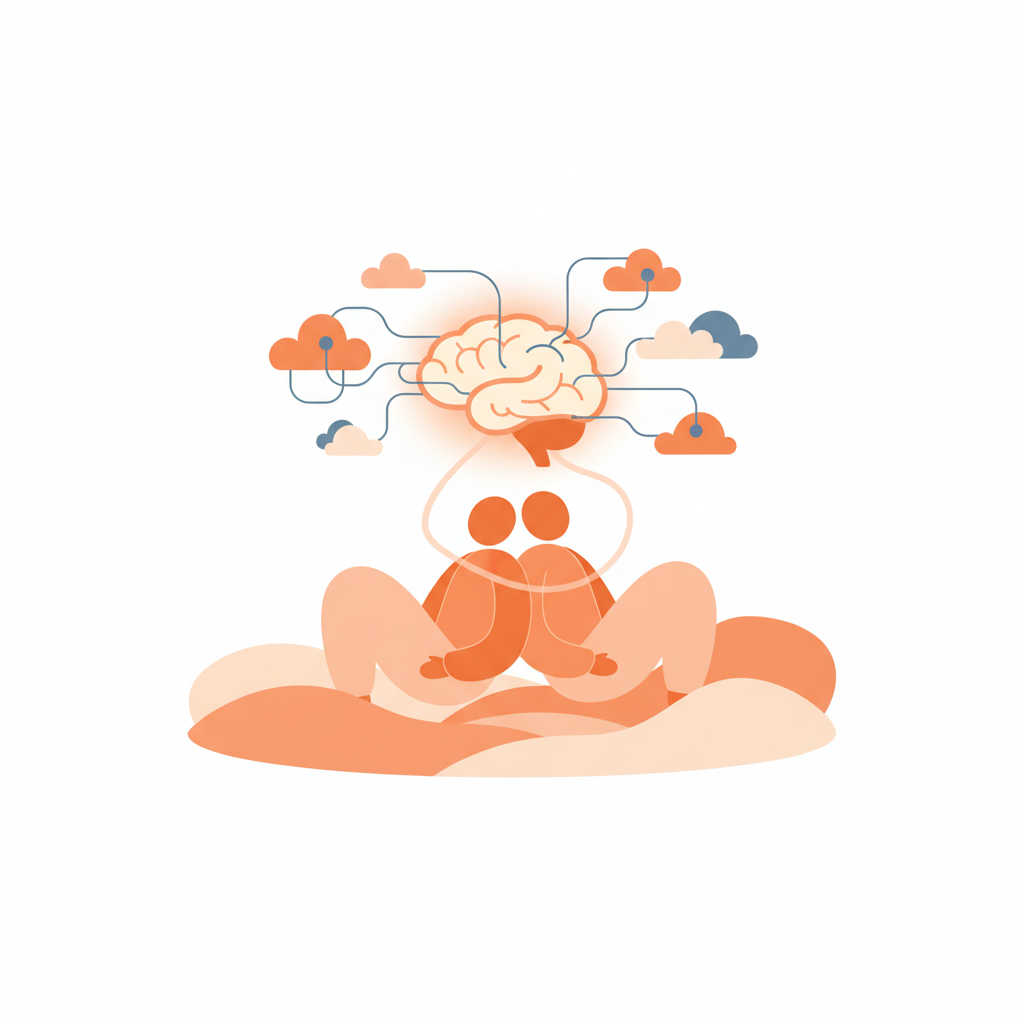
Inner silence is a state of mental quietude in which a person temporarily suspends their internal dialogue -- that ceaseless narrator who judges, plans, remembers, and anticipates -- to inhabit the present moment without cognitive filters. Unlike acoustic silence, which simply means the absence of external sound, inner silence is a deliberate act of consciousness: a voluntary surrender of the need to hold an opinion about everything that happens. The contemplative tradition has been exploring this territory for millennia: the Desert Fathers called it hesychia, Sufi mysticism speaks of sukun, and Zen Buddhism expresses it as mushin (empty mind). Contemporary psychology, supported by neuroimaging studies, has confirmed that this state produces measurable changes in the activity of the default mode network (DMN), reducing mental rumination and increasing the capacity for attention and empathy.
What the contemplative tradition always knew and science now demonstrates is that silence is not a luxury reserved for the secluded monk -- it is a necessity for every relational human being. A person who cannot quiet their inner world cannot truly listen to another. And a person who does not listen does not love: they merely negotiate.
Summary: Inner Silence and Relationships
| Dimension |
Without Inner Silence |
With Inner Silence |
| Listening |
You prepare your response while the other speaks |
You receive the other without agenda |
| Conflict |
You react from ego and defensiveness |
You respond from understanding |
| Empathy |
You project your story onto the other |
You perceive the other's actual experience |
| Presence |
Physically there but mentally absent |
Truly there, with your whole being |
| Intimacy |
Superficial, role-based |
Deep, vulnerability-based |
What Exactly Is Inner Silence?
It is not blanking out your mind -- a common misconception that discourages people who try it. Inner silence is more accurately a shift in your relationship with thoughts: instead of identifying with every idea that appears, you learn to watch them pass without latching on. The contemplative tradition describes it as "sitting by the riverbank and watching the logs float by without jumping onto any of them."
Neuroscientists such as Marcus Raichle at Washington University demonstrated that the default mode network -- the brain structure that activates when we are not focused on a task -- is responsible for rumination, self-criticism, and mental projection into the future or the past. When we practice inner silence through meditation, the activity of this network decreases while the areas associated with mindful attention and emotional regulation (prefrontal cortex and anterior insula) become more active.
In relational terms, the consequence is direct: a mind that ruminates less is a mind that listens more. And a mind that listens more builds healthier relationships.
Why Inner Noise Destroys Relationships
The contemplative tradition holds that most relational suffering does not stem from what the other person does, but from the story we tell ourselves about what the other person does. That story -- "they don't love me enough," "they always do the same thing," "they should know what I need" -- is the inner noise that distorts perception.
John Gottman, the psychologist who has studied more couples in laboratory settings than perhaps anyone, identified a phenomenon he called the absorbing state: a condition in which negativity feeds on itself and the couple becomes trapped in a destructive loop from which they cannot exit. What Gottman describes from empirical psychology coincides with what contemplatives describe from inner experience: when mental noise overtakes the mind, we lose the ability to see the other as they are. We see only the distorted image our ego projects.
Inner noise manifests in relationships in concrete ways:
- Reactive listening: instead of hearing the other person, we hear our reaction to them. While they speak, we are already formulating our response, our defence, or our counterattack.
- Biased interpretation: we assume the other's intentions without verifying them. "You're late because you don't care about me" instead of "You're late -- did something happen?"
- Narrative accumulation: every conflict connects to all previous ones. "You always do the same thing" is the phrase of accumulated inner noise.
- Inability to be present: the body is at dinner, but the mind is reviewing the morning's argument or anticipating the weekend's.
How to Cultivate Inner Silence
The contemplative path proposes a gradual journey that begins with attention to the body and progresses toward stillness of mind.
Step 1: Acoustic Silence (the environment)
Set aside a space free of stimulation: no phone, no music, no television. Five minutes a day is enough to start. Psychologist Imke Kirste at Duke University showed in 2013 that two hours of daily silence stimulated neurogenesis in the hippocampus of mice -- the brain region linked to memory and emotional regulation. You do not need two hours: you need to begin.
Step 2: Bodily Silence (stillness)
Sit without doing anything. Without a goal. Without evaluating whether you are doing it correctly. The contemplative tradition insists that sitting is already the complete practice. You do not need to "achieve" anything. The mere act of remaining still, without fleeing into action, is already training your capacity for presence.
Step 3: Mental Silence (observation)
Watch your thoughts without following them. When you notice you have latched onto an idea -- that you are planning, judging, or remembering -- return to the breath. That "returning" is the exercise. Every time you return, you strengthen the capacity to choose where you place your attention. And that capacity is exactly what you need during a disagreement with your partner: choosing to listen instead of react.
Step 4: Relational Silence (listening)
Transfer the practice to your relationships. In your next conversation with your partner, try to listen without preparing your response. Without judging. Without interpreting. Simply receive. You will notice it is extraordinarily difficult. And you will notice that when you manage it, even for a few seconds, the quality of the conversation changes radically.
What Does the Science Say About Silence and Relationships?
A study published in Psychological Science by Killingsworth and Gilbert (2010) showed that people spend roughly 47% of their waking time with a wandering mind, and that mind-wandering correlates significantly with unhappiness regardless of the activity being performed. Applied to relationships: nearly half the time you spend with your partner, you are not really there.
Research by Richard Davidson at the University of Wisconsin-Madison has shown that regular meditation -- the primary tool for cultivating inner silence -- increases activity in the left prefrontal cortex, associated with positive emotions and emotional regulation. Experienced meditators also show greater activity in the insula, the brain region that supports empathy.
The implication is clear: inner silence is not a spiritual indulgence but a neurological training that improves the competencies that matter most in relationships -- listening, empathy, emotional regulation, and presence.
How Does Inner Silence Affect a Couple in Practice?
When both members of a couple practice inner silence -- even five minutes a day -- observable changes occur:
- Arguments decrease in intensity: with greater self-regulation capacity, conflicts do not escalate as easily.
- Listening improves: by reducing inner noise, the capacity to receive what the other says without distorting it expands.
- Reactivity diminishes: instead of responding on emotional autopilot, a pause appears -- a space between stimulus and response -- that allows choice.
- Intimacy deepens: being genuinely present with the other generates a connection that words and shared activities alone cannot achieve.
At LetsShine.app, the practice of inner silence is one of the pillars of relational work. Emotional archaeology -- exploring why we react the way we react -- first requires learning to quiet the inner narrator who always has a ready-made justification.
Where to Begin Today
You do not need a meditation retreat or special training. You need five minutes, a chair, and the willingness to do nothing for that time. Sit. Breathe. Observe what happens inside you without trying to change it. And then, in your next conversation, try to carry that same attitude: listening without preparing your response. Being without agenda.
Inner silence does not eliminate conflicts. But it radically transforms the way you inhabit them. And that changes everything.
Frequently Asked Questions
Does inner silence mean making your mind go blank?
No. Inner silence does not consist of eliminating thoughts but of changing your relationship with them. Instead of identifying with every idea that appears, you learn to observe it without latching on. Thoughts keep arising; what changes is that you stop confusing yourself with them.
How much practice do I need before I notice changes in my relationships?
Studies from the University of Wisconsin-Madison suggest that eight weeks of daily practice of 10-15 minutes produce detectable changes in brain activity. In relational practice, many people notice improvements in the quality of their conversations from the first week, especially in the ability to listen without reacting.
Can I practice inner silence if I am not religious or spiritual?
Absolutely. Although the practice has millennial contemplative roots, secular meditation -- such as Jon Kabat-Zinn's MBSR programme -- demonstrates the same benefits without any religious component. Inner silence is a psychological skill, not a belief.
How can I practise inner silence with my partner?
Start by sitting together in silence for five minutes. Without speaking, without doing anything, simply sharing the space. Then practise silent listening: one person speaks for three minutes without interruption while the other listens without preparing a response. Then switch.
Does inner silence help relationships that are already in crisis?
Inner silence is not a magic solution, but it is a necessary condition for any repair. Without the ability to quiet mental noise, you cannot truly listen to the other, and without genuine listening there is no possible resolution. It is the first step, not the only one.