A breakup is the dissolution of the emotional bond between two people who were in a romantic relationship. From the perspective of affective neuroscience, a breakup activates the same brain regions as physical pain — the anterior insula and the anterior cingulate cortex — according to a study published in Proceedings of the National Academy of Sciences (Kross et al., 2011). This explains why a separation literally "hurts" and why phrases like "time heals everything" feel so unhelpful when you are in the middle of the storm. In the United States alone, there are roughly 750,000 divorces per year, not counting the breakups of unmarried couples, which are increasingly frequent. Getting through a breakup is not an act of willpower: it is a process with stages, setbacks, and lessons.
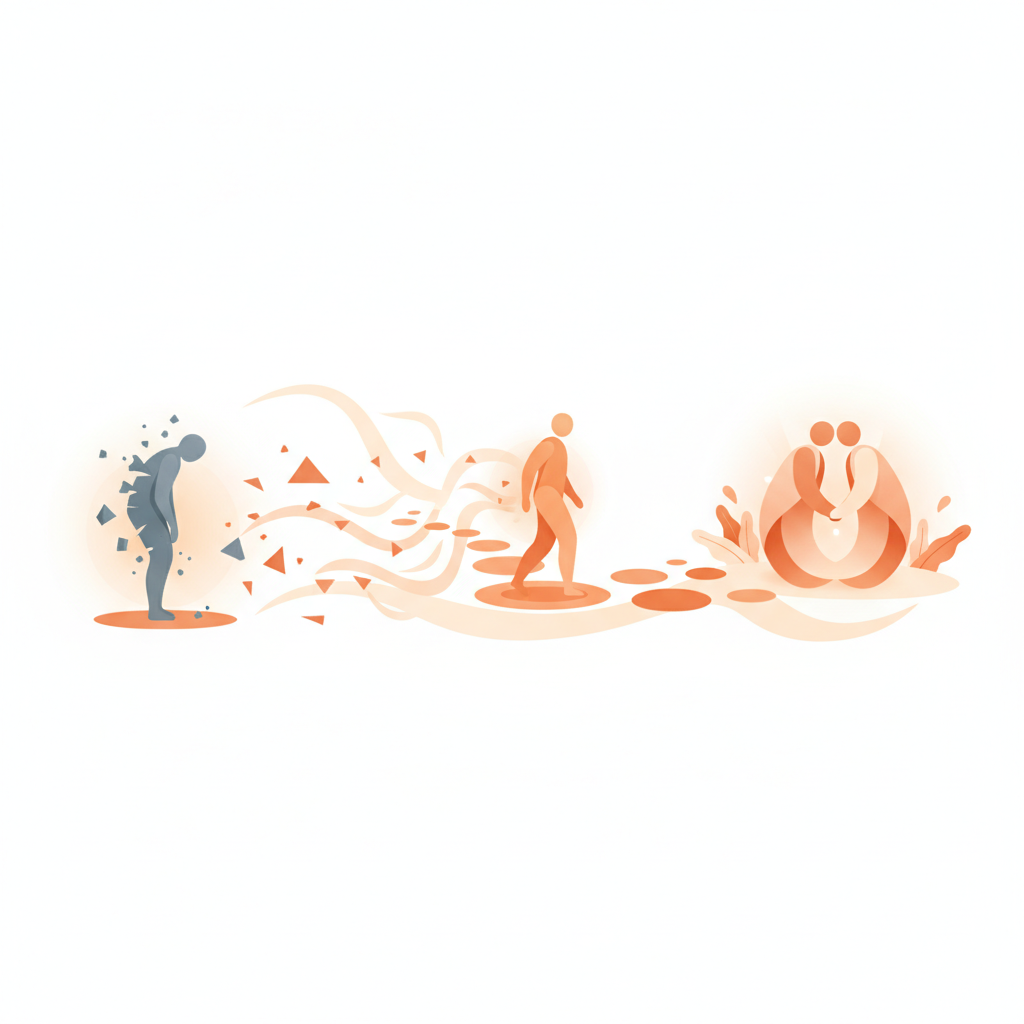
| Stage of grief |
Approximate duration |
What you feel |
What you need |
| Shock and denial |
Days to weeks |
Unreality, numbness |
Permission to not be okay |
| Yearning and searching |
Weeks to months |
Obsession, desire for contact |
No-contact or minimal contact |
| Disorganisation |
1–3 months |
Deep sadness, anger, guilt |
Social and professional support |
| Reorganisation |
3–12 months |
Gradual acceptance, new interests |
Rebuilding your identity |
How Long Does It Take to Get Over a Breakup?
There is no universal answer, but research offers guidance. A study published in The Journal of Positive Psychology (Lewandowski, 2009) found that most people experience a significant improvement in emotional wellbeing around 11 weeks after a breakup. However, long relationships, those involving children, or those with dynamics of emotional dependency may require between 6 and 18 months of active processing.
The important distinction is between "getting over it" and "forgetting." Getting through a breakup does not mean erasing that person from your memory or ceasing to feel. It means integrating the experience into your life story, extracting the lessons, and being able to move forward without the pain paralysing you.
What Are the Stages of Grief After a Breakup?
Psychiatrist Elisabeth Kubler-Ross popularised a five-stage model of grief (denial, anger, bargaining, depression, acceptance), though current research understands grief as a non-linear process in which stages overlap and repeat.
Stage 1: Shock and denial. "This can't be happening." Your brain protects you from pain too great to process all at once. You may feel unreality, emotional numbness, or even apparent calm.
Stage 2: Yearning and searching. This is the most dangerous phase for contact with your ex. Your brain, accustomed to the dopamine and oxytocin "dose" the relationship provided, desperately seeks to recover that source. You check their Instagram, re-read old conversations, fantasise about their return.
Stage 3: Emotional disorganisation. Here, deep sadness, anger, guilt, and the "what ifs" appear. It is normal to alternate between rage ("I didn't deserve this") and self-blame ("if I had done things differently…"). This is the most painful phase but also the most transformative if properly supported.
Stage 4: Reorganisation. Emotional intensity decreases. You begin to have good days without feeling guilty about it. You rediscover interests, make plans of your own, and start building an identity that does not depend on the relationship.
What Mistakes Prolong Pain After a Breakup?
1. Maintaining Contact
The immediate "let's stay friends" is, in most cases, an emotional trap. Contact keeps the attachment circuit active and hinders the grieving process. Most psychologists specialising in relationship loss recommend a minimum 60–90-day no-contact period (unless children are involved, in which case contact should be limited to logistics only).
2. Seeking Answers From the Other Person
"Why did you leave me? Is there someone else? What did I do wrong?" These questions rarely yield answers that soothe the pain. The person who ended the relationship can seldom clearly articulate their reasons, and the answers usually generate more questions.
3. Rebound Relationships
Starting a new relationship too soon to "cover up" the pain. It works as temporary anaesthesia but delays grief and is usually unfair to the new person.
4. Idealising the Relationship
Memory has a positivity bias when we feel loss. It is easy to remember the good times and forget the arguments, the wear-and-tear, and the reasons the relationship was not working.
5. Isolating Yourself
Pain drives you to shut yourself away, but isolation amplifies rumination and sadness. You do not need to go to parties or pretend you are fine; you need safe people with whom you can be however you are.
How to Get Through a Breakup Step by Step
Step 1: Allow Yourself to Feel the Pain
Crying is not weakness. Being sad is not pathological. Your body and mind need to process the loss. Give yourself permission to be unproductive, to cancel plans, to feel bad for a reasonable amount of time.
Step 2: Establish No Contact
Unfollow or mute your ex on social media. Not as an act of resentment, but as an act of self-protection. Every time you see a photo of them, your brain experiences a micro-grief.
Step 3: Write What You Feel
Expressive writing (journalling) has strong evidence as an emotional-processing tool. A classic study by James Pennebaker at the University of Texas at Austin demonstrated that writing about emotional experiences for 15–20 minutes a day reduces stress and improves psychological wellbeing. Tools like the AI on LetsShine.app can serve as a safe space where you can pour out what you feel and receive guided reflection to help you understand yourself.
Step 4: Analyse Your Patterns
A breakup is an enormously valuable learning opportunity. Ask yourself honestly:
- What pattern do I repeat in my relationships?
- What needs of my own did I neglect in order to please?
- What boundaries did I fail to set that I should have?
- What does this breakup tell me about my attachment style?
Step 5: Rebuild Your Identity
After a long relationship, it is common not to know who you are outside the couple. This is the moment to reconnect with what you enjoy, what interests you, what makes you feel alive. Sign up for that activity you always put off. Rekindle friendships you neglected. Travel solo. Rediscover yourself.
Step 6: Be Patient With Setbacks
It is not linear. You will have good weeks followed by a terrible day because a song, a scent, or an anniversary appeared. Setbacks do not mean you are not making progress: they are a natural part of the process.
How to Handle a Breakup When Children Are Involved
When children are involved, the breakup changes dimension because you stop having a partner but you do not stop having a bond. Some key principles:
- Children must never be messengers or judges. No "tell your father that…" and no "who do you prefer to live with?"
- Separate the ex-partner role from the co-parenting role. You can be hurt by your ex and still be an effective team as parents.
- Maintain routines and stability. Children need predictability, especially in times of change.
- Never speak badly of the other parent. Ever. Even if you have reasons. Children are half you and half the other person; when you criticise your ex in front of them, they receive the message that half of who they are is wrong.
Frequently Asked Questions
Is it normal to still love my ex after months?
Yes, it is completely normal. Emotional attachment does not switch off by conscious decision. Love can coexist with the acceptance that the relationship was not viable. Over time, that love transforms: it stops being a desire to return and becomes a serene affection for what once was.
Should I seek professional help after a breakup?
It is advisable when sadness persists for more than three months at the same intensity, when it affects your work or social performance, when thoughts of self-harm appear, or when you detect that you are repeating patterns from previous relationships. A psychologist can help you process the grief, and tools like LetsShine.app offer a guided-reflection space available around the clock for those moments when you need to express what you feel.
Does no contact really work?
Evidence and clinical experience support its effectiveness. A study from Villanova University found that people who reduced contact with their ex experienced less emotional distress and recovered sooner. It is not a way of punishing the other person: it is a way of protecting your grieving process.
How will I know I'm ready for another relationship?
When you can think about your ex without intense pain, when you do not need a partner to feel whole, when you can be alone without anxiety flooding you, and when your reason for seeking someone new is the desire to share your life — not the fear of loneliness.
Is it possible to get back with an ex and make it work?
In some cases yes, but only when both people have done deep personal work and the causes of the breakup have been addressed — not merely parked. Going back out of inertia, fear of loneliness, or because "we already know each other" usually reproduces the same patterns that led to the breakup.