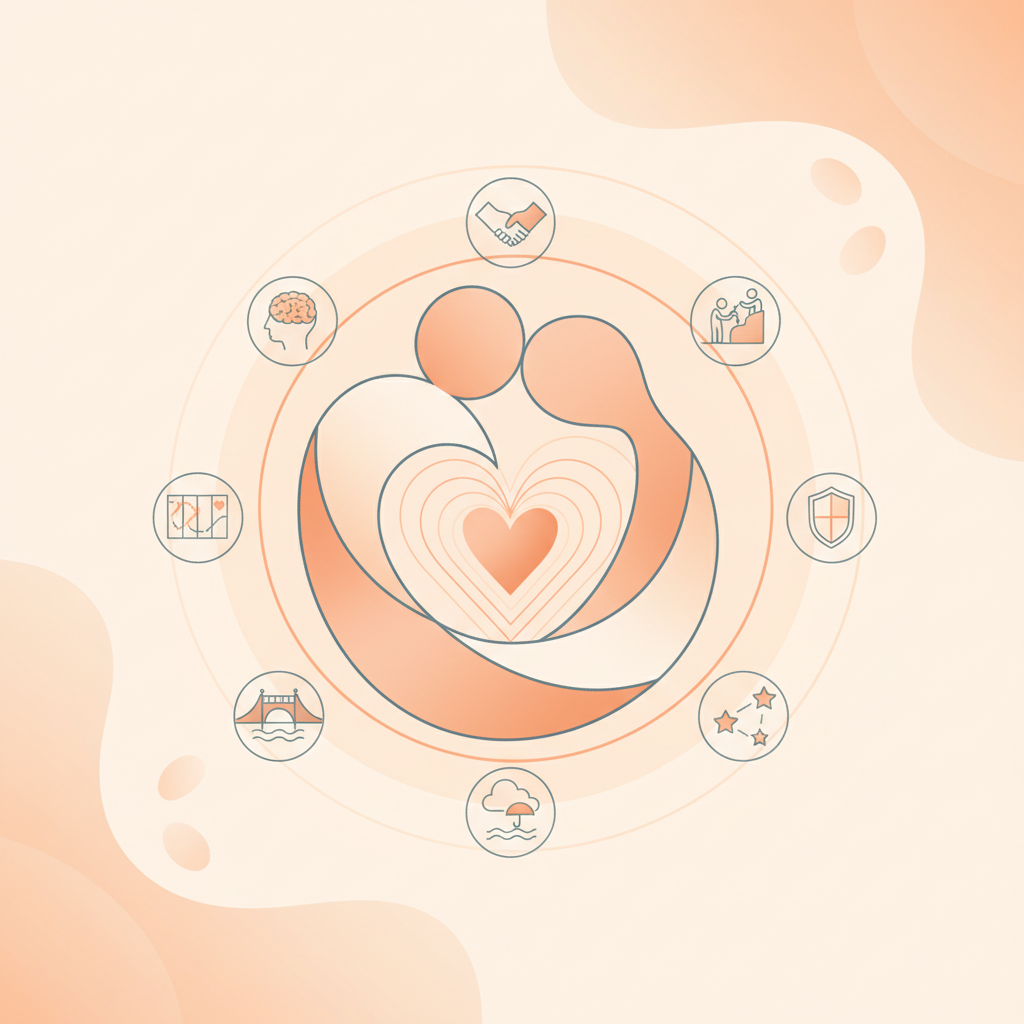
The Seven Principles for Making Marriage Work (1999) is John Gottman's most influential work, the fruit of over four decades of research at the Gottman Love Lab at the University of Washington, where he observed more than 3,000 couples using physiological and behavioural measurement tools. Gottman discovered that happy couples — whom he calls "masters" — are not couples without conflict but couples who have developed specific habits of connection, admiration, and emotional management that set them apart from the "disasters." These habits are summarised in seven principles that, applied consistently, predict relationship stability and satisfaction with an accuracy Gottman places at 91 %.
| Principle |
Core concept |
Question it answers |
| 1. Love Maps |
Knowledge of the other's inner world |
How well do I really know my partner? |
| 2. Fondness and Admiration |
An active appreciation system |
Do I express what I admire about my partner? |
| 3. Turning Toward |
Responding to bids for connection |
Do I respond when my partner reaches out? |
| 4. The Positive Perspective |
Charitable interpretation of the other's actions |
Do I give the benefit of the doubt? |
| 5. Managing Conflict |
Accepting perpetual problems, solving solvable ones |
Can I tell the difference between solvable and unsolvable conflicts? |
| 6. Making Dreams Come True |
Supporting the other's aspirations |
Do I know my partner's dreams and support them? |
| 7. Creating Shared Meaning |
Building a couple culture |
Do we have rituals, values, and goals that unite us? |
Principle 1: Enhance Your Love Maps
The first principle is the foundation for all the others: knowing your partner's inner world deeply — their worries, dreams, fears, and everyday joys. As we explore in detail in our article on the Love Map, couples who keep this knowledge updated survive crises and transitions better.
Exercise: Spend 20 minutes this week asking your partner questions that are not about logistics: "What worries you right now?" "What would you love to do that you have not done yet?"
Principle 2: Nurture Fondness and Admiration
Gottman found that 94 % of couples who speak about their history with warmth — remembering the good times, the qualities that attracted them, the obstacles they overcame together — stay together. The fondness and admiration system is the antidote to contempt, the most powerful predictor of divorce.
Sue Johnson complements this from EFT: "Admiration conveys a fundamental attachment message: you are valuable to me. Not for what you do, but for who you are." And Gary Chapman notes that words of affirmation — one of the five Love Languages — are the most direct route to expressing admiration.
Exercise: Every day, think of one quality you admire in your partner and tell them. It does not have to be grand: "I love how you make the children laugh" counts as much as "I admire your courage."
Principle 3: Turn Toward Each Other Instead of Away
This principle is based on the concept of bids for connection, which we develop in our dedicated article. Gottman found that "master" couples turn toward each other's bids 86 % of the time, while "disaster" couples do so only 33 %.
Exercise: For one day, pay attention to your partner's small signals — a comment, a sigh, a glance — and respond to them. Do not let them pass unnoticed.
Principle 4: Let Your Partner Influence You
Gottman discovered that men who accept their partners' influence are 81 % less likely to end in divorce. This does not mean giving in on everything but maintaining an attitude of respect and consideration toward the other's perspective.
Hendrix, from Imago Therapy, connects this principle with validation: accepting the other's influence means recognising that their worldview has legitimacy, even when it differs from yours.
Exercise: Next time your partner proposes something you disagree with, instead of automatically rejecting it, look for the part you can connect with.
Principle 5: Solve Your Solvable Problems
Gottman distinguishes between solvable problems (31 % of couple conflicts) and perpetual problems (the remaining 69 %). The perpetual ones — differences in personality, values, or fundamental needs — are not solved; they are managed with dialogue, humour, and acceptance. The solvable ones require a specific technique: the soft start-up.
The soft start-up means initiating the conversation without criticism or contempt. Instead of "you never help around the house" (attack), say "I have been exhausted this week — could we redistribute the chores?" (request).
Esther Perel adds that accepting perpetual problems is an act of relational maturity: "Choosing someone means choosing a set of unsolvable problems. The question is not whether you will have problems, but whether they are problems you can live with."
Exercise: Identify a recurring conflict with your partner. Is it solvable (a behaviour that can change) or perpetual (a fundamental difference)? If perpetual, explore how to live with it without it destroying you.
Principle 6: Overcome Gridlock
Unfulfilled dreams hide behind many perpetual conflicts. Gottman proposes that behind every rigid position lies a dream — a hope, a value, a deep need — that is not being expressed. When the couple explores those dreams, gridlock transforms into dialogue.
Exercise: Next time you get stuck on an issue, ask each other: "What dream lies behind your position?" Listen to the answer without trying to solve — with curiosity only.
Principle 7: Create Shared Meaning
The seventh principle is the deepest and least discussed. Gottman speaks of creating a "culture of the relationship" with its own rituals (how you celebrate, how you say goodbye, what traditions you hold), shared roles (how you understand parenthood, work, extended family), common goals, and symbols of your shared history.
Exercise: Create a ritual that is yours alone: a Sunday morning coffee, a walk after dinner, a question before bed. Small but consistent rituals are the mortar of a lasting relationship.
Frequently Asked Questions
Do Gottman's 7 principles work for LGBTQ+ couples?
Yes. Although Gottman's initial research was conducted with heterosexual couples, subsequent studies — including Gottman's own work with Robert Levenson — confirmed that the same principles apply to same-sex couples.
Can I apply the 7 principles without my partner reading the book?
Yes. Many of the principles (Love Maps, turning toward, admiration) can be practised unilaterally. When one partner changes how they relate, the other tends to respond.
Which principle is the most important?
Gottman identifies fondness and admiration (Principle 2) as the most protective. If both partners maintain a fundamentally positive view of each other, conflicts are managed better. Without that foundation, techniques are insufficient.
Do the 7 principles conflict with Sue Johnson's EFT?
No, they are complementary. Gottman offers behavioural tools; Johnson works on emotional bond transformation. Many therapists integrate both approaches with excellent results.
Is it normal not to fulfil all 7 principles?
Absolutely. No couple fulfils all of them all the time. Gottman does not propose perfection but direction: every small gesture toward connection counts. LetsShine.app can help you identify which principles need more attention in your relationship.