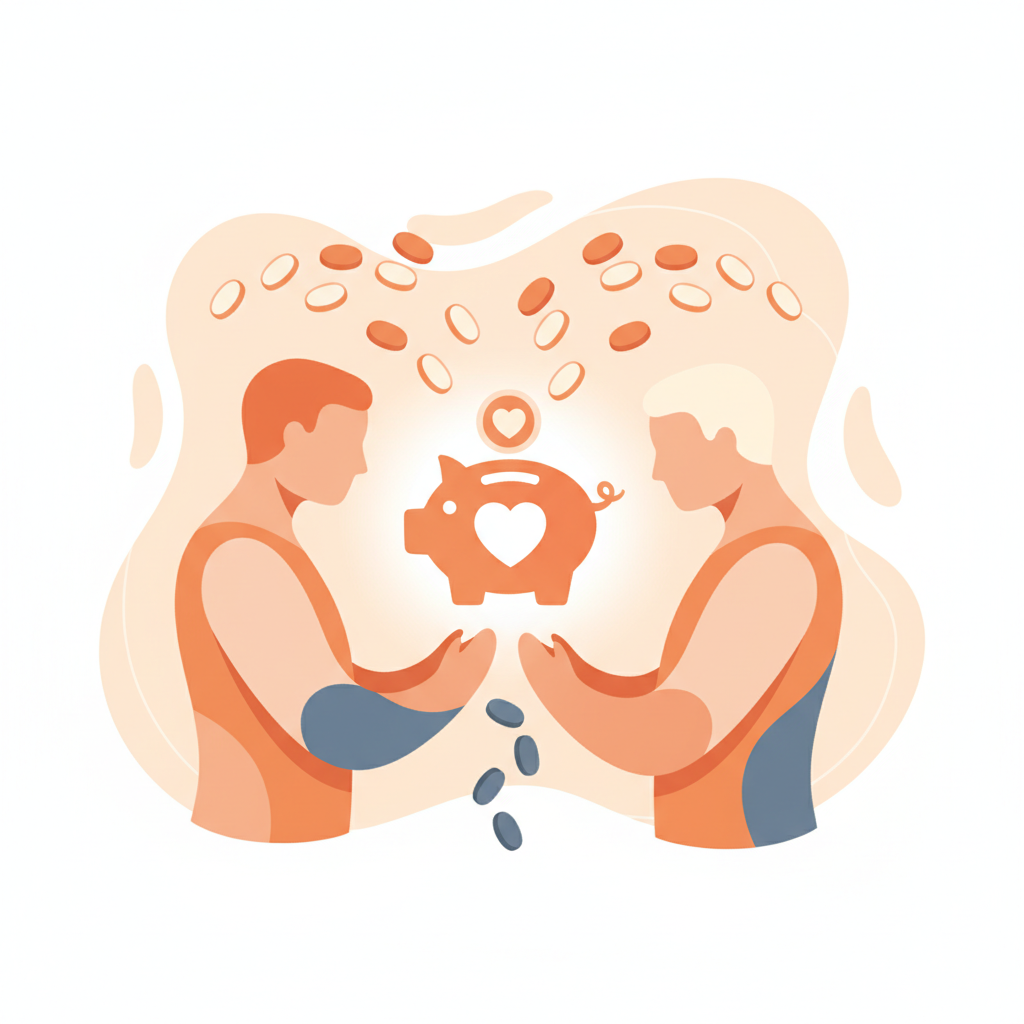
The emotional bank account is a metaphor coined by Stephen Covey in The 7 Habits of Highly Effective People (1989) and adopted and developed by John Gottman in the context of couple relationships. The idea is intuitive but profound: every interaction you have with your partner functions as a deposit or a withdrawal in an imaginary bank account. Gestures of affection, attentive listening, shared humour, support during difficult times — all of those are deposits. Criticism, contempt, indifference, broken promises — all of those are withdrawals. When the balance is positive — more deposits than withdrawals — the relationship has an emotional cushion that absorbs the inevitable conflicts. When the balance is negative, any minor disagreement can become a crisis because there is no reserve of goodwill to soften the impact.
| Transaction type |
Examples of deposits |
Examples of withdrawals |
| Attention |
Listening without looking at your phone |
Ignoring when they speak |
| Affection |
A hug when arriving home, a good morning kiss |
Physical coldness, avoiding contact |
| Recognition |
"I admire how you handled that" |
"You always do the same thing" |
| Support |
"How can I help you?" |
"That is your problem, not mine" |
| Repair |
"Sorry, I went too far" |
Refusing to acknowledge the error |
| Humour |
Laughing together about a situation |
Hurtful sarcasm |
| Interest |
Asking about their day, their worries |
Only talking about yourself |
| Loyalty |
Defending your partner in front of others |
Criticising your partner in front of others |
Why Do Withdrawals Weigh More Than Deposits?
Gottman, supported by Daniel Kahneman's research on the negativity bias, notes that negative interactions carry an emotional impact five times greater than positive ones. This explains the famous 5:1 ratio: you need at least five deposits to offset a single withdrawal.
Sue Johnson, from attachment theory, offers a neurobiological explanation: negative interactions activate the amygdala — the brain's fear centre — and the body enters survival mode. Oxytocin (the bonding hormone) decreases, cortisol (the stress hormone) increases. Your body literally registers each withdrawal as a threat to your attachment security.
Harville Hendrix adds the historical dimension: "Each withdrawal does not only subtract from the present; it also activates accumulated withdrawals from the past — including those from childhood." This is why a seemingly minor remark can provoke a disproportionate reaction: you are not reacting only to what just happened but to the entire history of withdrawals that phrase evokes.
How to Know What Your Emotional Balance Is
Gottman proposes several observable indicators:
Your account is positive when:
- You interpret your partner's actions generously (the positive perspective)
- Conflicts resolve without escalating into all-out war
- You can apologise and be forgiven without lingering resentment
- You enjoy time together and actively seek it
- When your partner makes a mistake, your first reaction is "they must have had a bad day" rather than "typical"
Your account is negative when:
- Everything your partner says or does irritates you
- Conflicts escalate quickly to include grievances from the past
- You feel more at ease when your partner is not around
- You interpret their actions with the worst possible intention
- Any disagreement feels like a threat to the relationship
Gary Chapman connects this to the Love Languages: "If your partner's love tank is empty — if they are not receiving love in their primary language — every withdrawal is amplified and every deposit goes unnoticed. It is like pouring water into a cracked glass."
Which Deposits Are Most Valuable?
Not all deposits carry the same weight. Gottman identifies the ones with the greatest impact:
1. Turning Toward Bids for Connection
As we explore in our article on bids, every micro-response to a bid is a deposit. They are small but constant — like a drip that fills the account drop by drop.
2. Repair After Conflict
Gottman found that the capacity for repair is more important than the intensity of the conflict. A couple that argues intensely but repairs afterwards keeps their account positive. A couple that argues little but never repairs drains the account without realising it. Saying "Sorry, I went too far" or "I do not think I understood you — can you explain again?" are enormous deposits.
3. Support During Times of Stress
Esther Perel notes that how a couple supports each other when life strikes — illness, job loss, family problems — is what truly defines the quality of the bond. "The biggest deposits are not made in the good times but in the difficult ones."
4. Verbalised Admiration
Expressing what you admire about your partner — not just thinking it, but saying it — is a deposit Gottman considers protective against contempt. "Admiration is the vaccine against the fourth horseman."
Which Withdrawals Are Most Costly?
1. Contempt
Gottman considers it the most powerful predictor of divorce. Sarcasm, mockery, insults disguised as humour, moral superiority. A single display of contempt can erase weeks of deposits.
2. Betrayal of Trust
Not just infidelity. Also sharing the couple's secrets with others, breaking promises, lying about important matters. Johnson notes that "trust is built drop by drop and destroyed by the bucket."
3. Systematic Indifference
Ignoring bids for connection, showing no interest in the other's world, living like flatmates. It is the quietest withdrawal — and therefore the most insidious.
4. "Always" and "Never"
Phrases like "you are always late" or "you never listen to me" are triple withdrawals: they criticise, generalise, and close the door to repair.
How to Recover an Account in the Red
- Stop the withdrawals before increasing the deposits. Gottman insists: it is not about compensating damage with more affection while you keep causing damage. First, identify your withdrawal patterns (criticism, sarcasm, indifference) and work on them.
- Make consistent, small deposits. A single grand gesture does not compensate for months of daily withdrawals. It is consistency that rebuilds the account.
- Use the Imago Dialogue to process accumulated wounds. Hendrix proposes that couples talk explicitly about the withdrawals that have hurt them most, using the mirroring-validation-empathy format.
- Seek help if the account has been negative for a long time. Sue Johnson warns that when distrust is entrenched, deposits get interpreted with suspicion: "What do they want now?" A therapist can help break through that filter.
Frequently Asked Questions
Is the emotional bank account a Gottman concept or a Covey concept?
The original metaphor is Stephen Covey's (1989), applied to relationships in general. Gottman adopted it and developed it specifically for couple relationships, integrating it with his research on the 5:1 ratio, bids for connection, and the Four Horsemen.
Can I measure my emotional account objectively?
There is no exact numerical measurement, but Gottman offers questionnaires in his books and workshops that evaluate indicators like the positive perspective, the fondness and admiration system, and friendship quality within the couple. On LetsShine.app, the AI analyses communication patterns to identify whether deposits or withdrawals predominate.
How long does it take to rebuild an empty emotional account?
It depends on the depth of the damage. Gottman estimates that committed couples can notice significant changes in 2-3 months of consistent effort. For traumas like infidelity, the timeline extends to 1-3 years.
Do deposits have to be "big" to count?
No. Gottman found that small daily gestures (a kiss, a genuine question, a shared laugh) are more powerful than occasional grand gestures (an expensive dinner, a holiday). Consistency beats intensity.
Can one person alone rebuild the couple's emotional account?
Partially. Increasing your deposits and reducing your withdrawals unilaterally does improve the relational climate. But the account is shared: for a full recovery, both partners need to participate. If your partner does not respond after a sustained effort, it may be a sign that you need professional help.
Your relationships can improve. Today.
Start free in 2 minutes. No credit card, no commitment. Just you, the people you care about, and an AI that helps you understand each other.
Start free now