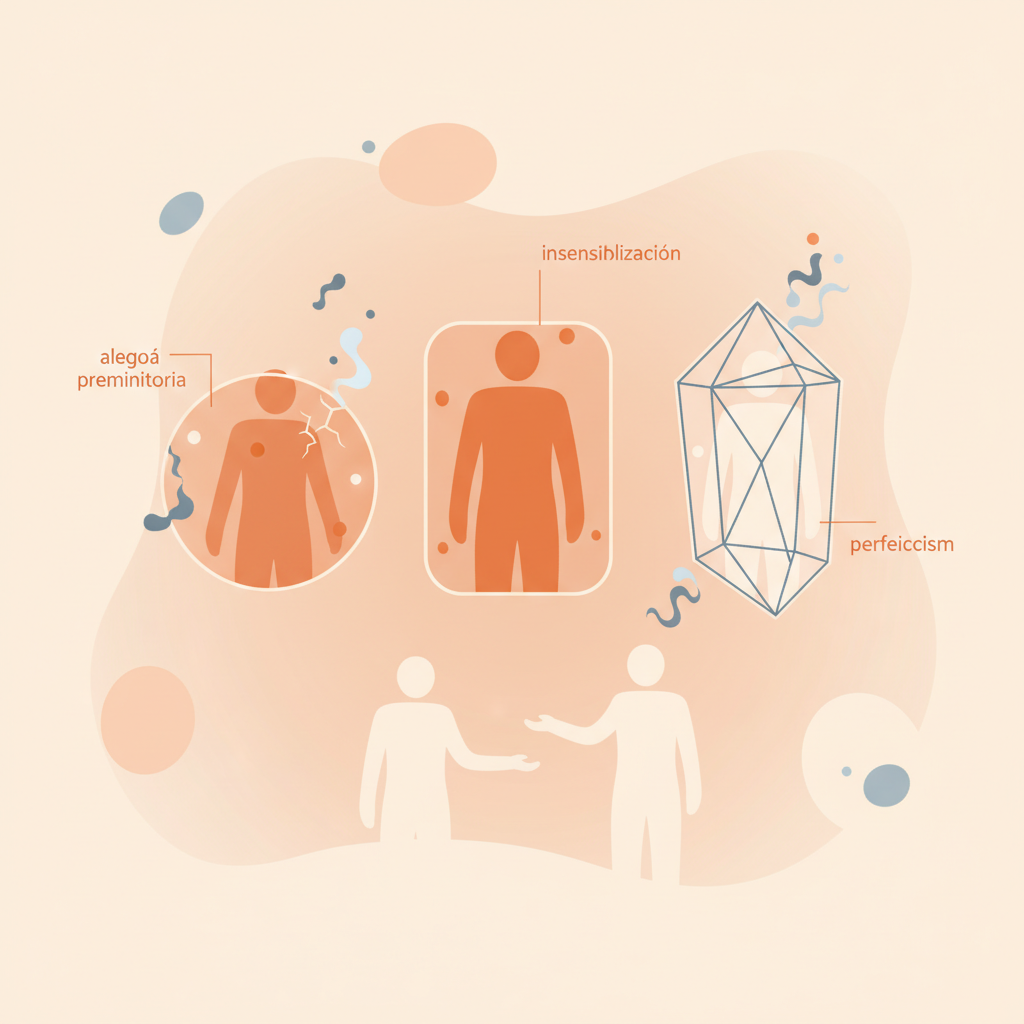
Emotional armour is the set of psychological strategies we use — generally unconsciously — to protect ourselves from vulnerability, emotional pain and shame. Brené Brown, in Daring Greatly and Atlas of the Heart, identifies three main forms of armour that repeat universally across her research with more than 350,000 participants: foreboding joy, numbing and perfectionism. These three strategies share a fundamental paradox: they are born from the desire to protect ourselves, but they end up destroying exactly what we need most — connection, joy and intimacy. Carl Rogers described a similar phenomenon when he spoke of "defences of the self": mechanisms the person develops to maintain a coherent self-image, but which distort actual experience and distance them from congruence — the capacity to live in harmony with what they truly feel.
| Armour |
How it works |
What you lose by using it |
How to disarm |
| Foreboding joy |
You anticipate catastrophe in moments of happiness |
The ability to enjoy |
Active gratitude in the moment |
| Numbing |
You anaesthetise emotions with substances, work or distraction |
The ability to feel (everything, not just pain) |
Presence and self-compassion |
| Perfectionism |
You try to be flawless to avoid criticism |
Authentic connection |
Accepting imperfection as human |
What Is Foreboding Joy and Why Does It Ruin Your Happiest Moments?
Brown describes foreboding joy as one of the most surprising and universal findings of her research. It occurs when you are experiencing a moment of genuine joy — watching your child sleep, laughing with your partner, celebrating an achievement — and suddenly your mind assaults you with a catastrophic image: "What if something happens to them?" "This is too good to last." "Something bad is surely coming."
The mechanism is defensive: the brain tries to protect you from future pain by "rehearsing tragedy." The unconscious logic is: "If I already anticipate the pain, it will hurt less when it arrives." But Brown demonstrates that this strategy is completely ineffective: "Preparing for pain does not reduce pain. The only thing it achieves is robbing you of joy."
This phenomenon is so common that in Brown's interviews, virtually all participants recognised it. Parents who cannot look at their children without imagining accidents. Couples who cannot enjoy a good moment without expecting the argument. People who sabotage their own happiness because the familiar territory of worry feels safer.
What Is the Antidote to Foreboding Joy?
Brown discovered that people who did not fall into foreboding joy shared a common practice: active gratitude. Not gratitude as an abstract concept, but as a concrete gesture in the precise moment of joy. When you feel the impulse to anticipate catastrophe, instead of following that impulse, you stop and say — aloud or to yourself: "I am grateful for this moment. Right now, this is real and it is good."
Neff connects this antidote to the mindfulness component of self-compassion: being present in the experience as it is, without projecting the future or dragging the past. Tara Brach describes it as "arriving at the present moment with open hands": without gripping fear or the desire for control.
What Is Emotional Numbing?
Numbing is the strategy of anaesthetising difficult emotions so as not to feel them. Brown clarifies in Daring Greatly a crucial point: "We cannot selectively numb emotions. When we numb pain, we also numb joy, gratitude and happiness."
The forms of numbing are varied and often socially acceptable:
- Substances: alcohol, food, drugs. The most obvious and also the most recognised form.
- Compulsive work: keeping perpetually busy so there is no time to feel. Western culture even rewards this form of numbing.
- Screens and social media: the infinite scroll as a way of avoiding being present with yourself.
- Compulsive shopping: seeking through consumption the dopamine not obtained from emotional connection.
- Hypercontrol: trying to control every aspect of life to avoid the uncertainty that generates difficult emotions.
Rogers observed that the person who disconnects from their emotions lives in a growing "incongruence" between their real experience and their awareness: they feel things they do not recognise, which generates diffuse anxiety, unexplained irritability and a generalised sense of emptiness.
How Does Numbing Affect Relationships?
When one or both partners numb, the relationship suffers in predictable ways. The numbed person appears emotionally absent — present in body but not in spirit. Their partner feels alone even in company. Intimacy erodes because intimacy requires the willingness to feel.
Brown notes a devastating pattern: one partner numbs, the other becomes increasingly desperate for connection, their desperation drives the numbing partner further into their armour, and a vicious cycle of disconnection takes hold.
Neff observes that numbing is often driven by shame: "I am afraid that if I let myself feel, I will discover something about myself I cannot face." Self-compassion — the willingness to meet yourself with kindness regardless of what you find — is the key to breaking the numbing cycle.
Why Is Perfectionism an Armour?
Brown is unequivocal: perfectionism is not about healthy achievement or high standards. It is an armour against shame. The perfectionist's unconscious calculation is: "If I am perfect, no one can criticise me. If no one can criticise me, I will not feel shame. If I do not feel shame, I am safe."
The cost is enormous: to maintain the illusion of perfection, you must hide anything that is messy, uncertain or incomplete — which is to say, everything that makes you human. You cannot be intimate with someone while performing perfection, because intimacy requires being seen as you actually are.
Brown connects this to Gottman's research: relationships thrive not on the absence of conflict or imperfection, but on the capacity for repair. Perfectionism kills repair because it cannot tolerate the admission of error.
How Do You Begin to Disarm?
Brown proposes that disarming starts with awareness. The invitation is not to rip the armour off — that would be too threatening — but to notice when you are putting it on. Three practical questions:
- When you feel joy: "Am I actually enjoying this, or am I bracing for disaster?" If bracing, practise gratitude.
- When you reach for a numbing agent: "What am I trying not to feel right now?" Name the emotion underneath.
- When you are controlling or perfecting: "Am I doing this for growth, or am I doing this to avoid being criticised?"
Tara Brach adds: "You do not have to disarm all at once. You just have to notice the armour, again and again, with compassion. The noticing itself begins to loosen it."
Frequently Asked Questions
Is it wrong to want to protect yourself emotionally?
Not at all. The issue is not the desire for protection — it is the cost. When armour becomes a permanent state rather than a temporary response, it prevents connection, joy and growth. Brown's invitation is not to stop protecting yourself, but to choose protection strategies that do not destroy what you are trying to protect.
Can you use more than one type of armour?
Absolutely. Most people use all three at different times. You might numb with work during the week, fall into foreboding joy on the weekend, and maintain perfectionism in your parenting. Recognising the patterns is the first step.
How does armour develop?
Brown and Rogers agree: armour develops in response to early experiences of shame, rejection or conditional love. A child who learns that emotions are dangerous or that love must be earned will develop strategies to manage those threats. The strategies work in childhood — the problem is that they persist into adulthood when they are no longer needed.
Can therapy help with emotional armour?
Yes. Professional support can help identify deeply ingrained patterns and provide a safe relational context in which to practise vulnerability. Brown notes that the therapeutic relationship itself — being seen and accepted by another person — is one of the most powerful ways to learn that armour is no longer necessary.
Is it possible to be completely armour-free?
Brown does not believe so, and she does not think that is the goal. The goal is awareness: knowing when you are armouring up, understanding what is driving it, and choosing whether the armour serves you in this moment or not. Wholehearted people are not armour-free — they are armour-aware.