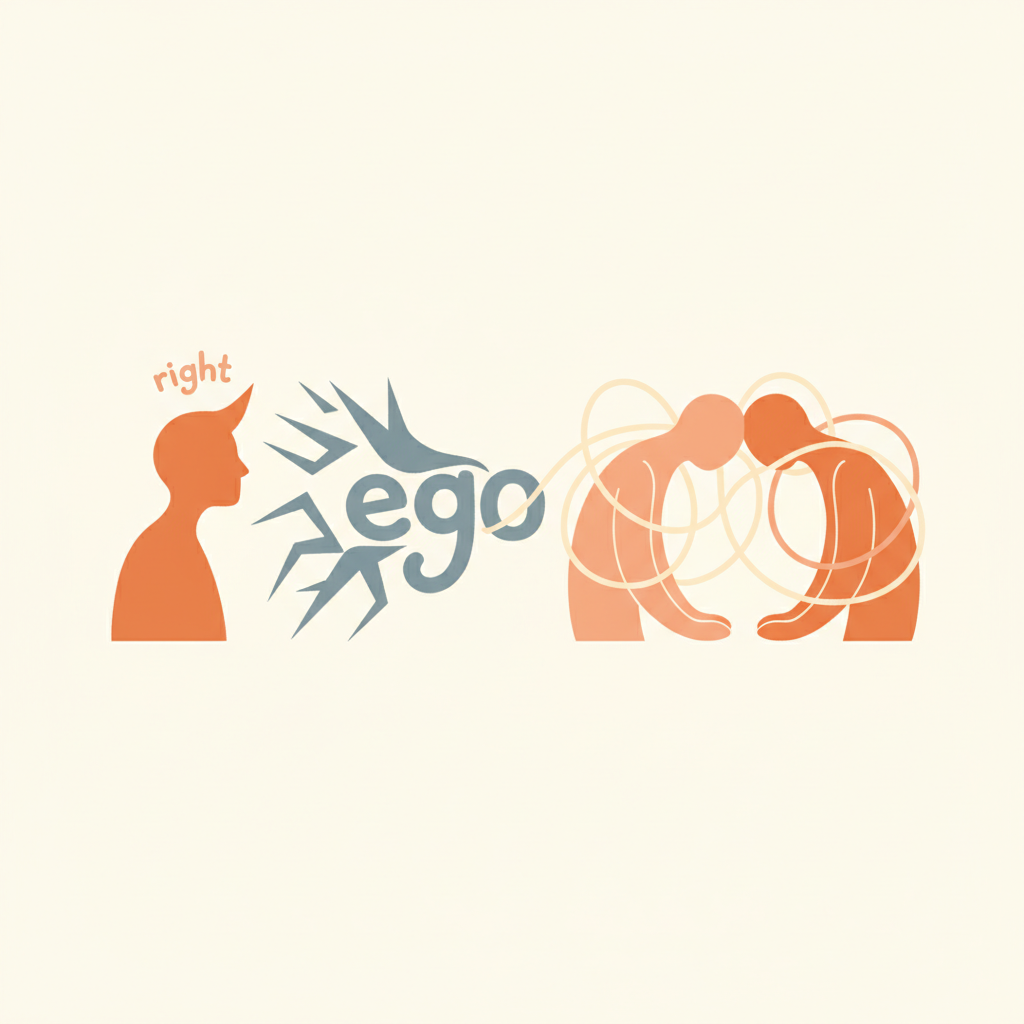
The ego, as contemplative traditions and modern psychology both describe it, is not the healthy sense of self that allows you to function in the world. It is the constructed identity -- the collection of beliefs, stories, and defences that the mind builds around a core question: "Who am I?" In itself, this construction is not harmful. The problem arises when the ego confuses its stories with reality and begins to defend those stories as though survival depended on it. In a relationship, this manifests as a relentless need to be right, to be seen as competent, to never appear weak, and to interpret every challenge from your partner as an attack on your very being.
Thich Nhat Hanh, the Vietnamese Zen master whose work on mindful relationships has influenced millions, wrote: "When another person makes you suffer, it is because he suffers deeply within himself, and his suffering is spilling over. He does not need punishment; he needs help." The same insight applies to the ego in relationships: when your ego reacts with fury to a partner's criticism, it is because something inside you is suffering -- and the ego's response is to attack outward rather than look inward.
How the Ego Operates in Relationships
The ego has a repertoire of moves that are remarkably consistent across people and cultures:
- Scorekeeping: mentally tallying who has done more, given more, or sacrificed more. The ego needs to believe it is "winning" the relationship.
- Defensiveness: hearing any feedback as criticism and any criticism as an existential threat. "You left the kitchen messy" gets processed as "You are a failure."
- Projection: attributing your own uncomfortable feelings to the other. "You're the one who's angry" when in fact you are the one who cannot tolerate your own anger.
- Stonewalling: withdrawing emotionally to punish the other or to protect the ego from further exposure. Gottman identified stonewalling as one of the "Four Horsemen" that predict relationship dissolution.
- Contempt: the ego's ultimate weapon -- dismissing the other's perspective not just as wrong, but as beneath consideration.
The Neuroscience of Ego Activation
When the ego feels threatened, the amygdala -- the brain's alarm system -- fires before the prefrontal cortex (the rational, reflective part of the brain) has time to assess the situation. This is what Daniel Goleman calls an "amygdala hijack." The result is that your body enters fight-or-flight mode during a simple conversation about household chores. Cortisol floods the system, narrowing your field of perception to threat detection. In this state, you literally cannot see your partner's perspective -- not because you refuse to, but because your neurobiology will not allow it.
Research by John Gottman at the University of Washington found that when a person's heart rate exceeds 100 beats per minute during a conflict conversation, their capacity for empathy drops to near zero. This is the ego's physiological signature: the body defending an identity that is not actually under threat.
Recognising Your Ego in Action
The first step in disarming the ego is learning to recognise it. Here are reliable signals:
Physical Signals
- Tightness in the chest or throat
- Clenched jaw
- Shallow, rapid breathing
- Heat rising to the face
- Feeling physically larger or more rigid
Mental Signals
- Rehearsing your counterargument while the other speaks
- Thinking in absolutes: "always," "never," "every time"
- Feeling certain you are 100% right
- The urge to "win" the conversation
- A voice inside saying "I shouldn't have to put up with this"
Relational Signals
- Your partner seems to shrink, go quiet, or become more aggressive
- The conversation starts looping -- the same points repeated
- You feel increasingly distant from the person sitting in front of you
- After the conversation, you feel hollow rather than connected
How to Step Aside and Let Love Through
Practice 1: Name it
When you notice ego activation, silently say to yourself: "That is my ego." Not "I am angry" but "My ego is activated." This linguistic shift creates psychological distance between you and the reaction, which is the foundation of mindful awareness. Neuroscientist Matthew Lieberman at UCLA has shown that labelling an emotion reduces amygdala activation -- a phenomenon he calls "affect labelling."
Practice 2: Breathe before you speak
Take three slow breaths before responding. This is not a coping trick but a neurological intervention: slow breathing activates the vagus nerve, which triggers the parasympathetic nervous system (rest-and-digest), counteracting the fight-or-flight state. Three breaths give your prefrontal cortex time to come back online.
Practice 3: Ask the ego's question
Ask yourself silently: "What am I defending right now?" Often the answer is surprising. You think you are defending a principle, but you are actually defending an image of yourself. You think you are fighting for fairness, but you are fighting for control. The honest answer to this question dissolves much of the ego's energy.
Practice 4: Choose connection over correctness
This is the hardest practice and the most transformative. In the heat of an argument, ask yourself: "Do I want to be right, or do I want to be close?" You cannot have both. Every time you choose closeness, the ego weakens slightly and the relationship strengthens significantly.
The Ego and Emotional Archaeology
At LetsShine.app, the concept of emotional archaeology provides a framework for understanding the ego's deeper roots. Your ego's need to be right in your current relationship often traces back to experiences long before this relationship existed. Perhaps being wrong as a child meant being punished. Perhaps showing vulnerability meant being ridiculed. The ego learned early that it must defend at all costs -- and it carries that programme into your adult relationships, where the rules are entirely different.
Uncovering these roots does not happen overnight. It requires patient self-inquiry, often supported by reflective tools or a skilled guide. But once you see the connection -- once you understand that your furious reaction to your partner's comment about the laundry is actually a forty-year-old defence against feeling inadequate -- the ego loses much of its grip. You do not need to fight it. You simply see through it.
Frequently Asked Questions
Is the ego always bad in relationships?
No. A healthy sense of self -- knowing your values, maintaining boundaries, having self-respect -- is essential. The problem is the defensive ego: the part that treats every disagreement as a battle for survival. The goal is not to eliminate the ego but to recognise when it has taken the wheel.
How do I know if it is my ego or a legitimate concern?
A useful test: if you feel an urgent need to be proven right, the ego is likely involved. If you can express your concern calmly and remain open to being wrong, it is more likely a genuine need. The ego always comes with urgency and certainty; real concerns can hold space for doubt.
Can both partners work on their egos at the same time?
Yes, and it is far more effective when both participate. When one person begins to step back from ego reactivity, it often creates space for the other to do the same. The relational field between two people is a system -- when one element changes, the whole system shifts.
My partner is the one with the big ego. What can I do?
You can only change your own behaviour. Paradoxically, when you stop engaging with your partner's ego -- when you refuse to take the bait and respond from a place of calm -- their ego often quiets as well. The ego needs an adversary; without one, it has nothing to push against.
How long does it take to tame the ego in relationships?
It is a lifelong practice, not a destination. Some shifts happen quickly -- recognising ego activation can be learned in days. Consistently choosing understanding over defensiveness is a slower transformation that deepens over months and years. The question is not "When will I arrive?" but "Am I moving in the right direction?"
Your relationships can improve. Today.
Start free in 2 minutes. No credit card, no commitment. Just you, the people you care about, and an AI that helps you understand each other.
Start free now