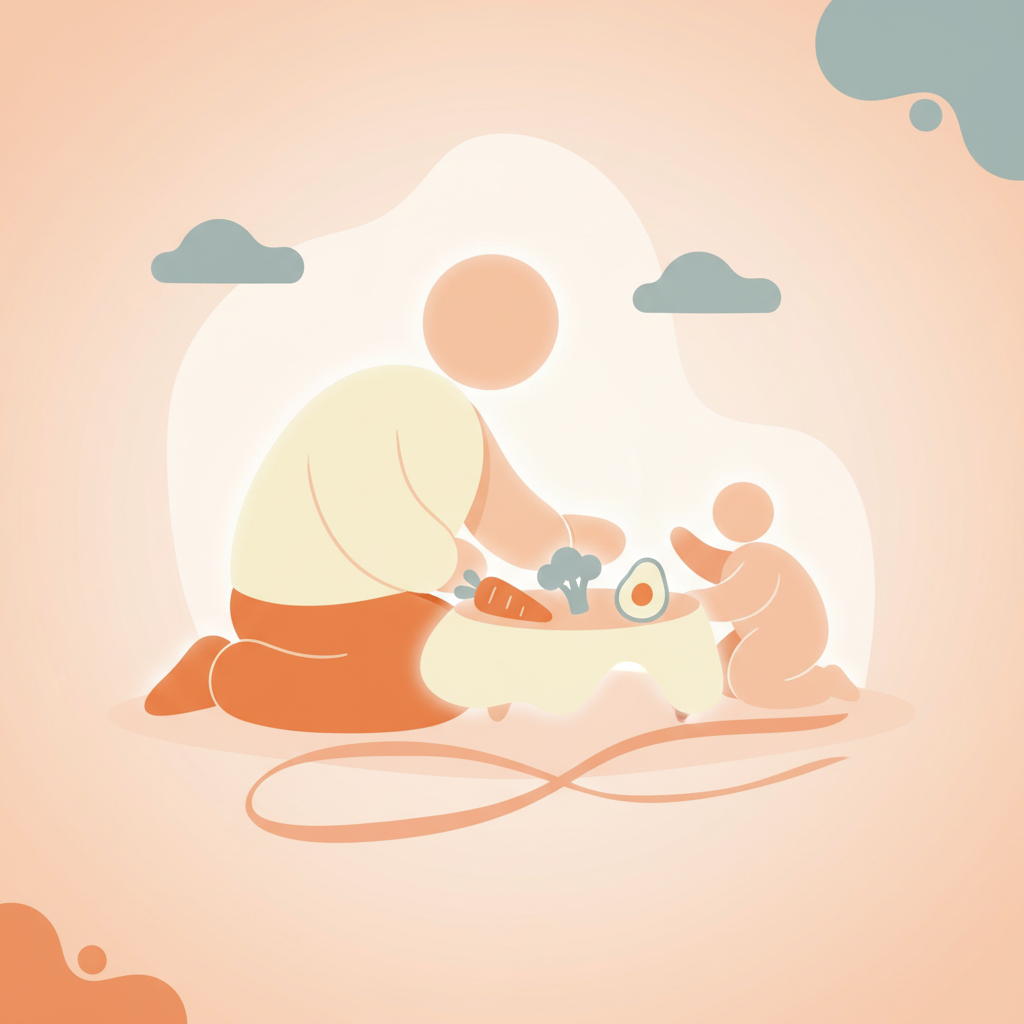
Baby Led Weaning (BLW) is an approach to complementary feeding in which the baby self-feeds with appropriately shaped pieces of food instead of being spoon-fed purees. It was systematised by British health visitor and midwife Gill Rapley and is supported by a growing body of evidence confirming its safety and benefits, provided basic conditions are met.
The AAP and the WHO endorse complementary feeding from around 6 months, and both recognise BLW as a valid method of introducing solids -- whether in its exclusive form or combined with purees (the BLISS approach or mixed complementary feeding).
What Are the Requirements for Starting BLW?
Before offering solids -- whether as purees or finger foods -- the baby must meet all of the following readiness signs, according to the AAP:
- At least 6 months old (around 180 days; never before 4 months).
- Sitting with minimal support and maintaining an upright trunk.
- Loss of the tongue-thrust reflex (no longer pushing food out of the mouth).
- Interest in food (reaching, grabbing, bringing objects to the mouth, watching others eat with curiosity).
- Reasonable hand-to-mouth coordination.
What Foods Are Safe for BLW and How Should They Be Cut?
The golden rule is: soft enough to squash between your finger and thumb, and shaped so the baby can hold it.
| Age |
Shape and Size |
Texture |
Examples |
| 6-7 months |
Finger-length sticks or strips the width of an adult finger |
Very soft, mashable with gums |
Steamed broccoli floret, ripe avocado strip, roasted sweet potato stick, banana with some peel for grip |
| 8-9 months |
Smaller pieces as pincer grasp develops |
Soft but can hold together |
Shredded chicken, small cooked pasta, quartered blueberries, small pieces of soft cheese |
| 10-12 months |
Bite-sized pieces, family foods adapted |
Varied textures |
Diced steamed vegetables, flaked fish, toast fingers with nut butter, cooked beans |
Which Foods Should Be Avoided?
The AAP and Gill Rapley identify the following as choking hazards that must be avoided or modified:
- Whole nuts and seeds (offer as nut butter or finely ground).
- Whole grapes and cherry tomatoes (cut lengthways into quarters).
- Raw carrot sticks (steam until soft).
- Popcorn, hard sweets, marshmallows.
- Whole sausages or hot dogs (cut lengthways, then into small pieces).
- Apple slices (cook until soft or grate).
- Honey before 12 months (botulism risk, not a choking risk).
Gagging vs Choking: Understanding the Difference
One of the biggest fears around BLW is choking. Research by Dr. Amy Brown (Swansea University) and others shows that BLW does not increase the risk of choking compared to spoon-feeding, provided the conditions above are met.
| Gagging |
Choking |
| Normal protective reflex |
Medical emergency |
| Baby is noisy: coughing, retching, eyes watering |
Baby is silent: no sound, may turn blue |
| Baby resolves it independently |
Requires immediate first aid |
| Common in the early weeks of BLW |
Rare when safe foods and supervision are in place |
Every parent starting BLW should take a paediatric first aid course that includes choking management. The AAP strongly recommends this as a prerequisite.
Can BLW Be Combined with Purees?
Absolutely. The BLISS (Baby-Led Introduction to SolidS) approach, researched at the University of Otago, combines self-feeding with iron-rich purees to address potential iron deficiency concerns. Many families find a mixed approach practical and stress-free.
What About Iron and Nutritional Concerns?
Iron is the nutrient most likely to be insufficient from breast milk alone after 6 months. The AAP recommends:
- Offering iron-rich foods from the very first meals: red meat, dark poultry meat, lentils, iron-fortified cereals, tofu.
- Pairing iron-rich foods with vitamin C sources (tomato, citrus, strawberry) to enhance absorption.
- Continuing breastfeeding or formula alongside solids until at least 12 months.
How Can LetsShine.app Support Your BLW Journey?
Starting solids can bring disagreements between partners about what is safe, how much mess is acceptable and how to handle well-meaning but unhelpful advice from grandparents. At LetsShine.app our AI mediator helps families navigate these conversations with empathy, keeping the focus on what truly matters: your child's wellbeing.
Frequently Asked Questions
Will my baby actually eat enough with BLW?
In the early weeks, BLW is about exploration and sensory learning, not caloric intake. Breast milk or formula remains the primary source of nutrition until 12 months. Intake gradually increases as the baby's skills develop.
Is BLW messy?
Yes, and that is a feature, not a bug. Sensory exploration through touch, smell and taste is how babies learn about food. A splash mat and a long-sleeved bib make clean-up easier.
Can premature babies do BLW?
Premature babies should start complementary feeding based on their corrected age and individual developmental readiness. Consult your paediatrician or neonatal team before starting any solids approach.
What if my baby has no teeth?
Babies do not need teeth to eat soft finger foods. Their gums are surprisingly strong and effective at mashing soft textures.
Your relationships can improve. Today.
Start free in 2 minutes. No credit card, no commitment. Just you, the people you care about, and an AI that helps you understand each other.
Start free now