Presence is the state of being fully here -- body, mind, and heart aligned in the same moment, in the same place, with the same person. It sounds simple. It is, in practice, the hardest thing a human being can do. Not because it requires effort in the conventional sense, but because it requires the cessation of all the ways we habitually avoid the present: planning, remembering, judging, checking our phones, rehearsing conversations, worrying about what comes next. Presence is what remains when all of that stops.
Thich Nhat Hanh, who spent decades teaching the practice of presence, wrote: "The most precious gift we can offer anyone is our attention. When mindfulness embraces those we love, they will bloom like flowers." This is not poetry for its own sake. It is a precise description of a neurobiological reality: human beings are wired to respond to the quality of attention they receive. A child whose parent is physically present but mentally absent develops differently from a child whose parent is genuinely there. A partner who receives your full attention -- even for five minutes -- feels it in their nervous system as safety, worthiness, and love.
Why Presence Is So Rare
The modern world is engineered against presence. The average person checks their phone 96 times a day (Asurion, 2019). Social media platforms are designed to fracture attention into ever-shorter fragments. The cult of productivity teaches us that every moment should be "used" for something. The result is a society of people who are extraordinarily efficient at doing and catastrophically impaired at being.
But the obstacles to presence are not only technological. They are psychological. Presence means being with what is -- including the uncomfortable, the uncertain, and the painful. When you are truly present with another person, you are available to their suffering as well as their joy. You cannot selectively show up. Presence is all or nothing. And for many people, the risk of feeling too much is sufficient motivation to keep the inner noise running as a protective buffer.
The Neuroscience of Presence
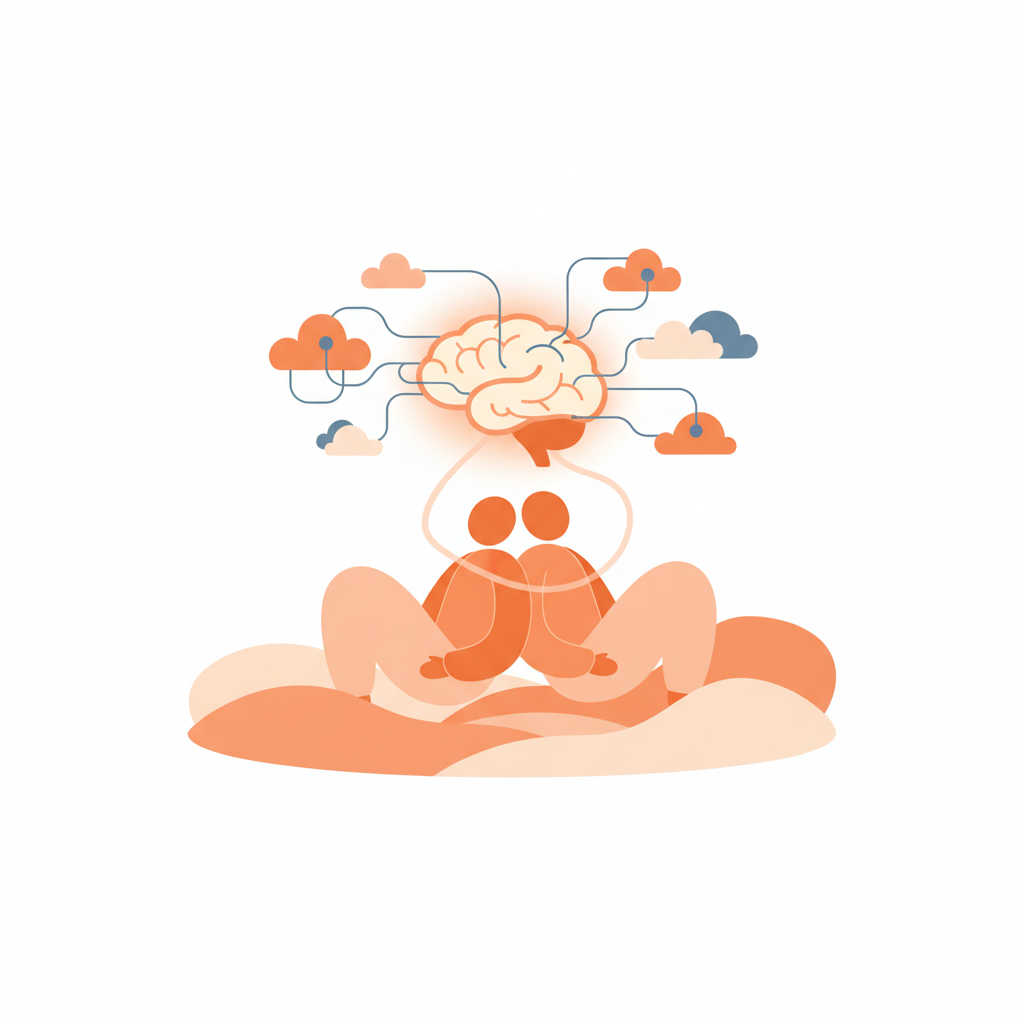
When you are genuinely present with another person, several neurological processes activate simultaneously:
- Mirror neuron system: you begin to internally simulate the other's emotional state, creating the basis for empathy.
- Vagal tone increases: the ventral vagal system (associated with social engagement and calm) becomes dominant, producing a felt sense of safety in both people.
- Default mode network quiets: the DMN, associated with self-referential thinking and mind-wandering, decreases in activity. You stop thinking about yourself and become available to the other.
- Prefrontal cortex engagement: the brain's executive centre comes online, enabling perspective-taking, emotional regulation, and nuanced understanding.
- Oxytocin release: genuine eye contact, attuned listening, and physical proximity trigger the release of oxytocin, deepening the felt sense of trust and connection.
This is not abstract neuroscience. These processes have tangible relational effects. When you are present with your partner, they literally feel safer, more connected, and more willing to be vulnerable. The quality of your attention is, for their nervous system, as real and as consequential as physical nourishment.
What Presence Is Not
It is not performance
Presence is not performing attentiveness. It is not making eye contact while your mind races elsewhere. It is not nodding and saying "mm-hmm" on autopilot. Your partner's nervous system can detect the difference between genuine and performed attention with remarkable accuracy. Faking it does not work.
It is not fixing
When your partner shares something difficult, presence does not mean immediately offering solutions, advice, or reassurance. It means staying with the difficulty -- holding the space for it to exist without rushing to resolve it. Often, what people need is not to have their problem solved but to have their experience witnessed.
It is not constant
No one can sustain full presence indefinitely. It is not a state to be maintained but a quality to be offered intentionally in moments that matter. The question is not "Am I always present?" but "Am I present when it counts?"
It is not passive
Presence involves active inner work: noticing when your mind wanders, gently returning your attention, choosing to stay with discomfort rather than escape it. It looks still from the outside but is intensely active on the inside.
How to Cultivate Presence in Relationships
Practice 1: The Five-Breath Arrival
Before any important conversation, take five conscious breaths. With each breath, release one layer of distraction: the work email, the unfinished errand, the thing that happened this morning, the plan for tomorrow, the judgement about what is about to be said. By the fifth breath, you are closer to here.
Practice 2: One Undivided Minute
Once a day, give your partner sixty seconds of completely undivided attention. Look at them. Listen to them. Be with them. No phone, no multitasking, no agenda. One minute. This practice is deceptively simple and surprisingly transformative. Many people discover they have not given anyone sixty seconds of full attention in years.
Practice 3: The Body as Anchor
When you notice your mind drifting during a conversation, bring your attention to the physical sensations in your body: the feeling of your feet on the floor, the weight of your hands in your lap, the contact of air entering your nostrils. The body is always in the present moment. It is the most reliable anchor for wandering attention.
Practice 4: Presence Through Touch
Hold your partner's hand for two minutes with full awareness. Feel the texture of their skin. The warmth. The subtle movements. Let the touch be the entire experience, not a backdrop to conversation or thought. Conscious touch is one of the most direct pathways to mutual presence.
Practice 5: The Evening Review
Before sleep, replay the day's interactions with your partner and notice: "When was I truly present? When did I drift?" This is not self-criticism but self-observation. Over time, the review reveals patterns (you drift when tired, when stressed, when the topic is uncomfortable) that inform your practice.
Presence as Relational Medicine
Many couples who seek help for their relationships describe the problem in terms of conflict, communication, or incompatibility. But beneath these presenting issues, the most common underlying deficit is a lack of presence. Partners who have not truly seen each other in months or years feel lonely within the relationship. They interpret this loneliness as a lack of love, when it is more often a lack of attention.
At LetsShine.app, the guided relational sessions are designed to create containers for presence -- structured moments when both partners set aside their usual defences and distractions and practise being with each other as they are, right now. The AI mediator supports this by slowing the conversation down, reflecting emotional content back, and gently interrupting the patterns that pull partners away from the present moment.
Is Presence Something You Achieve or Something You Practise?
It is practised. You never achieve it permanently. Presence is not a state that you reach and maintain: it is a decision you renew moment by moment. There will be minutes of full presence and hours of distraction. What matters is not the ratio but the direction: every time you notice you have drifted and return, you are practising. And every practice, however small, strengthens your capacity to be here. That "returning" -- again and again, without judging yourself for having left -- is the heart of contemplative practice and the heart of every relationship worth having.
Frequently Asked Questions
Is presence the same as attention?
Not exactly. Attention is a component of presence, but presence is wider: it includes emotional availability, openness without judgement, and the willingness to do nothing except be. You can pay analytical attention (studying the other) without being truly present (available to them).
How can I be present if my life is very stressful?
Start with micro-moments: three seconds of conscious eye contact, one minute of uninterrupted listening, the simple gesture of putting your phone away when your partner speaks. Presence does not require time: it requires intention. One minute of full presence is worth more than an hour of distracted company.
Will my partner notice if I start practising presence?
Yes, and probably sooner than you expect. Human beings are extraordinarily sensitive to the quality of attention they receive. Your partner will feel that something has changed -- even if they cannot name what -- because presence creates a quality in the relational space that absence cannot imitate.
Does presence diminish over years of relationship?
It tends to decline because familiarity breeds automatism: we believe we already "know" the other and stop looking at them with curiosity. But presence can be recovered at any age and any stage of a relationship. In fact, couples who recover it after years of autopilot describe it as a renewed falling in love -- but deeper.
Does being present mean I cannot think about other things when I am with my partner?
It is not about never thinking of anything else. It is about choosing where you place your attention when the moment calls for it. If your partner is telling you something important, presence is the priority. If you are reading quietly together on the sofa, you do not need active presence mode. Presence is selective, not permanent.