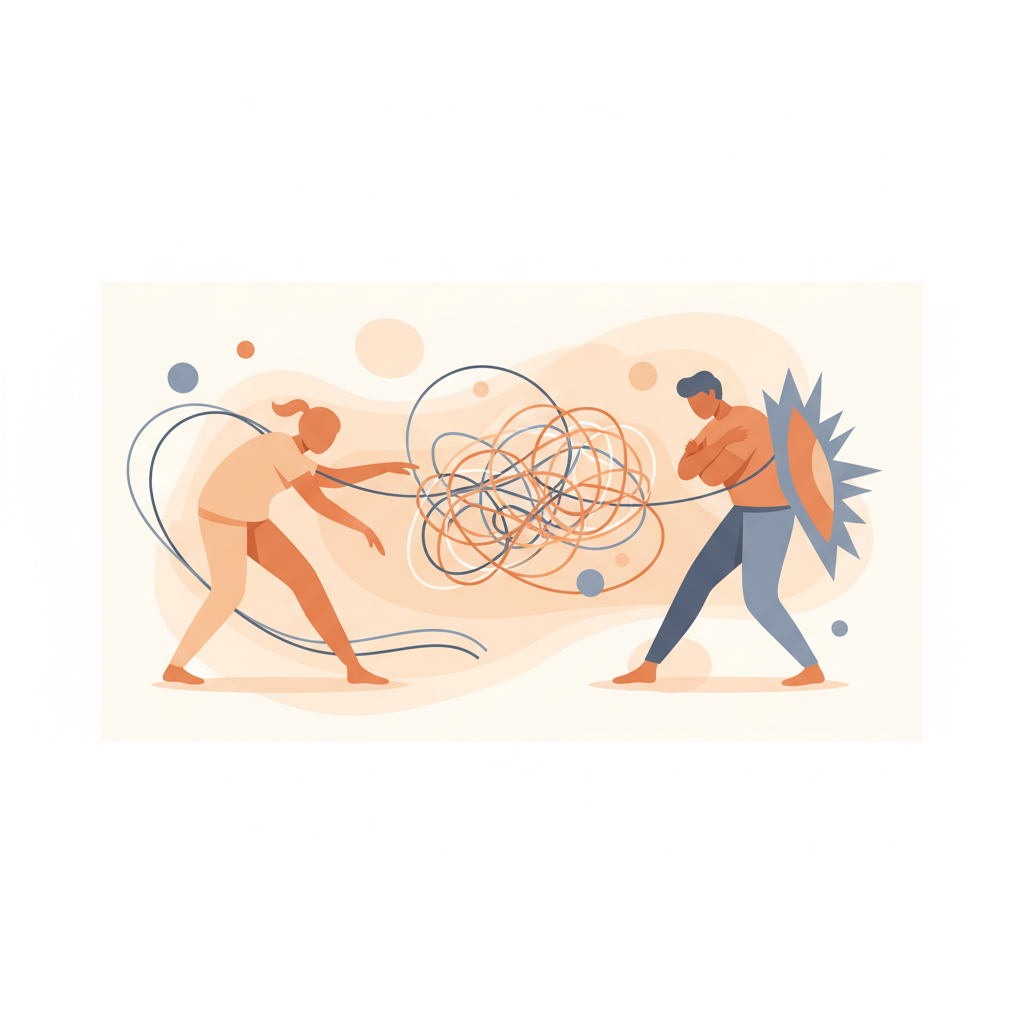
The combination of a person with anxious attachment and another with avoidant attachment is, according to research, the most frequent couple configuration and simultaneously the most conflictual. Attachment theory, formulated by John Bowlby in the second half of the twentieth century and applied to adult relationships by researchers like Cindy Hazan, Phillip Shaver, and — most influentially in the clinical realm — Sue Johnson, explains why these two ways of bonding attract magnetically and, at the same time, destroy each other if awareness and relational work do not intervene. The anxious person seeks closeness, validation, and explicit reassurance; the avoidant person seeks autonomy, space, and emotional self-regulation. What the anxious partner reads as coldness is actually the avoidant's survival strategy. What the avoidant partner reads as control is actually the anxious partner's attachment protest.
| Attachment style |
Origin in childhood |
Behaviour in relationship |
Deep need |
Core fear |
| Anxious (preoccupied) |
Inconsistent caregiver: sometimes available, sometimes absent |
Seeks closeness, asks for validation, hypervigilant to signs of rejection |
"I need to know you are there" |
Abandonment |
| Avoidant (dismissive) |
Emotionally distant or rejecting caregiver |
Withdraws from emotional intensity, minimises importance of emotions |
"I need space to feel safe" |
Invasion, loss of autonomy |
| Secure |
Consistent, available, and responsive caregiver |
Comfortable with both intimacy and autonomy |
"I can move close and away without fear" |
— |
Why Do Anxious and Avoidant Partners Attract Each Other?
The answer has several layers. From the perspective of attachment theory, Bowlby explained that insecure attachment styles are adaptive strategies: the anxious child learned to amplify their signals of need because their caregiver only responded when the signal was very intense; the avoidant child learned to suppress their needs because their caregiver responded to emotional demands with rejection or discomfort.
In adulthood, these strategies become automatic relational patterns. And they attract each other for a paradoxical reason: each confirms the relational model the other learned in childhood. The anxious partner recognises in the avoidant the intermittency they experienced with their caregiver — sometimes available, sometimes unreachable — and this feels familiar (they confuse familiarity with love). The avoidant partner recognises in the anxious the emotional intensity they feared as a child, yet simultaneously needs in order to feel desired.
Harville Hendrix would explain it through the Imago lens: "We fall in love with whoever activates our childhood wound, because the unconscious is seeking a second chance to heal." The anxious person chooses the avoidant to finally make the unreachable person stay. The avoidant person chooses the anxious to finally feel they can be loved without losing their identity.
How Does the Anxious-Avoidant Trap Manifest?
Sue Johnson describes the cycle with clinical precision:
- The anxious partner perceives distance (real or interpreted) and activates their attachment protest: they question, insist, complain, demand.
- The avoidant partner perceives pressure and activates their self-protection strategy: they shut down, retreat, rationalise, minimise.
- The avoidant's withdrawal confirms the anxious partner's fear (abandonment), intensifying their pursuit.
- The anxious partner's pursuit confirms the avoidant's fear (invasion), intensifying their withdrawal.
- The cycle escalates until one explodes (the anxious) or freezes (the avoidant).
Gottman quantifies this dynamic: in couples with the pursuer-withdrawer pattern, the withdrawer's (avoidant's) heart rate exceeds 100 beats per minute during conflicts — their body enters "flooding" mode — while the pursuer (anxious) interprets the withdrawal as proof of not being loved. Both suffer, but their suffering is invisible to each other.
Can an Anxious-Avoidant Couple Work?
Yes, with conscious effort. Sue Johnson has demonstrated that EFT can help these couples develop what she calls earned secure attachment: not the secure attachment that develops naturally in a healthy childhood but the one built consciously in the adult relationship through corrective bonding experiences.
Gary Chapman offers a practical angle: often, the anxious partner needs quality time and words of affirmation, while the avoidant shows love through acts of service or brief physical touch. When each learns the other's language, communication improves dramatically.
Esther Perel adds a cultural dimension: "We live in a society that glorifies independence and pathologises dependence. But needing someone is not weakness; it is biology. The problem is not needing — it is not knowing how to ask for what you need in a way the other can provide."
How Can the Anxious Partner Calm Their Attachment System?
- Identify triggers: what situations activate your relational anxiety? An unanswered text? A night your partner prefers to be alone? Naming the trigger reduces its power.
- Distinguish the alarm from real danger: your attachment system interprets distance as threat of abandonment. But distance is not abandonment. Gottman recommends a "self-regulation pause": before reacting, ask "Am I reacting to what is happening now or to what happened in my childhood?"
- Develop self-soothing: meditation, exercise, journaling. Not to replace connection with your partner but to avoid depending exclusively on it.
- Communicate the need, not the demand: "I feel insecure when you do not reply to my message. Could you let me know if you are going to be a while?" instead of "You never answer me!"
How Can the Avoidant Partner Open Up Without Feeling Invaded?
- Recognise that withdrawal is also a strategy, not a virtue: Johnson notes that avoidants often believe they are "independent" when they are actually disconnected. Emotional independence does not exist; we are social mammals.
- Practise vulnerability in small doses: you do not need to open up completely at once. Sharing a small feeling — "Today was a tough day" — is enough to start.
- Understand that the anxious partner's pursuit is love poorly expressed: when your partner pursues with questions or complaints, they are not trying to control you; they are saying "I need you and I do not know how to ask without you running away."
- Turn toward bids: every time your partner seeks connection — even if it feels uncomfortable — try to respond. You do not need to feel the emotion intensely; you just need to be present.
Is It Possible to Change Attachment Style?
Yes. Adult attachment research shows that between 20 % and 30 % of people shift their attachment style over their lifetime, generally toward greater security, through reparative relationships (partner, therapy, deep friendships). Johnson calls this "earned secure attachment" and considers it one of the most transformative outcomes of EFT.
Frequently Asked Questions
How do I know if I have anxious or avoidant attachment?
Anxious attachment manifests as hypervigilance to signs of rejection, constant need for validation, and fear of abandonment. Avoidant attachment manifests as discomfort with intimacy, a need for space, and a tendency to minimise emotions. On LetsShine.app, the AI can help you explore your attachment style through questions based on Bowlby's and Johnson's theories.
Is it inevitable that anxious and avoidant partners destroy each other?
No. With awareness of the pattern, honest communication, and ideally professional support (EFT or Gottman), these couples can build a bond that is deeper and more secure than many "secure + secure" couples who never had to do the work.
Is attachment genetically inherited?
Not directly. Attachment style is transmitted through relational experience with caregivers, not through genes. This means that parents with insecure attachment can raise children with secure attachment if they consciously work on how they relate.
Can individual therapy help with insecure attachment?
Yes. Johnson recommends individual therapy as a complement when one partner needs to work through attachment traumas that overwhelm the couple context. The therapeutic relationship itself can be an experience of secure attachment.
What book do you recommend for understanding attachment in couples?
Hold Me Tight by Sue Johnson is the most accessible reference. For deeper exploration of attachment styles, Attached by Amir Levine and Rachel Heller is excellent. Gottman addresses attachment in What Makes Love Last.
Your relationships can improve. Today.
Start free in 2 minutes. No credit card, no commitment. Just you, the people you care about, and an AI that helps you understand each other.
Start free now