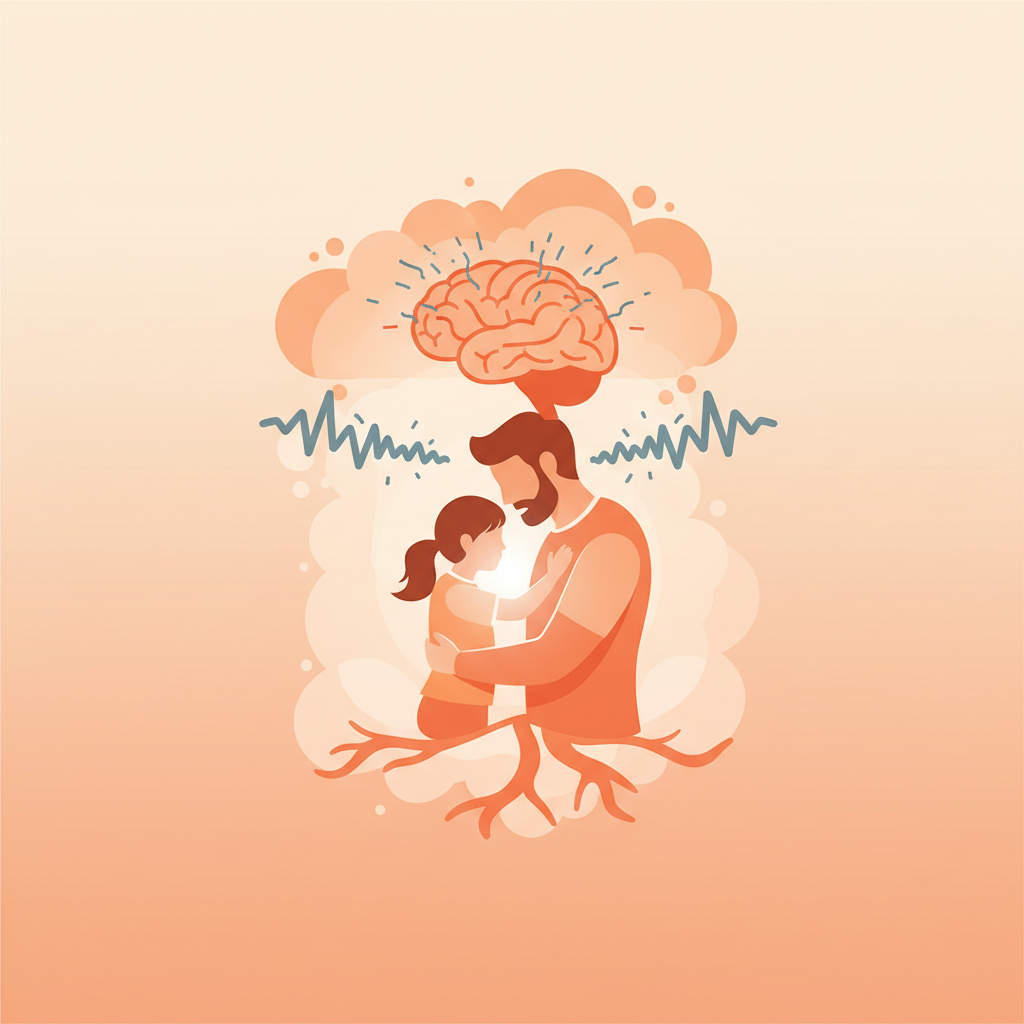
Yelling is the most widespread and least questioned disciplinary tool in parenting. Studies published in Child Development estimate that over 90% of parents acknowledge having yelled at their children at some point, and approximately 50% do so regularly. However, developmental neuroscience has demonstrated over the past two decades that yelling, far from correcting behavior, produces the opposite effect: it activates the brain's alarm system, floods developing structures with cortisol, disconnects the prefrontal cortex, and teaches the child that power is exercised with volume, not with reason. Yelling is not educating — it is overwhelming a brain that does not yet have the tools to process the threat.
What Happens in the Brain When You Yell
| Phase |
What Happens in the Child's Brain |
Consequence |
| 1. Threat detection |
Amygdala detects the yell as danger and activates the stress system |
Fight, flight, or freeze response |
| 2. Hormonal flood |
The HPA axis releases cortisol and adrenaline |
Heart rate rises, muscles tense, thinking shuts down |
| 3. Prefrontal disconnection |
Prefrontal cortex disconnects due to excess cortisol |
Child loses ability to reason, listen, and learn |
| 4. Emotional reaction |
Child cries, freezes, yells back, or submits |
No learning, only survival |
| 5. Residual stress |
Cortisol takes 20 minutes to several hours to metabolize |
Irritability, concentration difficulty, sleep disturbance |
Why Does the Brain Interpret a Yell as a Threat?
Because for a mammal's nervous system, a loud, sudden sound coming from a larger figure is indistinguishable from real danger. The amygdala — the brain's emotional sentinel — does not analyze whether the yell is justified or whether the parent has good intentions. It simply detects threat and activates the stress response in milliseconds, long before the prefrontal cortex can evaluate the situation.
Dr. Dan Siegel explains in The Whole-Brain Child that this response is especially intense in children because their amygdala has been fully operational since birth, while the prefrontal cortex — which could contextualize and reduce the alarm — does not mature until age 25. The child cannot tell themselves "my parent is yelling because they're stressed, not because I'm in danger." Their brain only registers: "Danger. Protect yourself."
What Effects Does Chronic Yelling Have on Brain Development?
An isolated yell in a context of secure attachment does not cause significant neurological damage. The problem appears when yelling becomes the habitual mode of communication. Research distinguishes between three types of stress:
- Positive stress: brief, moderate, with an available adult. Strengthens resilience.
- Tolerable stress: intense but temporary, with support afterward. Manageable.
- Toxic stress: intense, prolonged, or repetitive, without a regulating adult. Alters brain architecture.
Habitual yelling generates toxic stress. Dr. Bruce Perry's research at the Child Trauma Academy shows that "the brain adapts to the environment it perceives. If it perceives a threatening environment, it develops a brain designed for survival, not for learning, creativity, or connection." The documented effects include:
- Amygdala hypersensitivity: the child develops a hyperactive alarm system that interprets neutral signals as threats.
- Hippocampal reduction: excess cortisol damages hippocampal neurons, affecting memory and learning.
- Delayed prefrontal maturation: chronic stress conditions slow the development of the prefrontal cortex — the very structure the child needs for self-regulation.
- Altered reward circuits: the stressed brain seeks quick relief (screens, food, impulsive behavior).
Does Yelling Work to Make the Child Obey?
In the short term, sometimes yes. But what the parent interprets as "obedience" is actually a freeze response: the child shuts down from fear, not understanding. If your child goes quiet when you yell, they have not learned anything about what they did wrong. They have learned to be afraid of you.
Furthermore, research by Gottman and others demonstrates that yelling loses effectiveness over time: the brain habituates to the threat and the child needs increasingly intense stimuli to react. What started as an occasional yell becomes a pattern of escalation that can lead to verbal or physical aggression.
What to Do Instead of Yelling
1. Anticipate Your Own Overwhelm
Identify the signals in your own body before the yell: jaw tension, heat in the chest, accelerating pulse. When you detect those signals, stop. Breathe. If necessary, step away briefly: "I need a minute to calm down."
2. Use a Firm but Low Tone
Firmness does not require volume. A "stop" said in a low, serious tone with direct eye contact is more effective than a yell, because it activates attention without activating the alarm.
3. Name What You Feel
"I am very frustrated right now. I need to calm down before we talk about this." When you name your emotion, you model emotional regulation. Your child learns that feeling anger is legitimate; yelling is not.
4. Connect Before You Correct
Siegel and Perry agree: first validate the child's emotion, then set the boundary. "I understand you're angry. But hitting is not okay. What could you do next time?"
5. Repair When It Happens
Because it will happen. Nobody is perfect. Siegel insists that repair is as powerful as prevention: "I yelled at you and I'm sorry. I was very angry and I did not manage it well. Next time I'm going to try to handle it differently." That apology teaches the child something fundamental: adults make mistakes too, and taking responsibility is possible.
Why Is It So Hard to Stop Yelling?
Because yelling is an automatic response rooted in your own history. If you grew up in a home where people yelled, your brain learned that this is how boundaries are set. Mirror neurons did their work: you copied what you saw.
The good news is that neuroplasticity works in both directions. If your brain can learn to yell, it can learn to pause. But it requires conscious practice and, often, professional support or reflective spaces.
At LetsShine.app we accompany parents in this process. Our AI can help you identify the moments when you lose control, understand what triggers them, and build alternative responses. We do not judge — we accompany.
Is Yelling the Same as Abuse?
Legally, not always. But emotionally, the impact can be similar. A study published in Child Abuse & Neglect demonstrated that chronic verbal aggression (yelling, insults, humiliation) produces effects on the brain comparable to physical abuse: the same amygdala hyperactivation, the same hippocampal reduction, the same difficulty regulating emotions.
This does not mean that yelling once makes you abusive. It means that accumulation matters, and that examining your own pattern is an act of responsibility and love.
Frequently Asked Questions
Does a single yell damage my child's brain?
No. An isolated yell in a context of secure attachment does not cause neurological damage. What causes damage is the repeated pattern: yelling as a habitual form of communication generates toxic stress that affects brain development.
How do I distinguish between firmness and yelling?
Firmness is a serious, low, clear tone that conveys authority without threat. Yelling is a volume increase that conveys loss of control. The difference lies in who is in charge of your brain at that moment: the prefrontal cortex (firmness) or the amygdala (yelling).
What do I do if I yell and then feel guilty?
Repair. Approach your child, acknowledge what you did, and apologize. Repair teaches something fundamental: that mistakes exist, they can be acknowledged, and they do not destroy the bond. Siegel says repair can be even more formative than never having yelled at all.
Can children who have been yelled at recover?
Yes. Neuroplasticity allows the brain to reorganize when conditions change. If the yelling pattern is replaced with a respectful communication model, the child's brain can repair much of the damage. The key is the consistency of the change.
Is it true that "I was yelled at and I turned out fine"?
It is a common phrase, but misleading. The fact of having survived a hostile environment does not mean it left no mark. Many adults who were raised with yelling replicate the pattern with their own children without being aware of it, which confirms that the impact exists even if it is not visible at first glance.