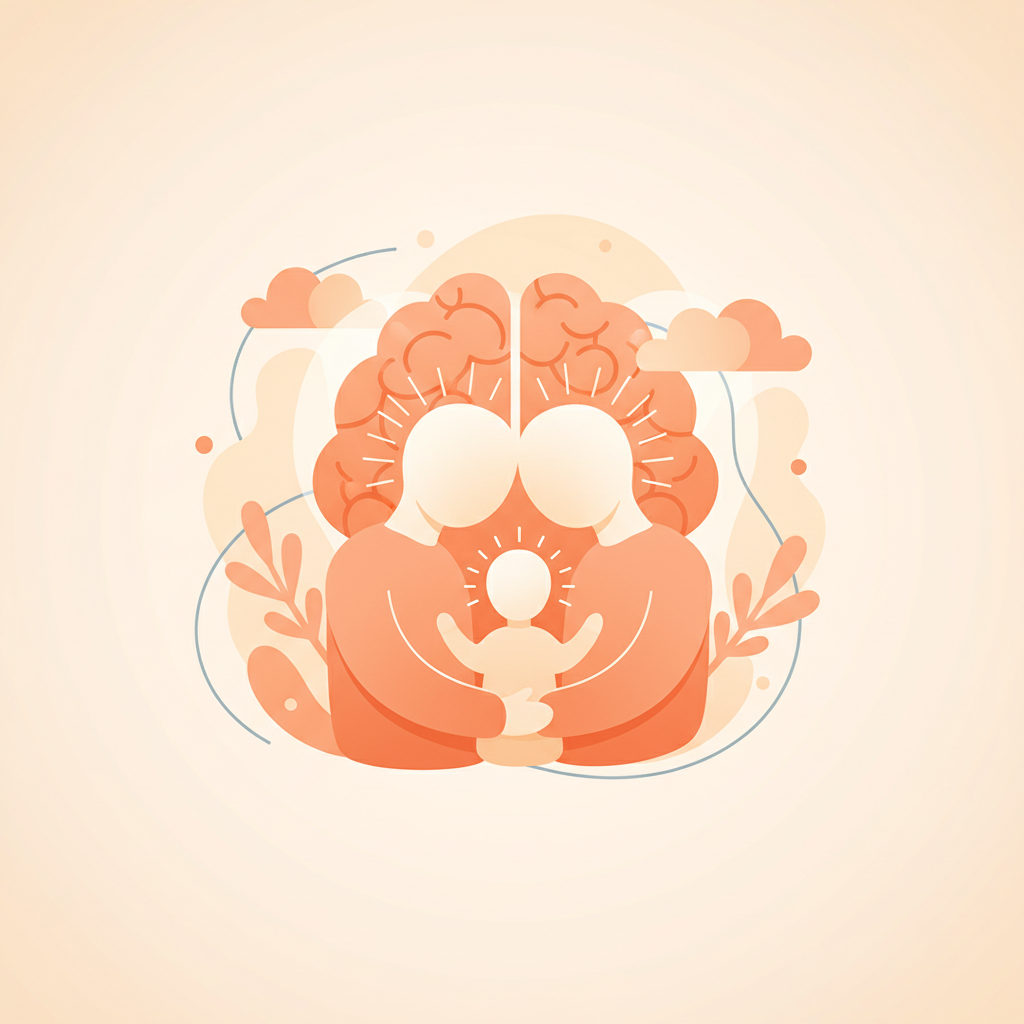
The human brain is the most complex organ in the known universe: one hundred billion neurons connected by over one hundred trillion synapses that develop and reorganize dramatically during the first years of life. Dr. Dan Siegel, clinical professor of psychiatry at UCLA and co-director of the Mindful Awareness Research Center, has spent decades translating this neuroscience into practical guidance for parents. His central thesis, shared with Dr. Bruce Perry and other leading developmental neuroscientists, is as simple as it is transformative: good parenting is not about controlling your child — it is about accompanying the development of their brain while respecting its timeline and needs.
The Architecture of Your Child's Brain
| Brain Layer |
Common Name |
Primary Function |
Matures... |
| Brainstem |
Reptilian brain |
Survival: breathing, hunger, sleep, alertness |
From birth |
| Limbic system |
Emotional brain |
Emotions, attachment, affective memory |
First 3-6 years |
| Neocortex (prefrontal cortex) |
Rational brain |
Planning, impulse control, empathy |
Until age 25 |
Why Does Brain Architecture Matter for Parenting?
Dr. Dan Siegel uses a powerful metaphor in The Whole-Brain Child: think of your child's brain as a house under construction. The foundation is the reptilian brain (basic needs met), the walls are the emotional brain (secure attachment and emotional regulation), and the roof is the rational brain (self-control, critical thinking, empathy). Trying to install the roof before building the walls is the most common mistake in traditional parenting — demanding self-control from a child whose emotional brain has not yet developed.
The key ideas that neuroscience supports:
- Love does not spoil: physical affection and emotional availability do not create entitled children. On the contrary, secure attachment is the foundation upon which autonomy is built.
- Boundaries are necessary, but delivery matters: a boundary set with respect strengthens the rational brain; a boundary set with yelling activates the reptilian brain and blocks learning.
- Your child is not misbehaving on purpose: when a child has a meltdown, the emotional brain has taken over because the rational brain cannot yet intervene.
- Example is the most powerful parenting tool: mirror neurons mean children learn more from what they see than from what they are told.
What Happens When You Understand Brain Development?
When you understand that your three-year-old's prefrontal cortex is not mature, you stop interpreting their tantrums as personal attacks and start seeing them for what they are: a brain that feels overwhelmed and lacks the tools to regulate itself. Dr. Bruce Perry, in The Boy Who Was Raised as a Dog, reinforces this: a child's behavior is a window into their neurological state, not a reflection of their character.
This understanding radically changes the adult's response. Instead of "stop crying" (which asks the child to do something their brain cannot do), the informed response is: "I can see you're very upset. I'm right here with you." That sentence activates the attachment system, reduces cortisol, and teaches emotional regulation through modeling.
The Three Brains and How They Develop
The Reptilian Brain: Survival
This is the oldest structure and the first to mature. It controls vital functions and fight-flight-freeze responses. When a child is hungry, tired, or afraid, this brain takes absolute control. You cannot educate a child who is hungry, exhausted, or feels unsafe. Meeting basic needs is not indulgence — it is building the foundation.
The Emotional Brain: Connection
The limbic system is the seat of emotions and attachment. It develops intensely during the first six years, and its quality depends directly on the relationship with attachment figures. As Dr. Perry emphasizes, "relationships are the agents of change" — the quality of connection with caregivers literally shapes the emotional circuitry of the developing brain.
The Rational Brain: Self-Control
The prefrontal cortex is the last region to mature — a process that does not conclude until around age 25. It is responsible for planning, impulse control, decision-making, and cognitive empathy. Siegel calls it the "upstairs brain" and explains that when a child "loses control," what is really happening is that the downstairs brain has disconnected the upstairs brain. It is not a failure of the child — it is neurobiology.
Applying Brain Science in Everyday Parenting
Neuroscience offers concrete strategies any family can incorporate:
- Connect before you correct: before explaining why something is wrong, validate the child's emotion. "I understand you're angry because you wanted to keep playing" before "but it's time for dinner."
- Use positive language: the child's brain processes "walk slowly" better than "don't run." Positive instructions activate the prefrontal cortex; negations confuse it.
- Play a lot: play is the brain's natural mechanism for learning. Every minute of free play strengthens neural connections that no worksheet can replicate.
- Allow frustration (with accompaniment): moderate frustration — always with an available adult — is the gym for the rational brain. Solving everything for the child atrophies their capacity for self-regulation.
Why Yelling and Punishment Backfire
Neuroscience demonstrates that yelling and punitive discipline produce the opposite of the intended effect. A shout activates the child's amygdala (fear response), floods their brain with cortisol, and disconnects the prefrontal cortex. The child obeys out of fear, not understanding, and real learning does not occur. Dr. Siegel summarizes it well: "Every time you yell, your child learns to yell. Every time you listen, your child learns to listen."
Arbitrary punishments present the same problem: they teach obedience through threat, not conviction. Brain-informed discipline prefers natural consequences and repair: "You broke your brother's toy, so let's think together about how we can fix it or how you can make it up to him."
At LetsShine.app we believe that understanding your child's brain is the first step toward more conscious, connected parenting. Our AI can help you reflect on your response patterns and discover why you react the way you do to your children's behavior.
Where to Start Today
- Observe: the next time your child has a meltdown, before reacting, ask yourself "which brain is in charge right now?"
- Connect: get down to their level, make eye contact, validate the emotion. The rational brain only activates when the emotional brain feels safe.
- Read: The Whole-Brain Child by Dr. Dan Siegel and The Boy Who Was Raised as a Dog by Dr. Bruce Perry are two essential books for any parent who wants to raise children with a scientific foundation.
Frequently Asked Questions
At what age does a child's rational brain mature?
The prefrontal cortex, responsible for self-control, planning, and empathy, does not complete its maturation until approximately age 25. This means asking a 4-year-old to "control themselves" is asking for something their biology does not yet consistently allow.
Does brain-based parenting mean no boundaries?
Absolutely not. Brain-informed parenting strongly supports boundaries as a fundamental tool. What it proposes is that boundaries be set with firmness and warmth, without yelling or arbitrary punishment. A clear, calm boundary strengthens the prefrontal cortex; a boundary imposed with aggression disconnects it.
Can I start applying these principles at any age?
From birth. In fact, the first three years are the most critical for brain architecture. The brain develops from the bottom up: first secure basic needs, then build the emotional bond, and only then can self-control develop.
At what age can I reason with my child?
Basic reasoning becomes possible around age 4-5, but always after connecting emotionally first. Before that age, emotional language (tone, touch, presence) is far more effective than logical explanations.
Can the AI at LetsShine help me with parenting?
Yes. LetsShine.app offers a space where parents can reflect on their parenting patterns, understand why they react certain ways, and explore alternatives that are more respectful of their children's brain development. The AI does not replace a professional, but offers support available at any time.
Your relationships can improve. Today.
Start free in 2 minutes. No credit card, no commitment. Just you, the people you care about, and an AI that helps you understand each other.
Start free now