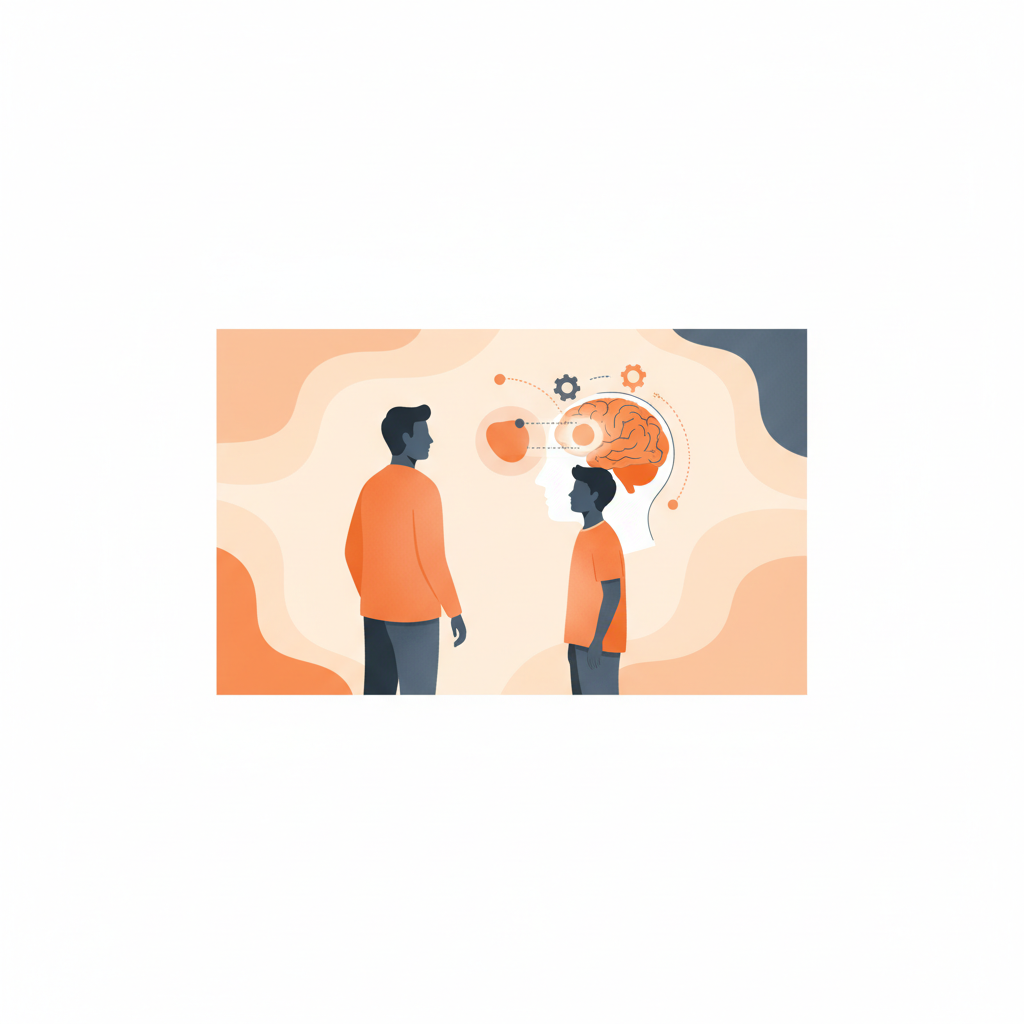
The teenage brain is an organ in the middle of a neurobiological overhaul that, between roughly 10 and 25, undergoes a restructuring as profound as the one that occurs in the first three years of life. This process — called synaptic pruning and myelination — particularly affects the prefrontal cortex, the region responsible for judgement, planning and impulse control. It explains most of the behaviours that baffle families: impulsivity, risk-seeking, emotional reactivity and social hypersensitivity.
Understanding this neurological reality is not an academic exercise; it is the foundation for stopping yourself from interpreting your teen's behaviour as a personal attack and starting to see it as a manifestation of a brain that is still learning how to operate.
| Brain structure |
Function |
Status in adolescence |
| Prefrontal cortex |
Planning, judgement, impulse control |
Immature — not fully developed until ~25 |
| Amygdala |
Emotional processing, threat detection |
Hyperactive, dominates responses |
| Limbic system |
Emotions, motivation, reward |
Highly active, drives sensation-seeking |
| Nucleus accumbens |
Reward circuit, dopamine |
Responds with greater intensity to novel stimuli |
| Corpus callosum |
Communication between hemispheres |
Undergoing myelination |
Why Does the Prefrontal Cortex Take So Long to Mature?
The prefrontal cortex is the last brain region to complete development. Frances Jensen, chair of neurology at the University of Pennsylvania and author of The Teenage Brain, compares it to a house mid-renovation: the foundations are there, the walls are up, but the work continues — and you have to live in it in the meantime. This area is responsible for:
- Evaluating consequences: imagining what will happen if I do this.
- Impulse control: pausing before acting.
- Perspective-taking: putting yourself in someone else's shoes.
- Emotional regulation: modulating the intensity of what you feel.
When you ask your teenager "What were you thinking?", the neurologically honest answer would be: "Not much, because the part of my brain that thinks before acting is not yet running at full capacity."
Why Do Teenagers Seek Risk?
Neuroscience has demonstrated that during adolescence there is a temporary imbalance between the limbic system (emotional, impulsive, reward-oriented) and the prefrontal cortex (rational, reflective, consequence-oriented). The limbic system matures first, creating what researchers call the maturational gap: a powerful engine with brakes that are still soft.
Furthermore, the nucleus accumbens — the hub of the reward circuit — shows heightened dopamine sensitivity during adolescence. This means that novel, intense, socially relevant experiences generate a proportionally greater hit of pleasure than they would in an adult. Risk, quite literally, feels better at 15 than at 40.
Laurence Steinberg's research at Temple University showed that teenagers take significantly more risks when peers are present than when alone — a pattern not seen in adults. The peer effect on risk is neurological, not just social pressure.
Does the Amygdala Hijack My Child?
The amygdala acts as the brain's alarm system. When it perceives a threat — a critical remark, a "no", a disapproving glance — it fires a fight-or-flight response before the prefrontal cortex has time to assess whether the threat is real.
In an adult, the prefrontal cortex usually moderates that response within milliseconds. In a teenager, moderation is slower, less efficient and more inconsistent. The result: explosive reactions that surprise the adolescent themselves afterward. "I don't know why I shouted" is not an excuse; it is an accurate description of what happened in their brain.
What Is Synaptic Pruning and Why Does It Matter?
During childhood, the brain generates an excess of neural connections (synapses). In adolescence, a pruning process begins: connections that are used get strengthened; those that are not get eliminated. This is the use it or lose it principle.
The implications are direct:
- Activities your teenager practises regularly (music, sport, reading, coding) will strengthen those neural networks.
- Those they abandon will weaken.
- The adolescent brain is, literally, sculpting itself.
Myelination — the coating of nerve fibres with a myelin sheath that speeds up signal transmission — advances from the back of the brain toward the front. That is why sensory and motor functions mature before executive functions.
Why Do Friends Matter More Than Parents?
The adolescent brain is wired to prioritise social connection with peers. Oxytocin and dopamine are released with greater force during peer interactions than during family interactions. It is not disrespect; it is biology.
Siegel calls this the social drive of adolescence: the brain needs to belong to a group outside the family to prepare for adult life. Social rejection activates the same brain regions as physical pain — functional MRI studies have confirmed this — which explains why a teenager can be devastated by an online comment that an adult would find trivial.
How Can I Use This Knowledge as a Parent?
Knowing the neuroscience of the teenage brain does not mean excusing every behaviour. It means adjusting your expectations and your strategy:
- Do not expect consistency: their brain is inconsistent. Yesterday they were mature; today they are impulsive. Both are them.
- Anticipate rather than react: if you know that high social-stimulation situations increase risk, prepare conversations before the party, not after the problem.
- Offer scaffolding, not walls: instead of banning, create structures that let them experiment with a safety net.
- Protect sleep: the teenage brain needs 8 to 10 hours of sleep to consolidate memory and regulate emotions. Sleep deprivation amplifies impulsivity and irritability.
- Practise neurological empathy: when they lose control, remember that their prefrontal cortex cannot yet do what you are asking. Do not shout; help them regulate, and talk once the storm passes.
At LetsShine.app, we use these neuroscientific principles to design family mediation sessions that account for the reality of the teenage brain — not the fantasy of how it should behave.
Frequently Asked Questions
At what age is the brain fully mature?
Current research places full maturation of the prefrontal cortex at around 25, although there is individual variability. This does not mean a teenager cannot make good decisions — it means they will do so less consistently than an adult, especially under emotional or social pressure.
Do girls mature earlier than boys?
On average, the female brain completes certain myelination processes 1-2 years earlier, which may translate into greater verbal, emotional and self-regulation capacity at younger ages. However, individual variability is enormous. Avoid stereotypes.
Does alcohol or cannabis affect the teenage brain differently?
Yes. A brain undergoing remodelling is significantly more vulnerable to toxic substances. Alcohol can interfere with myelination and synaptic pruning; cannabis can alter the development of dopaminergic circuits. Longitudinal studies show long-term cognitive effects when habitual use begins before 21. If you suspect regular use, consult a professional.
Does technology "damage" the teenage brain?
Not directly or irreversibly, but excessive screen use can interfere with sleep, reduce physical activity, limit face-to-face interaction and over-stimulate the reward circuit. The recommendation is not to demonise technology but to teach intentional use and prioritise experiences that favour real interpersonal connection.
Your relationships can improve. Today.
Start free in 2 minutes. No credit card, no commitment. Just you, the people you care about, and an AI that helps you understand each other.
Start free now