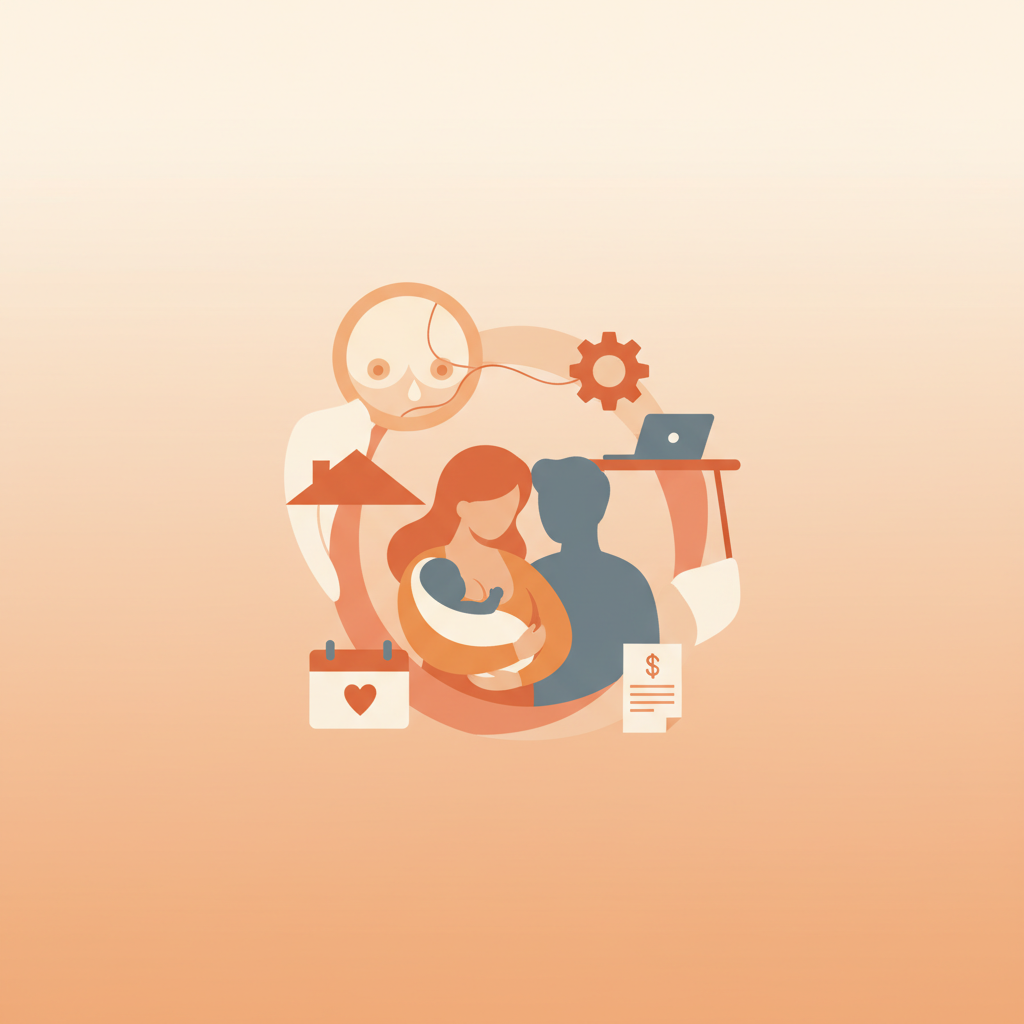
The return to work after maternity leave is one of the most emotionally complex transitions a new mother faces. It arrives whether you are ready or not — often before you feel ready — and it demands that you operate in two worlds simultaneously: the world of professional competence and the world of raw, consuming new parenthood. No orientation session prepares you for the feeling of leaving your baby for the first time, or for the strange guilt of enjoying your work when you get back.
In the United States, where there is no federal paid maternity leave, many mothers return as early as 6 weeks postpartum — a time when the body is still healing and the baby is deep in the fourth trimester. In countries with more generous policies (Canada, UK, much of Europe), the return may happen at 6, 9, or 12 months, but the emotional complexity is remarkably similar across borders.
This article is not about how to optimize your productivity upon return. It is about what you feel, why you feel it, and how to move through it with self-compassion.
The Emotional Landscape of the Return
Research by organizational psychologist Ellen Kossek and maternal scholar Caitlyn Collins (Making Motherhood Work) identifies several emotional themes that nearly all returning mothers experience:
Guilt
The most reported emotion. Guilt for leaving the baby. Guilt for wanting to leave. Guilt for not missing the baby as much as you "should." Guilt for missing a milestone. Guilt for the relief you feel at having an uninterrupted lunch.
Guilt is the tax that intensive mothering culture levies on working mothers. It does not reflect reality — it reflects an impossible standard.
Identity confusion
"Am I the same professional I was before?" Many mothers describe feeling like an imposter at work, as if they no longer belong in a world they once mastered. At the same time, they may feel like an imposter at home, worried that they are no longer the "full-time mother" their baby needs.
This is matrescence in action: the identity is still forming.
Grief and relief — simultaneously
Grief for the end of the cocooned maternity leave period. Relief at reclaiming a piece of your pre-baby self. Both are valid. Both can coexist.
Cognitive overload
The mental gymnastics of coordinating childcare drop-offs, pumping schedules, work deadlines, pediatric appointments, and household management creates a cognitive load that is qualitatively different from what non-parents carry.
Practical Strategies for the Transition
Before you go back
- Visit the workplace before your first day if possible. Familiarity reduces anxiety.
- Arrange a gradual return if your employer allows it. Part-time for the first few weeks can ease the transition.
- Set up childcare and do trial runs. Knowing your baby is well cared for reduces the cognitive burden.
- Have the conversation with your partner about who handles what. The logistics of two-working-parent families require explicit negotiation.
The first weeks
- Lower your performance expectations. You are not going to be at 100% immediately. Brain fog from sleep deprivation is real and temporary.
- Find your pumping rhythm if breastfeeding. Know your rights: in the US, the PUMP for Nursing Mothers Act requires employers to provide reasonable break time and a private space for pumping.
- Batch your emotional processing. You cannot fall apart at your desk, but you can set aside time to feel your feelings. A therapist, a journal, or a trusted friend who listens without fixing.
- Communicate boundaries clearly at work. "I leave at 5:30 because I have a baby" is a complete sentence.
The longer term
- Redefine what "having it all" means. For most people, it does not mean doing everything perfectly. It means making conscious trade-offs and being at peace with them.
- Invest in the partnership. The couples who navigate the return to work best are those who explicitly renegotiate roles — not once, but continuously.
- Build a village. Childcare providers, family, friends, neighbors, other working parents. You cannot do this alone, and you were never meant to.
The Partner's Role in the Return
When one parent returns to work, the entire family system shifts. The partner's role is crucial:
- Share the invisible work: who calls the pediatrician, who packs the daycare bag, who handles sick days.
- Do not keep score: "I changed three diapers yesterday" is not equitable — it is accounting.
- Check in on the emotional experience: "How was today really?" matters more than "How was your day?"
- Protect time for the returning parent: she needs space to grieve, adjust, and find her new rhythm.
Breastfeeding and the Return to Work
Returning to work does not have to mean the end of breastfeeding, though it often does due to lack of support:
- Pump at regular intervals (ideally matching previous nursing schedule) to maintain supply.
- Store milk following CDC guidelines: room temperature (4 hours), refrigerator (4 days), freezer (6-12 months).
- A supportive workplace makes all the difference. If yours is not, know your legal rights.
- Some mothers shift to breastfeeding only mornings, evenings, and weekends. This is a valid and sustainable approach.
- If you choose to wean, that is equally valid. How you feed is your decision.
Frequently Asked Questions
Is it normal to feel relieved about going back to work?
Completely. Wanting to use your professional skills, have adult conversation, and reclaim part of your identity does not diminish your love for your baby.
My baby cries at daycare drop-off. Am I traumatizing them?
Brief separation protests are developmentally normal and are not indicators of trauma. Most babies settle within minutes. If your childcare provider is warm and responsive, your baby is building secondary attachment bonds — which is healthy.
How do I deal with judgment from stay-at-home mothers (or working mothers)?
You do not owe anyone a justification for your choices. "This is what works for our family" is sufficient. The mommy wars serve no one.
Will my baby forget me if I work full-time?
No. Attachment is built on quality of interaction, not just quantity. A responsive, warm parent who works full-time can build perfectly secure attachment.
My employer is not accommodating about pumping. What can I do?
Know your legal rights (the PUMP Act in the US covers most employees). Document any violations. Contact a lactation consultant or organization like the National Women's Law Center for guidance.
Your relationships can improve. Today.
Start free in 2 minutes. No credit card, no commitment. Just you, the people you care about, and an AI that helps you understand each other.
Start free now