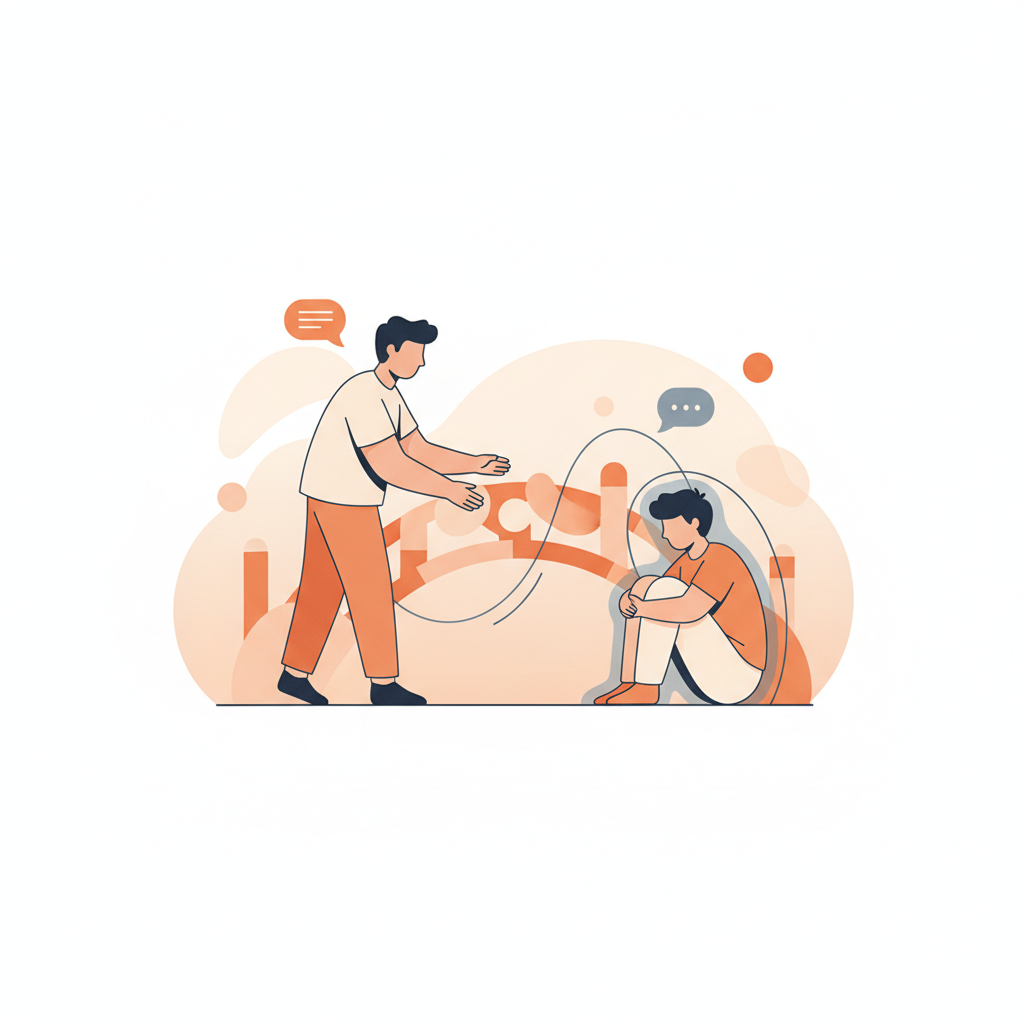
Adolescent withdrawal is the phenomenon in which a young person between 12 and 18 dramatically reduces verbal and emotional communication with their parents, responding in monosyllables, avoiding eye contact, or retreating to their bedroom. Although it is painful for parents, neuroscience has shown that this distancing is part of a healthy individuation process: the teenager needs to differentiate from their attachment figures to build their own identity. Dr. Daniel Siegel, in his book Brainstorm: The Power and Purpose of the Teenage Brain, explains that the adolescent brain is undergoing massive remodeling, with extensive synaptic pruning and an as-yet-incomplete prefrontal cortex, which directly affects communication, emotional management, and decision-making.
Understanding What Is Really Going On
| What It Looks Like |
What Is Actually Happening |
| "They hate me" |
They need to differentiate from you to find themselves |
| "They don't care about me" |
They care so much they need distance to avoid feeling engulfed |
| "They don't trust me" |
They trust you, but peers are now their primary reference |
| "They're being rebellious" |
They are developing critical thinking (sometimes clumsily) |
| "They used to tell me everything" |
They need privacy — a psychological space of their own |
Why Has My Teenager Stopped Talking to Me?
1. Brain Development in Progress
Between ages 12 and 25, the brain undergoes radical transformation. The limbic system (emotions) is running at full throttle, but the prefrontal cortex (control, planning, empathy) has not yet matured. The result: intense emotions without an effective brake. Your teenager is not going silent to spite you — often, they genuinely do not know how to articulate what they feel.
2. The Need for Individuation
Erik Erikson described adolescence as the stage of "identity vs. role confusion." To know who they are, teenagers need to explore who they are not, and that includes distancing from family values, tastes, and customs. It is a healthy process, even if it is uncomfortable.
3. Peers as the New Reference Group
Friends take center stage. It is not that family loses importance, but that the teenager needs validation from peers to build their social identity. What their friends think about their clothes, music, or ideas carries more weight than parental opinion.
4. Fear of Judgment
Many teenagers stop talking because they feel every conversation ends in evaluation, unsolicited advice, or a lecture. If they perceive that opening up equals being judged, they will choose silence as a protective mechanism.
5. Screens as Refuge
Phones and social media offer a space to connect with peers and escape the adult world. They are not the root cause of the distancing, but they can amplify it.
Common Mistakes Parents Make (With Good Intentions)
The car interrogation: "How was school? What did you do? Did you eat well? Who were you with?" Five questions in a row feel like a police interrogation. Result: "Fine. Nothing. Yes. People."
The preemptive lecture: "When I was your age..." or "You have to understand that..." The teenager tunes out within 30 seconds. Lectures do not teach; they bore and breed resistance.
Invading their space: entering their room without knocking, reading their messages, monitoring their social media. Privacy is a right, not a privilege. Violating it destroys trust.
Taking it personally: "After everything I do for you..." The distancing is not against you — it is for them. Making it personal adds guilt to an already difficult situation.
Comparing with others: "Maria's son tells her everything." You do not know what happens in other homes, and comparison only reinforces the feeling that they are not meeting your expectations.
How Can I Reconnect With My Teenager?
1. Practice "Presence Without Demand"
Be available without requiring interaction. Sit reading in the living room while they watch TV, cook together without forcing conversation, drive them somewhere without asking questions. Physical proximity without emotional pressure creates a safe space where communication can arise spontaneously.
2. Use the "Side by Side" Technique
Teenagers open up more when there is no direct eye contact. The deepest conversations tend to happen in the car, walking the dog, playing video games together, or doing a shared activity. Do not sit "face to face" to talk about feelings; go "side by side" doing something.
3. Ask Open-Ended Questions (and Few of Them)
Instead of "How was your day?" (answer: "Fine"), try more specific and genuinely curious questions:
- "What was the weirdest thing that happened today?"
- "Is there a teacher you especially like or dislike?"
- "I noticed you were listening to X artist. What do you like about their music?"
And after asking: really listen. Without interrupting, correcting, or offering your opinion unless they ask for it.
4. Share First
If you want them to open up, lead by example. Tell them about your day, something that worried you, or a mistake you made. Vulnerability is contagious. It does not need to be dramatic: "I messed up in a meeting today and felt pretty foolish" humanizes the adult and normalizes imperfection.
5. Respect Their "No" (and Their Silence)
If you ask something and they reply with a monosyllable or "I don't want to talk about it," accept it. "Okay, whenever you want, I'm here." That sentence, repeated without resentment, builds more bridge than any insistence.
6. Acknowledge Their Emotions Without Minimizing
"I understand you are angry" carries more weight than "It's not a big deal." To them it is a big deal. Their emotions are as real and intense as yours, even if the trigger seems trivial.
7. Negotiate Rules, Don't Impose Them
As they grow, teenagers need to participate in setting the rules. An imposed rule feels like arbitrary authority; a negotiated rule feels like an agreement. "What time do you think is reasonable to come home on Saturday? I need it to be no later than 11 p.m. Can we find a middle ground?"
8. Take Care of the Couple Relationship (or the Co-parenting Dynamic)
Teenagers are especially sensitive to the emotional climate at home. Arguments between parents, unspoken tension, or lack of adult communication directly affect their wellbeing. LetsShine.app offers AI tools so parents can improve their communication and navigate the challenges of adolescence together, creating a more stable family environment.
When Should I Really Worry?
Adolescent distancing is normal, but there are red flags that require professional attention:
- Total isolation (not talking to anyone, not even friends).
- Sudden changes in academic performance.
- Notable weight loss or gain.
- Signs of substance use.
- Self-harm or expressions of hopelessness.
- Frequent aggression or destruction of property.
In these cases, consult your pediatrician, a psychologist specializing in adolescence, or the school counselor. Seeking help is not giving up — it is acting responsibly.
Frequently Asked Questions
At what age is it normal for a teenager to stop talking to their parents?
Distancing usually begins between ages 11 and 13, coinciding with puberty. It peaks around 14-16 and, in most cases, communication improves significantly from age 18-20, once the young person has consolidated their identity.
Is it better to leave them alone or insist on talking?
Neither extreme. Do not chase them with questions, but do not disappear either. The key is "presence without demand": being available, showing genuine interest, and respecting their "no" without resentment.
Are screens the reason my teenager won't talk to me?
They are not the primary cause, but a catalyst. The distancing is developmental. That said, setting reasonable rules about screen use (especially during family moments like meals) encourages interaction. Negotiate the rules together.
How do my partner and I agree on boundaries with our teenager?
It is essential to present a united front, even if you disagree in private. LetsShine.app can help you structure these adult conversations, identifying points of agreement and finding compromises on points of disagreement.
Will they trust me again?
Yes, if you keep the bridge open. Most young adults acknowledge, once past adolescence, that their parents were there even when they pushed them away. Your consistency today is the foundation of tomorrow's relationship.