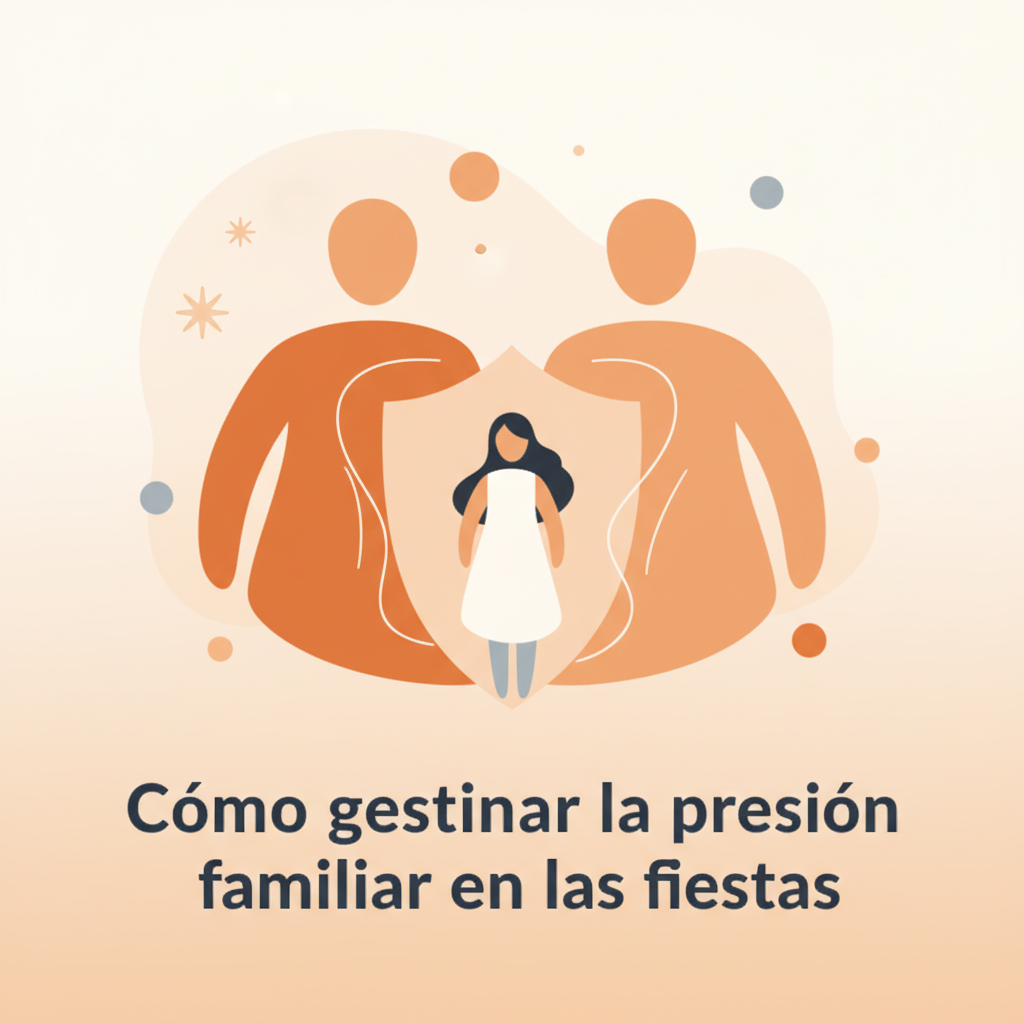
Family pressure at gatherings is the set of demands, expectations, and judgements — explicit or implied — that family members exert on one another during collective celebrations: Christmas, Thanksgiving, Easter, birthdays, weddings, and christenings. In cultures that place high value on family unity, the pressure takes on a particular intensity. A Harris Poll survey found that 45% of Americans experience increased stress around family gatherings, with the figure rising to over 50% among adults aged 25-40.
Family pressure isn't always ill-intentioned. Often it comes disguised as affection, interest, or tradition. But the effect on the person receiving it is the same: exhaustion, anxiety, and the feeling that your life is never enough in your family's eyes.
| Type of pressure |
Typical phrase |
Relative's need |
Impact on you |
| Reproductive |
"When are you having kids?" |
Perpetuating the family |
Guilt, invasion of privacy |
| Romantic |
"Seeing anyone?" |
Seeing you "settled" |
Shame, social pressure |
| Financial |
"Bought a house yet?" |
Evaluating your success |
Frustration, comparison |
| Ideological |
"Who did you vote for?" |
Validating their beliefs |
Tension, confrontation |
| Moral |
"You don't go to church anymore?" |
Maintaining tradition |
Guilt, distance |
| Physical |
"You look thin/heavy!" |
Control, projection |
Shame, disordered eating |
Why does my family pressure me at gatherings?
Because gatherings are the shop window where the family measures itself. Each member functions as an indicator of the clan's "success": if everyone is married, with children, a stable job, and good health, the family perceives itself as successful. When a member doesn't meet those indicators — for whatever reason — the family system reacts with pressure to "catch up."
Behind every awkward question lies a need of the family system: security, continuity, control, validation. That doesn't justify the pressure, but understanding it helps you not take it personally and respond from calm rather than defensiveness.
How to set boundaries without breaking the family
1. Prepare courteous but firm responses
Before the gathering, rehearse answers for the questions you know are coming. You don't have to explain your personal life. "I'm good, thanks for asking" is a complete response.
2. Use humour as a shield
Humour defuses tension without generating conflict. To "When are you having kids?" a "When I win the lottery" closes the topic with a smile. Humour deflects without offending.
3. Change the subject gracefully
"Speaking of news, have you seen the latest..." Redirecting the conversation is more effective than trying to change anyone's mind.
4. Set the boundary in private
If a relative insists on a topic that makes you uncomfortable, address it later one-on-one. "Aunt Mary, I love you, but every time you ask about my love life in front of everyone, I feel really uncomfortable. I'd appreciate it if we could drop that subject." A private boundary protects both parties' dignity.
5. Accept that you can't control others
You can control what you say, what you tolerate, and how long you stay. You can't control what others say. If after setting boundaries the pressure continues, the legitimate option is to reduce exposure: stay for less time, attend fewer events, or in extreme cases, not go.
How to handle family pressure aimed at your partner
Your partner shouldn't have to defend themselves alone against your family. If your mother makes comments about their job, weight, or cooking, the responsibility to set the boundary is yours, not your partner's. "Mum, please respect Sarah. She's my partner and I chose her."
At LetsShine.app we work with couples and families who need to learn to set boundaries without destroying bonds, with the help of an AI mediator that facilitates conversation without judgement.
What if family pressure is affecting my mental health?
If family gatherings cause anticipatory anxiety (you're already nervous days before), if they affect your sleep, appetite, or mood persistently, it's time to seek professional help. Family shouldn't be a chronic source of suffering. A therapist can help you manage the relationship with your family from a more protected place.
Is it selfish to prioritise my wellbeing over family tradition?
No. It's necessary. Tradition shouldn't be maintained at the expense of your mental health. You can love your family and, at the same time, protect yourself from the pressure it exerts. Those two things aren't contradictory.
Frequently asked questions
How do I respond to the classic "When are you having kids?"
With whatever truth you want to share. If you don't want to explain: "When the time comes, you'll be the first to know." If you want a clearer boundary: "I'd prefer not to discuss that — it's very personal."
Do I have to go to every family gathering even if it causes me distress?
No. You can choose which to attend and which to skip. Going to every gathering out of obligation feeds resentment. Going to those you can manage emotionally protects your health and the quality of your presence.
How do I tell my family I need distance without them getting offended?
They may get offended anyway. You can't control the other person's reaction. What you can do is communicate with care: "I love you all, but I need to manage my time differently. It's not against you."
Does family pressure diminish with age?
Sometimes it does; sometimes it just changes topic. They stop asking about the boyfriend and start asking about children. They stop asking about children and start opining on how you raise them. The key isn't waiting for them to stop but learning to manage the pressure from your side.
Your relationships can improve. Today.
Start free in 2 minutes. No credit card, no commitment. Just you, the people you care about, and an AI that helps you understand each other.
Start free now